

OpenAI’s Code Red Emergency: What Sam Altman’s Strategic Pivot Means for ChatGPT Users
Imagine being at the top of your game and suddenly realizing the competition is catching up. That’s exactly what happened to OpenAI in early December 2025 when Google launched Gemini 3 Pro—a model so powerful that it outperformed OpenAI’s best offerings across key benchmarks. Sam Altman, OpenAI’s CEO, did something unprecedented: he hit the panic button and declared “code red” across the entire organization. Everything changed overnight.
This wasn’t just another product update. Altman essentially told his engineering teams to drop everything—pause advertising plans, halt the Sora video generator, shelve the personal assistant called Pulse, and forget about health and shopping AI agents for now. All hands on deck to fix ChatGPT. The reason? Google’s Gemini 3 Pro didn’t just match OpenAI’s capabilities—it leapfrogged them on virtually every measure that matters to customers and businesses.
Let’s break down what’s happening, why it matters to you, and what’s coming next.
The Competitive Pressure That Sparked the Emergency Response
Think of the AI race like a smartphone market from a decade ago. When Apple released the iPhone, everyone else scrambled to catch up. Right now, Google released something that made OpenAI feel like the competition was suddenly ahead. Gemini 3 Pro hit benchmarks that GPT-5 struggled with, including coding tasks (WebDev Arena), complex reasoning (GPQA Diamond scoring 91.9% accuracy), and even mathematical problem-solving (achieving a perfect 100% on Amy 2025 benchmarks).
The wake-up call was so loud that even major business leaders noticed. Marc Benioff, CEO of Salesforce, famously switched from ChatGPT to Gemini after using it for just two hours, calling the leap “insane.” Investors worried. Users started exploring alternatives. For the first time in years, OpenAI’s dominance in AI looked vulnerable.
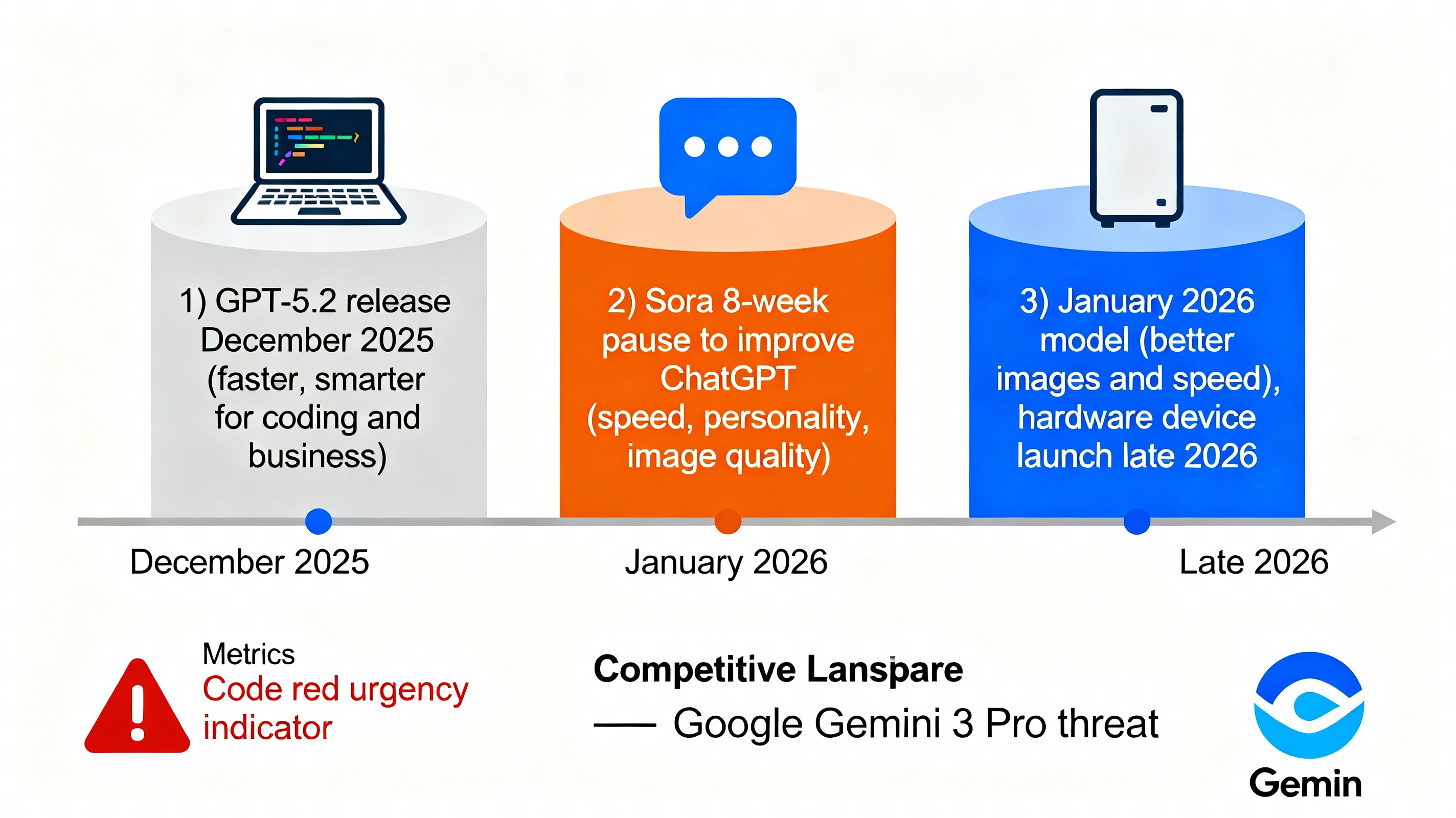
Understanding Sam Altman’s “Code Red” Initiative
When Altman sent his internal memo to employees, he wasn’t using the term lightly. A “code red” is a full emergency—the equivalent of slamming on the brakes and redirecting everything. Here’s what this means in practical terms:
📌 All-hands-on-deck mentality: The company began daily cross-team stand-ups to coordinate efforts and remove bottlenecks
📌 Resource reallocation: Engineers pulled from other projects moved to ChatGPT improvements
📌 Immediate pauses: Advertising integration, the Pulse personal assistant, health and shopping agents—all delayed indefinitely
📌 Focus areas: Speed improvements, better reliability, smarter responses, and personalization features
The goal is simple: make ChatGPT so good that no matter what Google or Anthropic releases, users stay loyal. But here’s the key detail that caught many people’s attention—Altman made a controversial choice.
The Sora Pause: Why OpenAI Paused Its Video Generator for 8 Weeks
One of the most shocking moves was pausing development on Sora, OpenAI’s AI video generation tool. Imagine building something groundbreaking and then saying, “We’re going to stop working on it for eight weeks.” But that’s exactly what happened.
The decision reveals something important about OpenAI’s thinking. Rather than chase moonshot projects like artificial general intelligence (AGI) or cutting-edge video generation, Altman realized OpenAI needed to focus on the cash cow—ChatGPT. The company depends on ChatGPT’s user satisfaction for revenue, market share, and investor confidence.
By pausing Sora, OpenAI freed up engineering resources, computational power, and focus to improve ChatGPT’s core features. It’s a strategic pivot from innovation-for-innovation’s-sake to customer-satisfaction-first. Some see it as pragmatic; others see it as abandoning the ambitious goals OpenAI was founded on.
✅ What the pause accomplishes: More engineers, more GPU computing time, and clearer priorities for the core product
⛔️ What you lose temporarily: No new Sora features, no video-generation improvements, no expansion to broader users
GPT-5.2: OpenAI’s Direct Response (December 2025)
Here’s the exciting part. OpenAI moved fast. According to multiple credible sources, the company released GPT-5.2 in early December 2025—a model specifically designed to match and potentially exceed Gemini 3 Pro’s performance.
What does GPT-5.2 bring to the table?
👉 Enhanced coding abilities: Better at writing, understanding, and debugging code. This is crucial for software developers and businesses relying on AI for development
👉 Faster response speeds: The model generates answers quicker without sacrificing quality—important for professional and business customers
👉 Improved ChatGPT experience: Smarter handling of complex queries, better personalization, and more intuitive responses
👉 Optimized for B2B (business customers): Specifically tuned to handle enterprise-level demands where speed and reliability are non-negotiable
Why did OpenAI prioritize these features? Because Google’s Gemini 3 Pro dominated exactly these categories. By releasing GPT-5.2, OpenAI isn’t just responding—it’s trying to prove that quick action and focus can beat first-mover advantage.
The January 2026 Model: The Follow-Up Punch
But Altman didn’t stop at GPT-5.2. According to internal memos and statements, OpenAI is planning a second major release in January 2026. This model is supposed to feature:
📌 Better image generation: If Gemini 3’s Nano Banana Pro (their image generator) is beating DALL-E 3, OpenAI needs to match it. The January model addresses this specifically
📌 Improved speed: Users want fast responses, and OpenAI is optimizing for millisecond-level improvements
📌 Enhanced personality: ChatGPT will feel more natural, more conversational, and more attuned to different communication styles
Once this January release is complete, Altman declared that OpenAI will “end the code red”—lifting the emergency protocols and returning to normal operations. This two-model release strategy essentially says: “We’re not backing down from competition.”
What This Means for Different User Groups
For casual ChatGPT users: You’ll notice faster, smoother interactions. Better image generation when you need to create visuals. The AI will feel more “human” in conversations.
For software developers: GPT-5.2 is a direct appeal to you. Better coding, fewer errors, smarter debugging. This could save hours on development work.
For business customers: Speed and reliability matter in enterprise. GPT-5.2 and the January model are being optimized specifically for B2B needs like processing large documents, handling complex workflows, and integrating with business tools.
For creators and video producers: The Sora pause hurts. But it buys time for Sora to be more powerful when it returns. Think of it as a sacrifice now for a better tool later.
The Bigger Picture: Hardware and Beyond
While everyone’s focused on the current model wars, Altman is playing an even longer game. OpenAI is developing its first hardware device—an AI-native device that will compete directly with Apple’s ecosystem. We’re talking about screenless smart speakers, AI glasses, wearable pins, and potentially even pocket-sized devices that could replace some smartphone functions.
The prototype development is already underway with partnerships from Luxshare (which makes AirPods and iPhone components) and leadership from Jony Ive, the legendary Apple designer. Expected launch? Late 2026 or early 2027.
This hardware play is why the code red matters so much. OpenAI sees itself competing with Apple, not just Google. Dominating ChatGPT now ensures the foundation for a successful hardware ecosystem later. It’s a multi-year strategy, not a quick fix.
Why This Battle Matters Beyond AI Enthusiasts
The race between OpenAI, Google, and Anthropic isn’t just about which company releases the coolest AI. Here’s why you should care:
👉 Your tools get better faster: Competition drives innovation. Every model release means improvements that filter down to apps you actually use
👉 Pricing gets competitive: Companies competing hard often adjust pricing to stay attractive. You might benefit from better features at similar or lower prices
👉 AI becomes more accessible: As models improve and competition heats up, more people can access powerful AI tools through ChatGPT, Google Search, and other platforms
👉 Safety and ethics come into focus: Intense competition also pushes companies to address concerns around AI safety, bias, and responsible deployment
The Unspoken Question: Can OpenAI Recover?
Google’s Gemini 3 Pro genuinely impressed industry experts and users. For the first time since ChatGPT launched in November 2022, people started asking: “Is there a better AI assistant than ChatGPT?”
Altman’s code red gamble is a bet that speed and focus can close this gap. If GPT-5.2 and the January model prove competitive or superior, OpenAI signals that it won’t be knocked off its throne. If they fall short, the narrative changes—a narrative where the undisputed leader has lost its edge.
The chess match is real. The stakes are high. And the winners and losers in AI development will reshape how we work, create, and solve problems for years to come.
What’s Next? Your Part in This Story
As a user or potential customer, you’re in the ideal position to watch this unfold. Over the next few weeks and months, you’ll see:
📌 GPT-5.2 becoming available across ChatGPT (already rolling out to paid users first)
📌 The January 2026 release with improved images and speed coming to all ChatGPT users
📌 Potential new features in search (something Altman mentioned as a growth opportunity)
📌 The eventual Sora comeback—likely more powerful after the eight-week development surge
📌 Hints about hardware at tech conferences and announcements throughout 2026
The AI landscape is shifting rapidly. OpenAI’s code red initiative proves that even dominant players feel pressure and must adapt. Whether you’re building products with AI, using ChatGPT daily, or just curious about AI’s future, this moment represents a pivot point—one where the industry’s assumptions about who’s winning are being rewritten in real-time.
Keep your eyes on what OpenAI releases in December and January. These models will tell the real story of whether emergency-mode pivoting works in AI development. And based on the stakes involved, Altman is betting everything that it does.







