Meta Muse Wonder Full at a Glance
Four critical distinctions every developer and engineering team needs to know before planning an integration or buying a subscription:
01 · CODING LEADER
79.0%
DeepSWE 1.1 (#1 Global)
Beats Claude Opus 5.5 (74.2%) and GPT-6 Astra (74.1%) on autonomous bug fixing and patch creation.
02 · SWE-MARATHON (xHIGH)
57.5%
Long-Horizon Engineering
A massive +11.2 point lead over Opus 5.5 (46.3%) when resolving multi-file repository issues over hours.
03 · THE GREENFIELD GAP
59.0%
ProgramBench (From-Scratch)
Trails Claude Opus 5.5 (70.5%) by 11.5 points. Explains real-world struggles with building 3D apps from scratch.
04 · PERSISTENT MEMORY
85.5%
Active Memory · 1M Ctx
Remembers repo constraints and architecture across weeks, ending the standard 3-day context wipeout.
Architecture Ingestion → Active Focus Loop → Multi-File Verification → Continuous Patching
Watch our 60-second video breakdown: Meta Muse Wonder Full specs & coding tests.
When I booted up my workstation this morning, I did not expect Meta to drop a frontier reasoning model that directly challenges Anthropic and OpenAI.
For the past year, most people viewed Meta mainly as an open-source provider through the Llama series. But Meta’s Superintelligence Labs just introduced two heavyweight frontier systems: Muse Wonder and its flagship sibling, Muse Wonder Full.
Instead of building another casual text chatbot, Meta designed these models to tackle long-running autonomous work. They are built to read multi-file codebases, remember context across weeks, and fix real bugs without giving up when an error pops up.
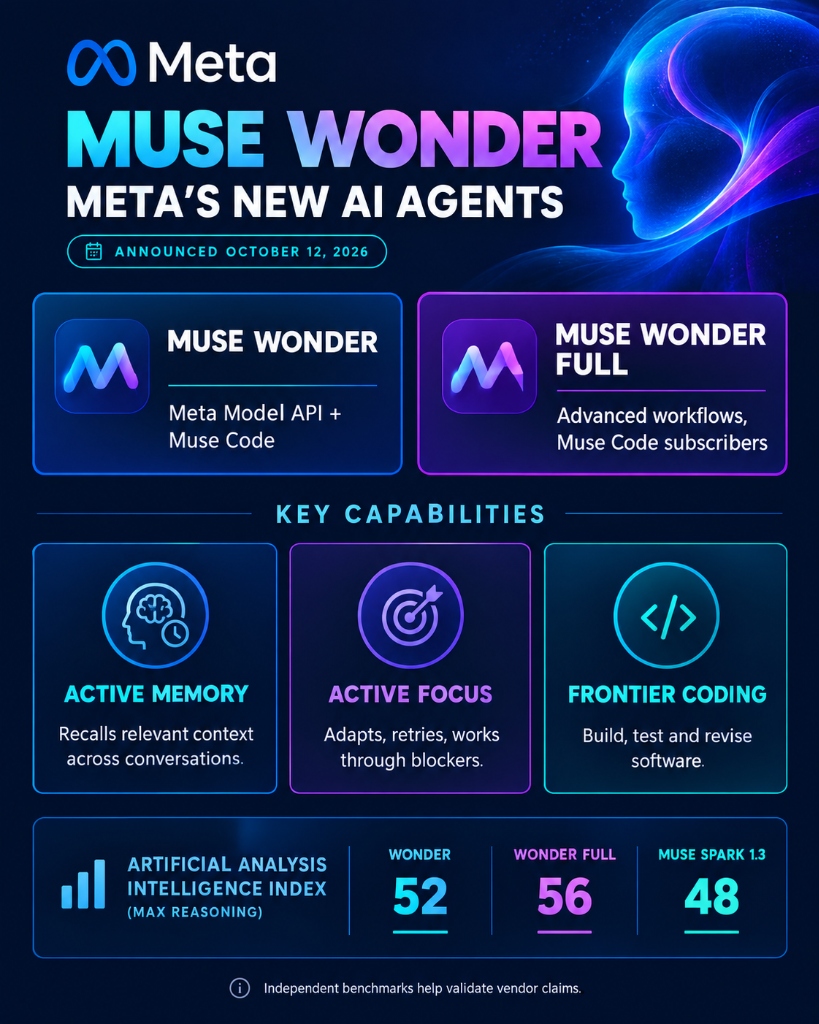
Infographic: Meta Muse Wonder Overview, Key Capabilities, and Artificial Analysis Scores
I spent the day analyzing the official launch benchmarks, tracking real developer evaluations, checking the Artificial Analysis leaderboards, and combing through live coding tests.
Here is what Muse Wonder Full actually delivers, where the benchmarks shine, the surprising areas where it struggles, and the pricing catches you need to know before subscribing.
What Is Muse Wonder Full?
To understand this launch, you have to separate the two different models Meta released under the Muse family:
- Muse Wonder (
muse-wonder-1.0): The standard frontier model. It is available to developers through the Meta Model API and comes with a 1-million-token context window. - Muse Wonder Full (
muse-wonder-full-1.0): The flagship frontier model. This is Meta’s heaviest reasoning system, tuned for deep multi-step problem solving and complex software engineering.
Muse Wonder (1.0)
Muse Wonder Full (1.0)
Both models accept multimodal inputs—including text, images, video, and audio—and generate text responses. They were trained at Meta’s Prometheus data center using massive reinforcement learning pipelines.
The key difference from earlier models like Muse Spark is how they handle persistent work. Meta introduced two distinct architectural capabilities: Active Memory and Active Focus.
The Two Core Breakthroughs: Active Memory & Active Focus
Most AI chatbots suffer from digital amnesia. You explain your architecture, set your preferences, and close the tab. The next morning, you have to re-explain everything from scratch.
Meta built two specific mechanisms into Muse Wonder to solve this exact headache.
1. Active Memory (Remembering Context Across Weeks)
Active Memory is an autonomous background retention engine. Instead of dumping your chat history into an expensive prompt cache every turn, the model extracts relevant preferences, project constraints, and working habits, storing them across separate sessions.
- How it works: If you tell the model your cloud deployment constraints or API conventions on Monday, it automatically recalls those parameters on Friday when you ask it to scaffold a microservice.
- The test numbers: On Meta’s official MemoryBench evaluation, Muse Wonder scored 85.6% and Muse Wonder Full reached 85.5%, outperforming Claude Opus 5.5 (81.5%) and GPT-6 Astra (81.4%).
2. Active Focus (Pushing Through Blockers)
If you have used coding agents, you know the common failure pattern: the model runs a script, hits an unexpected syntax error or package conflict, and throws its hands up asking you what to do.
Active Focus trains the model to act more like a senior engineer who hits an unexpected wall:
- It generates alternative hypotheses when an initial fix fails.
- It reads compiler errors, rewrites test configurations, and retries on its own.
- It stops to ask for human confirmation only before destructive operations (such as dropping a database table or sending an outbound email).
The Official Benchmark Comparison: Full 14-Metric Matrix
Below is the verified benchmark comparison across all 14 evaluated disciplines, comparing Muse Wonder Full (max) and Muse Wonder (max) directly against Claude Opus 5.5 (max), GPT-6 Astra (max), and Claude Fable 5.1 (max):
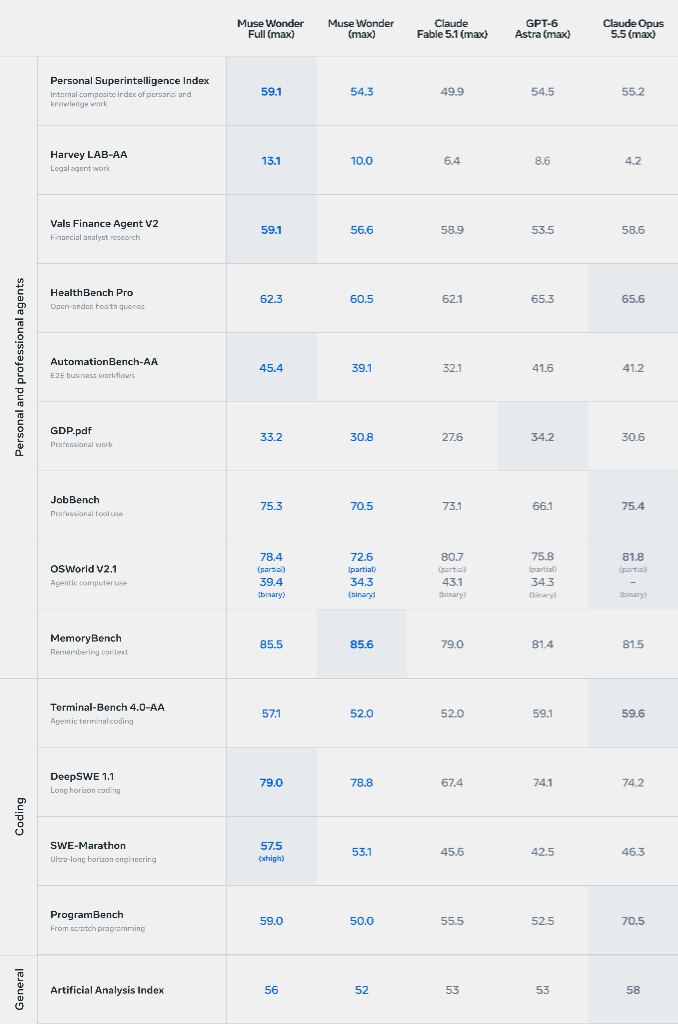
Official Benchmark Infographic: Meta Muse Wonder Full vs. Claude Opus 5.5, GPT-6 Astra, and Claude Fable 5.1 across all 14 evaluated disciplines
Meta Muse Wonder Full vs. Frontier Rivals
| Benchmark / Discipline | Muse Wonder Full | Muse Wonder | Claude Fable 5.1 | GPT-6 Astra | Claude Opus 5.5 |
|---|---|---|---|---|---|
| 1. Personal & Professional Agents | |||||
| Personal Superintelligence Index Composite index of knowledge work |
59.1 (🏆 #1) | 54.3 | 49.9 | 54.5 | 55.2 |
| Harvey LAB-AA Legal agent contract work |
13.1 (🏆 #1) | 10.0 | 6.4 | 8.6 | 4.2 |
| Vals Finance Agent V2 Financial analyst research |
59.1 (🏆 #1) | 56.6 | 58.9 | 53.5 | 58.6 |
| HealthBench Pro Open-ended health queries |
62.3 | 60.5 | 62.1 | 65.3 | 65.6 (🏆 #1) |
| AutomationBench-AA End-to-end business workflows |
45.4 (🏆 #1) | 39.1 | 32.1 | 41.6 | 41.2 |
| GDP.pdf Professional document work |
33.2 | 30.8 | 27.6 | 34.2 (🏆 #1) | 30.6 |
| JobBench Professional tool usage |
75.3 | 70.5 | 73.1 | 66.1 | 75.4 (🏆 #1) |
| OSWorld V2.1 Agentic computer / browser control |
78.4 (partial) 39.4 (binary) |
72.6 (partial) 34.3 (binary) |
80.7 (partial) 43.1 (binary) |
75.8 (partial) 34.3 (binary) |
81.8 (partial) |
| MemoryBench Remembering cross-session context |
85.5 | 85.6 (🏆 #1) | 79.0 | 81.4 | 81.5 |
| 2. Coding & Software Engineering | |||||
| Terminal-Bench 4.0-AA Agentic terminal coding |
57.1 | 52.0 | 52.0 | 59.1 | 59.6 (🏆 #1) |
| DeepSWE 1.1 Long-horizon repository issue resolution |
79.0% (🏆 #1) | 78.8% | 67.4% | 74.1% | 74.2% |
| SWE-Marathon Ultra-long horizon engineering (xhigh) |
57.5% (🏆 #1) | 53.1% | 45.6% | 42.5% | 46.3% |
| ProgramBench From-scratch program creation |
59.0% | 50.0% | 55.5% | 52.5% | 70.5% (🏆 #1) |
| 3. General Intelligence | |||||
| Artificial Analysis Index Composite global benchmark index |
56 (Rank #2) | 52 | 53 | 53 | 58 (Rank #1) |
What the Numbers Actually Mean: Two Crucial Coding Realities
When you analyze the benchmark matrix alongside real hands-on tests, two massive patterns emerge:
1. The SWE-Marathon Domination (Ultra-Long Engineering)
On SWE-Marathon, Muse Wonder Full scored 57.5%, beating Claude Opus 5.5 (46.3%) by more than 11 points and crushing GPT-6 Astra (42.5%).
This test measures how well a model holds its train of thought when refactoring real-world codebases with dozens of files, long dependency trees, and tricky merge conflicts. Muse Wonder Full does not lose the plot after 20 minutes of troubleshooting; it persists through the dirty work.
2. The ProgramBench Gap (Building From Scratch)
On ProgramBench, which evaluates creating complete, functioning software applications from scratch, the picture flips completely:
- Claude Opus 5.5: 70.5%
- Muse Wonder Full: 59.0%
- Muse Wonder: 50.0%
Opus 5.5 leads Muse Wonder Full by 11.5 full percentage points. This explains why early developer testers who asked Muse Wonder to build 3D games, Three.js animations, or single-page apps from scratch experienced visual bugs, misaligned camera angles, and clipping issues. Muse Wonder is an elite troubleshooter and bug-fixer, but Opus remains the undisputed champion when scaffolding new applications out of thin air.
What Happened in Live Testing: The 3D Controversy
Within hours of the drop, developers put Muse Wonder Full through real-world stress tests.
When testers tasked the model with creating playable 3D games in Godot, Blender, and Three.js (such as a first-person subway shooter or a skate park simulation), the output suffered from backward camera placements, broken coordinate transforms, and collision glitches.
“The whole team feels dumb now, but it’s true: we did not explicitly train our models on 3D demo games. Obviously, in retrospect, we probably should have done a bit of that. But no regrets. Please try Muse Wonder on your actual coding work.” — Alexander Wang, Chief AI Officer at Meta
Developer advocates like Theo defended the architecture, noting that 3D demo games test spatial geometry rather than standard enterprise software engineering. While that is true, it highlights that teams working on computer graphics, CAD tools, or interactive canvas applications should remain on Claude Opus 5.5.
Launch-Day Quota Glitches
Another immediate friction point was quota exhaustion. Several developers who signed up for the $50 per month Power Usage plan in Muse Code burned through their weekly limit in less than half an hour.
Meta confirmed this was caused by an aggressive session counter bug and deployed a server-side fix, though high-effort reasoning sessions remain computationally heavy.
Pricing, Token Economics, and Access Limits
| Model Variant | Access Channel | Pricing / Token Cost | Context Window |
|---|---|---|---|
| Muse Wonder (1.0) | Meta Model API | $4.00 / 1M input · $20.00 / 1M output $0.20 / 1M cached input |
1,000,000 tokens |
| Muse Wonder Full (1.0) | Muse Code Subscription | $50/mo (Power Usage) $200/mo (Maximum Usage) |
1,000,000 tokens |
The Standalone API Catch
The most important detail for developers: Muse Wonder Full is not available on a public pay-as-you-go API.
If you want to integrate Meta’s new architecture into your custom automations or IDE plugins, you can only call the standard Muse Wonder model via the Meta Model API ($4/$20 per million tokens). If you want the maximum intelligence of Muse Wonder Full, you must work inside Meta’s proprietary Muse Code terminal tool.
When to Use Muse Wonder Full vs. When to Avoid It
| ✅ Use Muse Wonder Full When… | ❌ Avoid It & Use an Alternative When… |
|---|---|
| You are tackling deep repository refactoring or long-horizon bug resolution (DeepSWE 79%, SWE-Marathon 57.5%). | You are generating 3D web apps, Three.js games, or canvas animations (ProgramBench 59% vs. Opus 5.5 at 70.5%). |
| You need an agent that remembers your architectural conventions across weeks without daily re-explaining. | You need a direct pay-as-you-go REST API for your own app (use Muse Wonder API or GPT-6 Sol). |
| You are analyzing legal leases, corporate compliance documents, or financial research (Harvey LAB 13.1%). | You are on a budget and cannot justify a $50 to $200 monthly terminal subscription. |
| You want an autonomous terminal worker that troubleshoots and retries tests instead of quitting immediately. | You need ultra-fast, cheap autocomplete tokens (use Gemini 3.7 Flash or Qwen 3.8). |
The Verdict on Meta’s Frontier Agent
Meta Superintelligence Labs has built a legitimate contender at the top of the AI frontier.
By prioritizing Active Memory (remembering user context over time) and Active Focus (refusing to give up when code fails), Muse Wonder Full solves two of the most irritating bottlenecks in software engineering.
- If your day involves untangling messy codebases, long terminal sessions, or analyzing dense legal files: Muse Wonder Full is one of the most capable tools on the planet.
- If your work requires building applications from scratch or crafting 3D experiences: Claude Opus 5.5 remains clearly ahead.
For developers wanting to experiment today, calling Muse Wonder via the Meta Model API at $4/$20 is the most cost-effective entry point. Unless you spend all day in a terminal resolving complex repository issues, hold off on the $200/month Muse Code tier until the ecosystem and quotas fully stabilize.