

Space-Based AI: The Orbital Computing Revolution
How intelligent satellites are transforming data processing and creating a new paradigm for space-based computing
On-Orbit AI Processing Revolution
Satellites now function as intelligent nodes with embedded AI accelerators, enabling real-time data analysis in space rather than relying on ground-based processing. This fundamental shift transforms satellites from simple data collectors to autonomous decision-makers.
Inter-Satellite Mesh Networks
Optical links connect satellites into distributed computing constellations that share processing tasks, creating orbital data centers with reduced latency and enhanced bandwidth efficiency. These mesh networks enable unprecedented computational power through collaborative processing.
10x Energy Advantage
Space-based data centers leverage constant solar power in sun-synchronous orbits, potentially offering dramatically lower energy costs compared to terrestrial facilities while eliminating land footprint concerns. This sustainable approach provides continuous power without the cooling challenges faced on Earth.
Bandwidth Optimization Through Edge Intelligence
AI filtering in orbit identifies critical “needles in the haystack” (threat vectors, anomalies), reducing data transmission needs by up to 90% and freeing congested satellite communications channels. This intelligent pre-processing ensures only the most valuable data is transmitted to Earth.
Critical Real-Time Applications
Enables immediate response for climate monitoring, disaster detection, maritime surveillance, and defense applications through onboard analysis of multispectral imagery without ground transmission delays. This capability transforms response times from hours to minutes for critical situations.
Next-Generation AI Infrastructure
Tech leaders deploying advanced processors (TPUs, GPUs) in space create scalable computing platforms that will transform how we process the massive data streams from increasingly capable satellite constellations. This orbital AI infrastructure represents the next frontier in computing.
The Solar-Powered AI Revolution: How Satellites Could Transform Computing Forever
You've probably heard that artificial intelligence is hungry—hungry for electricity, data centers, and non-stop power. But what if the solution wasn't on Earth at all, but floating above it?
In December 2025, Elon Musk shared an ambitious vision that major tech companies like Google, Amazon, and even Chinese firms are seriously exploring: moving AI computing from Earth-based data centers into space. This isn't science fiction anymore—it's happening. Companies are launching satellites right now with onboard AI processors, powered by the sun, sending results back to Earth through laser beams. Understanding this shift matters because it could reshape how you access AI services, what they cost, and how sustainable they are.
Why Earth's AI Problem Needs a Space Solution
Think about your phone, laptop, or any AI service you use. Every ChatGPT response, every AI image you generate, every machine learning prediction comes from massive data centers consuming ridiculous amounts of electricity. In 2024, U.S. data centers used about 200 terawatt-hours of electricity—roughly equivalent to Thailand's entire annual power consumption. By 2028, more than half of all data center electricity will power AI systems alone.
The problem? Earth has limits. Data centers need constant cooling, expensive real estate, and local electricity grids already struggling under demand. Meanwhile, Earth only captures about 10,000 terawatts of solar energy annually (enough to power civilization many times over), but we can only harvest tiny fractions of it due to clouds, nighttime, seasons, and the cost of covering land with solar panels.
Space, on the other hand, has unlimited sunlight. A solar panel in orbit can be up to 8 times more productive than one on Earth, producing power nearly continuously without weather interruptions or darkness. This is the fundamental insight driving the space-based AI rush.
How Space-Based AI Computing Actually Works
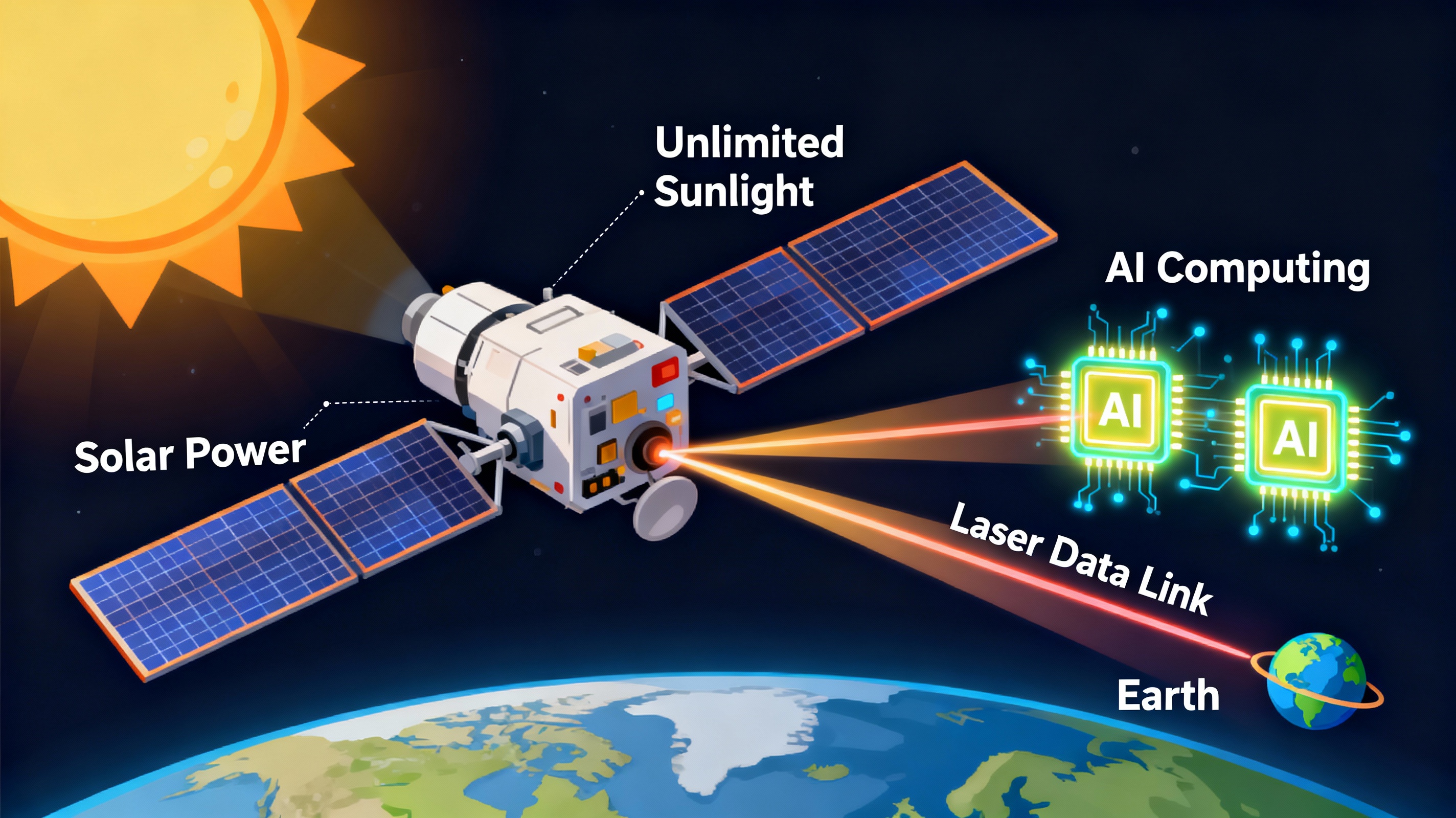
Picture a satellite orbiting Earth in a "dawn-dusk" orbit, always catching sunlight. It's equipped with solar panels generating power continuously, AI processors (like Google's TPU chips) crunching data, and a laser system beaming results back to ground stations at the speed of light.
Here's the genius: instead of transmitting massive amounts of raw data to Earth for processing, the satellite does the heavy computing work in orbit and only sends back results. This saves bandwidth dramatically. Using laser technology, these satellites can transmit data at terabit-per-second speeds—roughly 100 to 1000 times faster than traditional radio systems. To put that in perspective: transmitting a complete map of Mars takes 9 days with lasers instead of 9 weeks with older radio tech.
Elon Musk's proposal is even more ambitious. He suggests launching one megaton of satellites annually, each generating about 100 kilowatts of power. This would add roughly 100 gigawatts of new AI computing capacity per year—with almost no maintenance costs. For context, that's equivalent to adding the power output of a large nuclear power plant to global AI infrastructure every single year.
The next phase? Building satellite factories on the Moon, launching satellites using a mass driver (essentially a giant catapult), which would eliminate rocket costs entirely and enable Kardashev Type II civilization—a level where humanity harnesses the entire energy output of the sun.
The Technical Challenges (And How They're Being Solved)
Space isn't friendly to computers. Radiation from solar flares and cosmic rays can corrupt data, extreme temperatures swing hundreds of degrees, and vacuum creates unique cooling challenges. But researchers are already solving these problems.
Radiation Hardening: Google tested its Trillium TPU chips (the processors powering its newest AI models) in space conditions. Results? The chips showed surprising radiation tolerance, only showing irregularities after doses nearly three times higher than expected for a five-year mission. Engineers are developing radiation-hardened chips using clever designs that detect and recover from faults automatically.
Thermal Management: Here's something counterintuitive—space is actually better for cooling than Earth. In a vacuum, heat radiates away efficiently with no convection getting in the way. Satellites use radiator panels and passive cooling, requiring far less energy than Earth data centers pumping coolant through massive systems.
Maintaining Formation: Multiple satellites must fly in extremely tight formation (hundreds of meters apart) to achieve data center-level bandwidth between them. Google's research shows this is possible with modest station-keeping maneuvers, using physics models derived from orbital mechanics.
Laser Communication: The breakthrough here is dense wavelength-division multiplexing (DWDM)—essentially running thousands of different laser signals through the same channel. Google's team already demonstrated 1.6 terabits per second transmission between satellites in lab tests.
Comparing Earth vs. Space: The Numbers That Matter
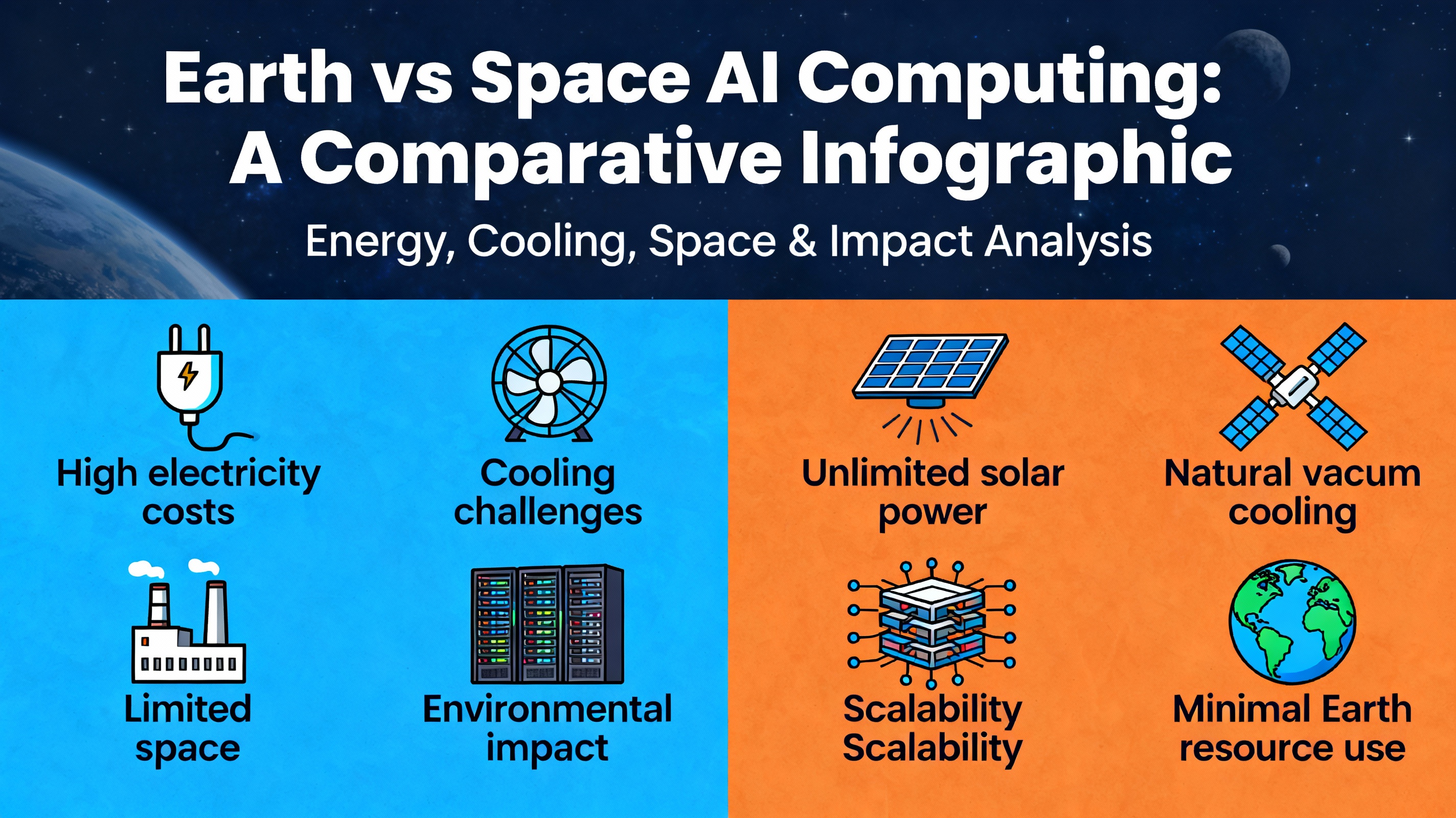
| Aspect | Earth Data Centers | Space-Based Computing |
|---|---|---|
| Power Source | Grid electricity (variable, sometimes fossil fuels) | Solar energy (unlimited, continuous) |
| Cooling Costs | ₹50-100+ lakhs ($6,000-12,000 USD) annually per megawatt | Minimal (natural vacuum cooling) |
| Land Requirements | Multiple acres per facility | None (operates in orbit) |
| Energy Efficiency | 4-8 times more electricity than actual computing | Potentially much more efficient |
| Launch/Setup Cost | Millions upfront (land, construction, permits) | High initially, decreasing rapidly |
| Scalability Speed | Slow (years to build new facilities) | Fast (launch satellites as needed) |
| Carbon Footprint (long-term) | Growing with demand; reaches 63-83 Mt CO2 by 2030 | Payback in ~5 years, then carbon-neutral |
The Economics: When Does Space Make Financial Sense?
Launch costs are the critical variable. Historically, putting anything in space costs thousands per kilogram. But SpaceX's reusable Falcon 9 rockets and upcoming Starship are changing the equation. Google's research suggests that if launch costs fall to under $200 per kilogram (expected by the mid-2030s), operating a space-based data center becomes cost-comparable to running a terrestrial facility—factoring in energy costs alone.
Musk is pushing harder. He claims Starship could eventually launch for just $1 million per mission, which would accelerate this timeline dramatically. Even at ₹8 crore ($10 million USD) per launch, the math works out: you're spreading that cost across years of operation and enormous computing capacity.
The real economic win isn't immediate—it's in scale. Companies aren't abandoning Earth data centers next year. But as satellites become cheaper to launch and operate, as orbital infrastructure matures, and as AI demand continues its explosive growth, space becomes the obvious choice for new capacity.
Who's Racing to Space? The Current Players
Google's Project Suncatcher aims to launch two prototype satellites by early 2027, testing TPU chips and laser inter-satellite links. Their research paper shows they're dead serious about this—they've already solved major physics and engineering problems.
China's Star Computing Program launched 12 AI satellites in May 2025, each capable of 744 trillion operations per second. They plan 2,800 satellites total, creating a megawatt-scale orbital data center by 2035—potentially exceeding China's entire ground-based computing capacity.
SpaceX's Starcloud-1 satellite, launched in November 2025, carried Nvidia GPUs into orbit, proving AI hardware works reliably in space.
Amazon, xAI (Musk's AI company), and dozens of smaller startups are all investing heavily in space infrastructure.
This isn't competition—it's a race. The company that cracks space-based AI first gains an enormous advantage in compute capacity, operating costs, and scalability.
The Environmental Question: Is Space Computing Actually Green?
This is where it gets complicated. Launching a satellite has a carbon footprint—the rockets burn fuel, releasing emissions into the atmosphere. Once in orbit, satellites eventually deorbit (after 25 years or so), burning up in the atmosphere and releasing aluminum oxide, aluminum chloride, and other compounds that could affect the ozone layer and climate.
Current research suggests that by 2033, approximately 3,500 tonnes of aerosols could be released into the atmosphere annually from re-entering satellites. That's a real concern as satellite populations explode.
However, scientists calculated that space-based data centers could offset their launch carbon emissions within five years of operation. After that five-year payback period, they run on renewable solar energy indefinitely, generating zero emissions per unit of computation. Compare that to Earth data centers, which rely on grids where 40-50% of electricity still comes from fossil fuels in many regions. Over a 25-year satellite lifetime, space-based systems could be dramatically cleaner.
The solution isn't choosing between Earth and space—it's using space for massive, ongoing workloads and Earth data centers for latency-sensitive tasks requiring ground proximity.
What This Means for You
If you're a content creator, developer, or anyone using AI services, space-based computing could mean cheaper, faster, and more accessible tools. Currently, running large language models or image generation at scale costs thousands monthly. If compute costs drop 50-80% (plausible when powered by free solar energy), AI services become affordable for small creators and businesses.
Latency might improve too. Processing happening in orbit means shorter paths, potentially faster responses, especially as laser ground stations (already being built) multiply across regions.
There's also a sustainability angle. If space computing becomes the dominant infrastructure for AI, the industry's carbon footprint could stabilize or even decline despite exploding demand. That's significant when climate concerns are increasingly driving adoption decisions.
For YouTube creators specifically, this matters. If AI video generation, upscaling, and editing cost one-tenth as much to run on cloud services, more creators can afford premium tools. Better availability of computation means more innovation in AI features for creators.
The Obstacles Still Standing Between Vision and Reality
Despite the excitement, significant challenges remain. Radiation testing is ongoing—we won't have full data until satellites operate for years. Thermal management at gigawatt scales hasn't been proven. In-orbit servicing (maintaining and upgrading satellites) requires technologies not yet operational. Regulatory frameworks for space-based infrastructure are still being written.
There's also the question of depreciation. Computer chips improve rapidly—what's cutting-edge today is obsolete in three years. Space-based chips can't be easily swapped out. Keeping orbital data centers technologically current could require regular satellite replacement, which has cost and environmental implications.
Space debris is a real concern. Launching tens of thousands of satellites increases collision risk and creates more objects that eventually become uncontrollable debris. Smart design (biodegradable materials, de-orbit mechanisms, collision avoidance) helps, but it's an unsolved problem as satellite populations grow exponentially.
The Timeline: What's Actually Happening When
2025-2027: Prototype satellites launch (Google, China, others). Real-world testing begins.
2027-2030: If prototypes succeed, companies begin deploying operational constellations (thousands of satellites). First commercial services launch.
2030-2035: Scale ramps up significantly. Space-based compute becomes cost-competitive with or cheaper than Earth facilities for many workloads.
2035+: Lunar manufacturing could kick in, enabling radical cost reductions. Space becomes the dominant computing infrastructure for non-latency-sensitive AI workloads.
This timeline isn't guaranteed—engineering challenges could delay progress. But the consensus among leading researchers and companies is that space-based AI is coming, probably within a decade.
Bringing It Back to Reality
The space-based AI movement isn't about abandoning Earth. It's about solving a real problem: planetary electricity limits can't sustain exponential AI growth indefinitely. Elon Musk's vision of Kardashev Type II civilization—where humanity harnesses stellar energy rather than just planetary resources—sounds extreme. But the first steps are already being taken by companies launching satellites this year.
What makes this genuinely interesting isn't the sci-fi aesthetics. It's the practical economics. When compute costs drop dramatically, when energy becomes unlimited, when infrastructure scales without terrestrial constraints, the entire AI industry transforms. Services become cheaper, more powerful, more accessible.
For creators, developers, entrepreneurs, and regular users, that shift matters. It's the difference between AI being an expensive tool for well-funded companies and AI being infrastructure anyone can build with.
The sun's been broadcasting free energy into space for billions of years. Humanity is finally figuring out how to use it. And unlike many moonshots, this one has financial logic behind it. Space-based AI isn't coming because it's futuristic—it's coming because it makes economic sense.
Learn more about Google's approach at their official research publication on space-based AI infrastructure.







