
Most artificial intelligence models today are conversational engines. Tools like OpenAI ChatGPT, Anthropic Claude, and Google Gemini are designed to talk, write, brainstorm, and explain. They act like articulate researchers composing essays one sentence at a time.
However, the vast majority of software operations do not need a polite conversation or a two-paragraph essay.
When an automated system processes an incoming customer support ticket, checks an image for safety, or routes an email, it only needs a single, reliable decision:
* Is this urgent? (Yes or No)
* Which department handles this? (Billing, Tech, or Sales)
* What is the severity level? (1 to 5)
Using a giant, chatty AI model for these micro-decisions is slow, expensive, and prone to parsing errors.
To solve this problem, TypeSafe AI—a San Francisco startup founded by former OpenAI researcher Diogo Almeida—emerged from stealth in September 2026 with a $40 million seed round and launched Jev.
Jev is the first widely deployed “System One” AI model: an engine designed entirely for lightning-fast, structured decisions instead of open-ended conversational text.
⚡ Executive Summary: What Is Jev?
Traditional LLM:  Input State ──(Generates token-by-token)──► 2,000ms - 5,000ms ──► Paragraph of Text / JSON
TypeSafe Jev:     Input State ──(Single forward pass)     ──► 70ms - 500ms      ──► Typed Choice / Score / Yes-No
🧠 The Human Brain Analogy: “System 1” vs. “System 2”
To understand why Jev exists, it helps to understand how human decision-making works, popularized by psychologist Daniel Kahneman in Thinking, Fast and Slow:
┌────────────────────────────────────────┐      ┌────────────────────────────────────────┐
│            SYSTEM 1 (Jev)              │      │       SYSTEM 2 (GPT / Claude)          │
│ • Fast, automatic, and intuitive       │      │ • Slow, analytical, and deliberate     │
│ • "Is that a red light? Stop."         │      │ • "Draft a 10-page market analysis."   │
│ • Sub-second reflex, zero fluff        │      │ • Requires multi-step reasoning        │
└────────────────────────────────────────┘      └────────────────────────────────────────┘
- System 2 (Traditional LLMs): When you ask Claude or ChatGPT to write a marketing strategy or debug complex code, it thinks step-by-step, analyzes nuances, and generates sentences. This takes several seconds and substantial compute power.
- System 1 (Jev): When your software needs an instant reflex—such as flagging spam, checking user sentiment, or routing an alert—it does not need deliberate reflection. Jev acts as an automated reflex system.
🔍 How Jev Works: The 3 Core Primitives
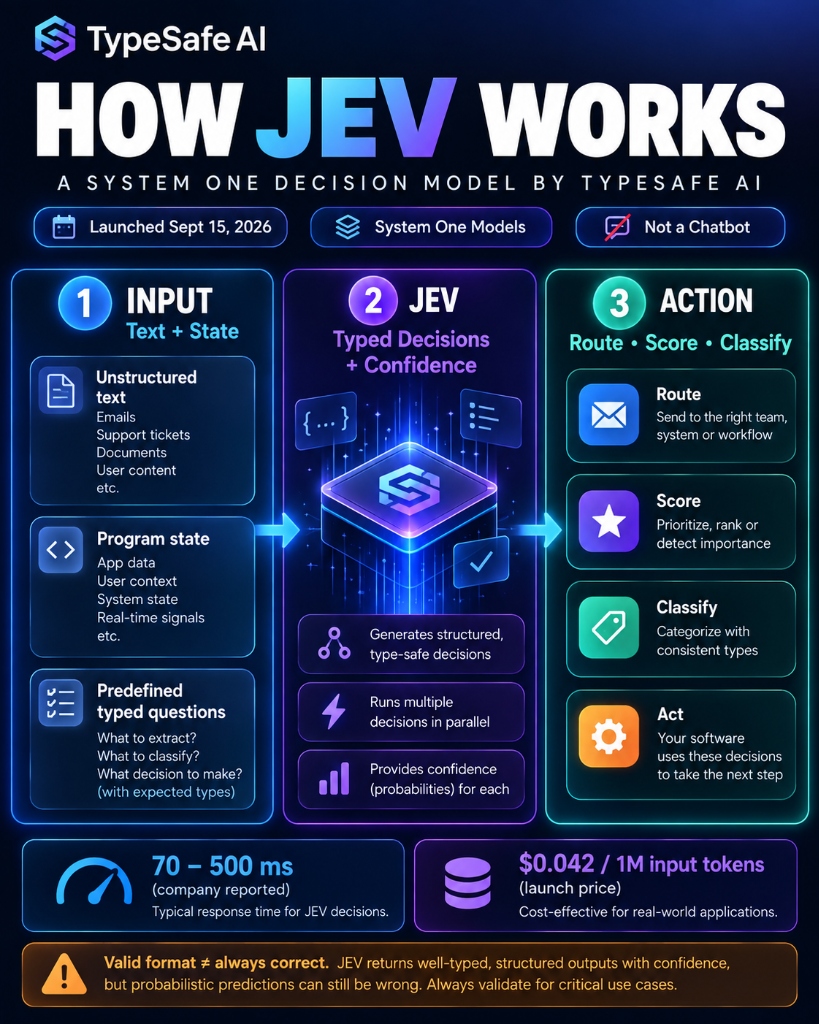
Infographic: The TypeSafe AI Jev 3-Stage Pipeline (Input State → Parallel Decision Primitives → Software Action)
Valid Format ≠ Always Correct: While Jev returns strictly typed, structured outputs with calibrated probabilities, probabilistic predictions can still be wrong. Software teams must maintain sanity checks and guardrails for mission-critical workflows.
Jev completely eliminates the concept of an open-ended chat window. Instead of prompting the model to “Please answer in JSON without markdown”, developers query program state using three native decision primitives:
Application Data (Support Ticket, Email, Sensor Log)
        │
        ├──► 1. `noul`   ──► Calibrated probability (0.0 to 1.0) for True/False
        ├──► 2. `choice` ──► Categorical pick from a fixed string list
        └──► 3. `score`  ──► Numerical rating on a defined rubric scale
1. noul (Calibrated Probability)
Returns a mathematical probability between 0.0 and 1.0 answering a binary question.
* Example: “Does this customer message threaten to cancel their account?” → Returns 0.87 (87% confidence).
2. choice (Categorical Selection)
Directly selects one option from a predefined list provided by the developer.
* Example: “Which department handles this request?” Options: ["billing", "technical_support", "sales"] → Returns "billing".
3. score (Calibrated Rating)
Evaluates state against an integer or floating-point range according to developer instructions.
* Example: “Rate the urgency of this ticket from 1 to 5” → Returns 4.
Because all questions are submitted simultaneously in a single HTTP request, Jev evaluates all three primitives in parallel during a single forward pass through the neural network.
⚖️ Jev vs. Traditional LLMs: Why Is It Up to 200× Faster and 400× Cheaper?
To understand Jev’s speed and cost advantage, look at how the underlying hardware processes information:
1. Autoregressive (Traditional LLMs) vs. Non-Autoregressive (Jev)
- Traditional LLMs are Autoregressive: They predict one word (token) at a time. To generate a 200-word JSON response, the model must run 200 sequential passes through the graphics card (GPU). Each word waits for the previous word to finish, compounding latency.
- Jev is Non-Autoregressive: It does not produce a stream of words. It evaluates the entire input context and calculates the final decision scores across all categories in one single parallel pass.
2. Why Output Tokens Are 100% Free
Because traditional models run one GPU pass per output word, AI providers charge heavily for output tokens ($10 to $15 per million tokens on flagship tiers).
Because Jev completes its work in a single pass and returns scalar numbers or selected enums rather than generating a token stream, its computational cost for output is negligible. TypeSafe AI charges $0.042 per million input tokens and $0.00 for output tokens.
🎯 When to Use Jev vs. Traditional LLMs: The Decision Matrix

Not every AI task should use Jev, and not every AI task should use ChatGPT. Choosing the right tool depends entirely on whether your application needs generation or decision-making.
Does the task require generating original text, prose, or code?
        │
        ├──► YES ──► Use Traditional LLM (GPT-4o, Claude 3.7 / 5, Gemini)
        │
        └──► NO  ──► Does the task require choosing an option, grading, or routing?
                      │
                      └──► YES ──► Use TypeSafe Jev (Sub-500ms, Ultra-low cost)
🏛️ The Ideal Architecture: The “Gatekeeper & Thinker” Hybrid
In production systems, engineering teams do not replace large models with Jev. Instead, they pair them together:
Incoming User Query
        │
        ▼
┌────────────────────────────────────────────────────────┐
│               GATEKEEPER LAYER: Jev                    │
│ • Runs in 120ms for $0.00004                           │
│ • Question 1: Is this prompt malicious? (Yes/No)       │
│ • Question 2: Can this be answered from cached FAQ?    │
│ • Question 3: Which downstream model is required?      │
└────────────────────────────────────────────────────────┘
        │
        ├──[Trivial / Blocked] ──► Return instant canned response (Total Latency: 150ms)
        │
        └──[Complex Reasoning] ──► Route to Claude 3.7 or GPT-5 for deep generation
By placing Jev as an intake filter in front of large conversational models, organizations can intercept 60% to 80% of routine requests at sub-second speeds, slashing monthly AI API bills while reducing application latency.
🔬 Behind the Science: RLCD vs. RLHF & The Community Context
RLHF vs. RLCD
- RLHF (Reinforcement Learning from Human Feedback): Traditional chat models are trained with human evaluators who reward polite, comprehensive, conversational answers. This often causes models to sound overly confident even when they are guessing.
- RLCD (Reinforcement Learning for Calibrated Decisions): Jev is trained using RLCD, which mathematically rewards calibrated uncertainty. If Jev assigns an 80% probability to a label across 1,000 requests, it is mathematically calibrated to be correct in approximately 800 of those instances.
The Open-Source “Laya” Context
Following TypeSafe AI’s launch, discussions in the developer community highlighted prior open-source initiatives such as Laya, an earlier project that explored non-autoregressive decision models.
While community developers noted that classification-focused architectures had been prototyped in academic and open-source settings, TypeSafe AI’s primary contribution has been packaging calibrated classification into an enterprise-ready, low-latency API managed under robust commercial service-level guarantees.
🚀 Availability & How to Get Started
Jev is available for commercial deployment and developer integration:
- Official Provider: Accessible directly via TypeSafe AI Console (
jev-latest). - Cloud & Edge Gateways: Supported through Vercel AI Gateway, Cloudflare Workers AI, and DigitalOcean’s Model Catalog.
- Pricing: $0.042 per million input tokens, with free output tokens.
Quickstart Implementation (Python)
Connecting to Jev requires standard Python libraries:
import os
from typesafe import TypeSafeClient

# Automatically reads TYPESAFE_API_KEY from environment variables
client = TypeSafeClient()

customer_message = "I need to dispute an unauthorized renewal charge on my credit card immediately."

# Evaluate multiple decisions in a single sub-second pass
response = client.system_one(
    state=customer_message,
    questions={
        "is_urgent": {
            "type": "noul",
            "instructions": "Does the user require immediate intervention?"
        },
        "target_queue": {
            "type": "choice",
            "choices": ["billing_disputes", "technical_bugs", "general_inquiry"]
        },
        "sentiment_score": {
            "type": "score",
            "min": 1,
            "max": 5,
            "instructions": "Score user satisfaction from 1 (furious) to 5 (delighted)."
        }
    },
    model="jev-latest"
)

# Access clean, machine-typed values directly without JSON parsing
print(f"Urgent: {response.is_urgent.probability > 0.75}") # True
print(f"Queue: {response.target_queue.choice}")           # 'billing_disputes'
print(f"Sentiment: {response.sentiment_score.score}/5")   # 1/5
📌 Strategic Conclusion
The release of Jev highlights an essential shift in enterprise artificial intelligence: specialization over raw scale.
While general-purpose language models will continue to lead in creative writing and deep multi-step reasoning, high-volume production software requires predictable speed, deterministic types, and economical operation.
For developers building high-throughput agent swarms, automated content moderation queues, or real-time triage systems, adding a dedicated System-1 decision engine provides a practical path to faster, more reliable software.