

 Finland’s Data Center Heat Recovery
How Finland is pioneering sustainable urban heating by capturing waste heat from data centers
Heat Recovery System
Waste heat from data centers is captured using heat pumps and redirected into Finland’s district heating networks to warm residential and commercial buildings across cities, creating an innovative circular energy ecosystem.
Heating Thousands of Homes
A single data center’s recovered heat can meet the annual heating needs of thousands of homes – Equinix’s HE5 center heats approximately 1,500 apartments while Google’s Hamina facility provides 80% of the local district heating demand.
Carbon Emission Reduction
The system significantly reduces carbon emissions by eliminating the need to burn fossil fuels for heating, with Google’s recovered heat being 97% carbon-free due to its clean energy-powered data center operations.
Economic Benefits
Data centers lower their cooling costs while energy companies can offer reduced heating prices to consumers, creating a sustainable economic model that benefits both businesses and residents.
Efficient Water Usage
The closed-loop system returns cooled water back to the data centers, optimizing water usage and creating an efficient circular energy ecosystem that minimizes waste.
Successful Partnerships
Finland’s established heat infrastructure has enabled successful partnerships between major tech companies (Google, Microsoft, Equinix) and energy providers, creating a replicable model for sustainable urban development.
Why Finland’s “Hot” Data Centers Are Suddenly Heating Whole Cities
If you’ve seen viral posts saying “Finland is heating entire cities with data centers”, they’re not exaggerating. In the last few days, this story has exploded across social platforms because it sounds almost magical: giant rooms full of computers are helping keep homes warm in winter instead of just wasting heat into the air.
Here’s what is really happening, in simple terms: Finland is capturing the waste heat from energy-efficient data centers and feeding it into its existing district heating networks. That means the same servers that run cloud apps, AI models, and websites are also helping to heat water and buildings for residents and businesses. Recent official announcements from energy companies and government agencies confirm that this is not a small pilot anymore – it is becoming a core part of Finland’s heating strategy.
What Exactly Is District Heating (And Why Finland Uses It So Well)
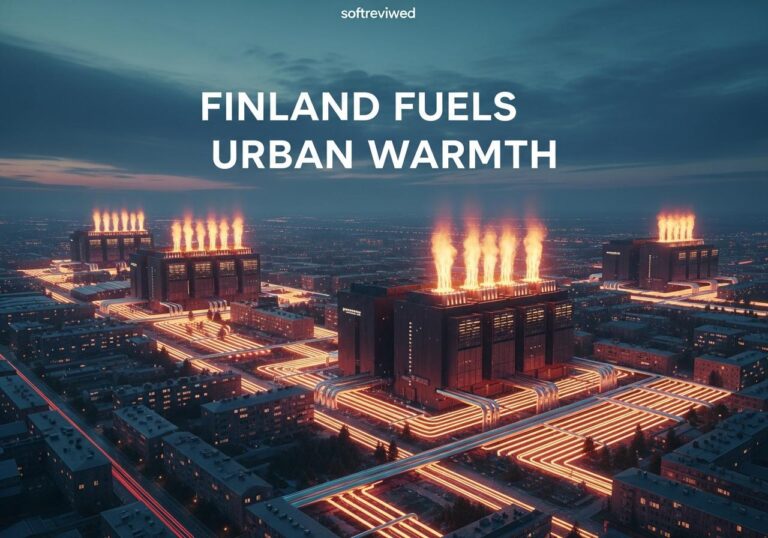
To understand the “magic”, you first need district heating. Think of district heating as a giant shared geyser for a city. Instead of every building having its own big boiler, a central system heats water and then pipes that hot water to many buildings through underground insulated pipes.
Countries like Finland, Sweden, and Denmark have used district heating for decades because:
- 📌 Winters are long and very cold.
- 📌 Cities are dense enough that shared pipes make economic sense.
- 📌 Governments have pushed for efficient, cleaner heating systems.
Finland already had a strong district heating backbone before data centers entered the picture. That existing network is the “highway” that now carries repurposed heat from data centers to homes and offices.
How a Data Center Becomes a Giant Urban Radiator
At its core, a data center is just a massive collection of powerful computers (servers). When servers work hard, they get hot – just like your laptop when you play a heavy game. Normally, that heat is treated like a problem: something to be removed as cheaply as possible.
Finland flips that story. Instead of throwing the heat away, it treats it like a useful product.
Step-by-Step: From Hot Servers to Hot Showers
Here’s the simple step-by-step journey, without technical jargon:
📌 Servers do digital work
They run apps, AI models, cloud storage, and more. This consumes electricity and produces heat.📌 Cooling system collects the heat
Instead of just blowing hot air out, many modern Finnish data centers use liquid cooling or efficient air systems that concentrate the heat into warm water or air streams.📌 Heat exchangers and heat pumps step in
- Heat exchangers move the heat from the data center cooling loop into a separate water loop.
- Large industrial heat pumps “upgrade” the temperature of this water so it’s hot enough for district heating pipes (think of them as super-efficient reverse fridges).
📌 Hot water goes into the city’s district heating network
The upgraded hot water is pushed into the district heating pipes that already connect homes, offices, and public buildings.📌 Buildings use that heat for radiators and hot water
Residents take hot showers and warm their homes, not knowing the warmth started as server heat.📌 Control systems and AI keep everything balanced
Smart control systems optimize when to store heat, when to use backup sources, and how to blend heat from data centers, air, wastewater, and electric boilers.
In short: instead of “heat → waste”, the chain becomes “heat → city resource”.
Simple Analogy: Turning a Gaming PC into a Neighborhood Heater
Imagine your gaming PC in a small bedroom. When you play for hours, the room becomes warm. Now, imagine:
- The room is the size of a football stadium.
- Hundreds of thousands of gaming PCs are stacked in racks.
- All the warm air is captured and sent into a big water tank, then piped to nearby homes.
That’s basically what Finland is doing – just with stricter engineering and safety standards.
Real Projects: Microsoft, Fortum, and Google Turn Heat into a Public Service
This idea is not just theory. Several large, well-documented projects show how serious Finland is.
Espoo, Kirkkonummi, and Kauniainen: Microsoft x Fortum Mega-Project
Energy company Fortum and Microsoft are building one of the world’s largest data center heat recovery systems for the Helsinki region, especially the cities of Espoo, Kirkkonummi, and Kauniainen.
Key facts from official company and industry sources:
- ✅ The data centers will run on 100% emission-free electricity.
- ✅ Up to 40% of the district heating needs of Espoo, Kirkkonummi, and Kauniainen will eventually be covered by waste heat from Microsoft’s data centers once they are fully running.
- ✅ The project is expected to reduce carbon dioxide emissions by around 400,000 tons per year when fully operational – comparable to removing tens of thousands of cars from the road.
- ✅ Fortum has committed to making district heat coal-free in this area by 2025 and carbon-neutral by around 2030, and data center heat is a major pillar of that plan.
Fortum describes this as the largest data center heat recovery concept of its kind in the world, and the project has received support from European and national funding programs.
Hamina: Google’s Data Center Warming a Finnish Town
On the south coast in Hamina, Google is doing something very similar with its large data center.
From Google and local energy company Haminan Energia:
- ✅ Waste heat from Google’s Hamina data center will cover up to 80% of the annual heat demand of the local district heating network when the system is fully active.
- ✅ The heat will be 97% carbon-free, because the data center itself already operates mainly on carbon-free electricity, and the heat pumps use low-carbon power.
- ✅ A 7.5 MW heat pump plant will produce around 40 GWh of district heating per year, roughly equivalent to the heating needs of about 2,000 households.
- ✅ The heat is supplied free of charge to the district heating company, strengthening the town’s energy security and helping keep prices under control.
Local officials have publicly praised this as an example of how tech investment can directly support the community’s climate and energy goals.
Finland’s Bigger Picture: Waste Heat as a “Resource, Not Waste”
A recent communication from Business Finland (a government organization) describes the national strategy clearly: Finland wants to tightly integrate data centers, waste heat, renewable energy, and smart grids so that “waste heat is not energy waste, but a valuable resource.”
Some key highlights from that national overview:
- ✅ Between 2023 and 2024, the share of renewables, heat recovery, and electric boilers in Finland’s heating mix rose significantly.
- ✅ A vast majority of electricity is renewable and CO₂-neutral, giving a clean base for heat recovery.
- ✅ The grid reliability is extremely high, with availability around 99.9995%, which is crucial for both data centers and district heating.
- ✅ Large “sand batteries”, cavern thermal storage, and power-to-heat units help handle seasonal and daily fluctuations.
Together, these projects show that data center heat is not an isolated gimmick but part of a carefully designed national energy system.
Why This Matters for Climate, Cities, and Your Energy Bills
To see why this is exciting, let’s quickly compare a traditional data center with a heat-recycling Finnish one.
| Aspect | Traditional Data Center | Finland-Style Heat-Recycling Data Center |
|---|---|---|
| What happens to waste heat | Mostly dumped into air or water ⛔️ | Captured and pumped into city district heating ✅ |
| Contribution to local heating | Almost zero | Can provide 40–80% of local heating demand in some areas ✅ |
| Fuel for heating | Separate gas/coal/biomass boilers ⛔️ | Mostly electricity + recovered heat (often low-carbon) ✅ |
| Climate impact | High overall emissions | Major CO₂ reductions vs separate fossil fuel heating ✅ |
| Benefit to local community | Mainly jobs and tax | Jobs, tax, plus lower-carbon, often more stable heating ✅ |
Benefits in Simple Terms
Here’s how this setup helps different groups.
For cities and residents:
- ✅ Lower carbon footprint: Less need to burn coal, gas, or oil for heating.
- ✅ Better use of existing pipes: District heating networks become more efficient by using every drop of available heat.
- ✅ Energy security: Heat is produced locally from a reliable, year-round source (data centers don’t “take weekends off”).
For data center operators:
- ✅ Social license to operate: It’s easier to justify large power-hungry data centers when they also heat tens of thousands of homes.
- ✅ Improved efficiency metrics: Heat-reuse improves energy-use indicators and sustainability scores, which investors and regulators like.
- ✅ Better integration with local authorities: Working with city utilities builds long-term partnerships and helps secure permits and power connections.
For the climate:
- ✅ Less wasted energy: Every unit of heat that replaces fossil fuel burning reduces emissions.
- ✅ Supports clean electricity: When combined with renewables and smart grids, heat-reuse makes all that green power even more valuable.
The Flip Side: Technical, Economic, and Ethical Challenges
Of course, this is not “free magic”. There are real limits and trade-offs.
Technical and Seasonal Limits (Including “What About Summer?”)
People online are already asking smart questions like “What does Finland do in the summer?” when heating demand is low. That question is very fair.
Some key technical constraints:
⛔️ You need district heating pipes
If a city doesn’t have a district heating system, it’s much harder and more expensive to reuse heat at scale.⛔️ Distance matters
Heat does not travel as easily as electricity. Data centers usually need to be relatively close to where the heat is used, or the system becomes inefficient.⛔️ Seasonal variation
In winter, the heat is super valuable. In summer, demand drops, so either:- Heat pumps run less.
- Heat is stored in large underground or tank systems.
- The system focuses more on other uses (like industrial processes or absorption cooling).
⛔️ Complex engineering and controls
Balancing renewables, waste heat, electric boilers, and storage needs advanced control systems and very careful design.
Finland is partly solving these issues with large thermal storage (like sand batteries and cavern storage) and by combining several heat sources (wastewater, air, data centers) instead of relying on just one.
Economic and Practical Trade-Offs
Even with all the benefits, money and practicality matter:
⛔️ High upfront investment
Building heat pump plants, pipes, and control systems can cost hundreds of millions of euros. Investors and utilities need long-term confidence to commit.⛔️ Lock-in risk
If a data center closes or scales down, the city could lose a major heat source. Contracts and backup systems are needed to manage that risk.⛔️ Not ideal everywhere
Very warm regions might not benefit as much from using data center heat for space heating, although they could reuse it for industrial processes or cooling.
Social License, Greenwashing, and Data Ethics
There are also ethical and perception aspects:
📌 Greenwashing risk
A highly energy-hungry data center can look “green” because of heat reuse while still using enormous amounts of electricity. Transparency about total energy use and emissions is crucial.📌 Local vs. global benefit
Local residents may enjoy cleaner heating, but the data center’s primary purpose still serves global digital services. Policymakers must ensure local communities get a fair share of the benefits (jobs, heat, investment).📌 Data and critical infrastructure
Concentrating both digital infrastructure and a big chunk of city heating in a few sites creates security and resilience questions. These are being managed with redundancy and strong regulations, but they need constant attention.
At the same time, experts in Finland highlight that, when done transparently and with strong regulation, heat reuse is one of the clearest examples of a real circular economy solution, not just marketing.
Could This Model Work in Other Countries (Including India)?
This is probably the question you care about most: “Can my city do this too?”
What Cold Countries Can Copy Today
Countries with:
- cold winters,
- existing or planned district heating networks, and
- strong renewable energy plans
can copy Finland’s model relatively quickly. That includes many European countries, parts of North America, and some regions in East Asia.
Key “must-haves”:
- ✅ A dense urban area where district heating makes sense.
- ✅ Data centers either inside or close to that urban area.
- ✅ Policy support and long-term contracts between utilities and data center operators.
- ✅ Investment in heat pumps, storage, and smart control systems.
What Warmer Countries Like India Could Do Instead
India and many other warmer countries still have huge potential, just with slightly different goals.
Remember: waste heat isn’t only good for “heating houses in winter”. It can also support:
- 📌 Industrial process heat (for factories, food processing, textiles, etc.).
- 📌 Absorption cooling systems that use heat to drive cooling for buildings.
- 📌 Hot water supply in hospitals, colleges, and large residential complexes.
For a country like India, possible paths include:
- ✅ Building “heat-aware” data center parks near industrial clusters, so waste heat can assist in low-temperature processes.
- ✅ Using waste heat to drive district cooling in IT parks, malls, and new smart city zones (cooling powered partly by heat is counter-intuitive but very real technology).
- ✅ Planning new urban districts with shared energy loops, where data centers, factories, and large buildings share heat and cooling like Finland shares heat through district networks.
In short, the exact copy of “heating whole cities in winter” might not fit India’s climate, but the principle of “never waste a watt of heat if you can reuse it” absolutely does.
Key Takeaways You Can Remember in 30 Seconds
To wrap up, here are the main points in simple, memory-friendly form:
👉 Data centers are giant heaters in disguise.
Finland decided not to waste that heat and instead pushes it into city-wide heating networks.👉 Real projects are already big, not small pilots.
- Microsoft and Fortum’s project near Helsinki aims to supply about 40% of district heat in several cities and cut emissions by around 400,000 tons of CO₂ per year.
- Google’s Hamina data center will provide up to 80% of local district heating, nearly all carbon-free.
👉 The system works because Finland combines several strengths.
Strong district heating networks, clean electricity, smart grids, and energy storage make heat-reuse practical and reliable.👉 There are real limits and trade-offs.
You need pipes, investment, careful planning, backup systems, and honesty about total energy use. Heat reuse doesn’t magically make all data center impacts disappear.👉 The core lesson is universal.
Whether in Finland, Europe, or India, the big idea is simple:
If something gets hot anyway (like servers), design your city so that heat is used, not wasted.
If you think of data centers as “giant community radiators” instead of just “internet factories”, it becomes much easier to imagine smarter, cleaner cities where digital and physical infrastructure help each other instead of working separately.







