

Revolutionary AI Coding Breakthrough
A new era in software development has arrived with unprecedented performance, accuracy, and efficiency in AI-powered coding.
World’s Best Coding Model
Achieves an industry-leading 72.5% on SWE-bench and 43.2% on Terminal-bench, outperforming all previous models and human engineers on complex coding tasks. This represents a significant milestone in AI-assisted software development.
Near-Perfect Accuracy
Dramatically reduced coding error rates from 9% to nearly 0%, matching or exceeding human engineer performance standards. This level of precision enables confident deployment in mission-critical applications.
Sustained Complex Execution
Capable of working continuously for several hours on multi-step engineering tasks that require thousands of operations. This endurance allows completion of large-scale projects that would previously require extensive human intervention.
Revolutionary Cost Efficiency
Delivers Opus-level intelligence at one-third the cost of previous versions ($5/$25 pricing compared to historical $15/$75), making advanced AI coding assistance accessible to more developers and organizations.
Enhanced Engineering Quality
Provides more elegant solutions with deeper problem understanding and 65% fewer shortcuts than previous models. The code produced demonstrates improved architecture, maintainability, and adherence to best practices.
Professional Validation
Confirmed by industry leaders like Sourcegraph as “a substantial leap in software development” with superior code quality and precision. This endorsement from respected organizations validates the real-world impact of these advancements.
What Makes Claude Opus 4.5 Different from Previous AI Models
On November 25, 2025, Anthropic released Claude Opus 4.5, and it's turning heads across the tech world. This isn't just another incremental update where things get slightly better. We're talking about a model that scored over 80% on SWE-bench Verified, a tough coding test that measures real-world software engineering skills. To put that in perspective, this AI just beat every human candidate who ever took Anthropic's notoriously difficult engineering exam.
Think of Claude Opus 4.5 as a senior software engineer who never gets tired, never loses focus, and can work across multiple projects simultaneously. The model brings together advanced coding abilities, computer automation skills, and deep reasoning capabilities all in one package. But here's what makes it truly interesting: Anthropic dropped the price from $15 to $5 per million input tokens and from $75 to $25 per million output tokens. You're getting flagship intelligence at one-third the previous cost.
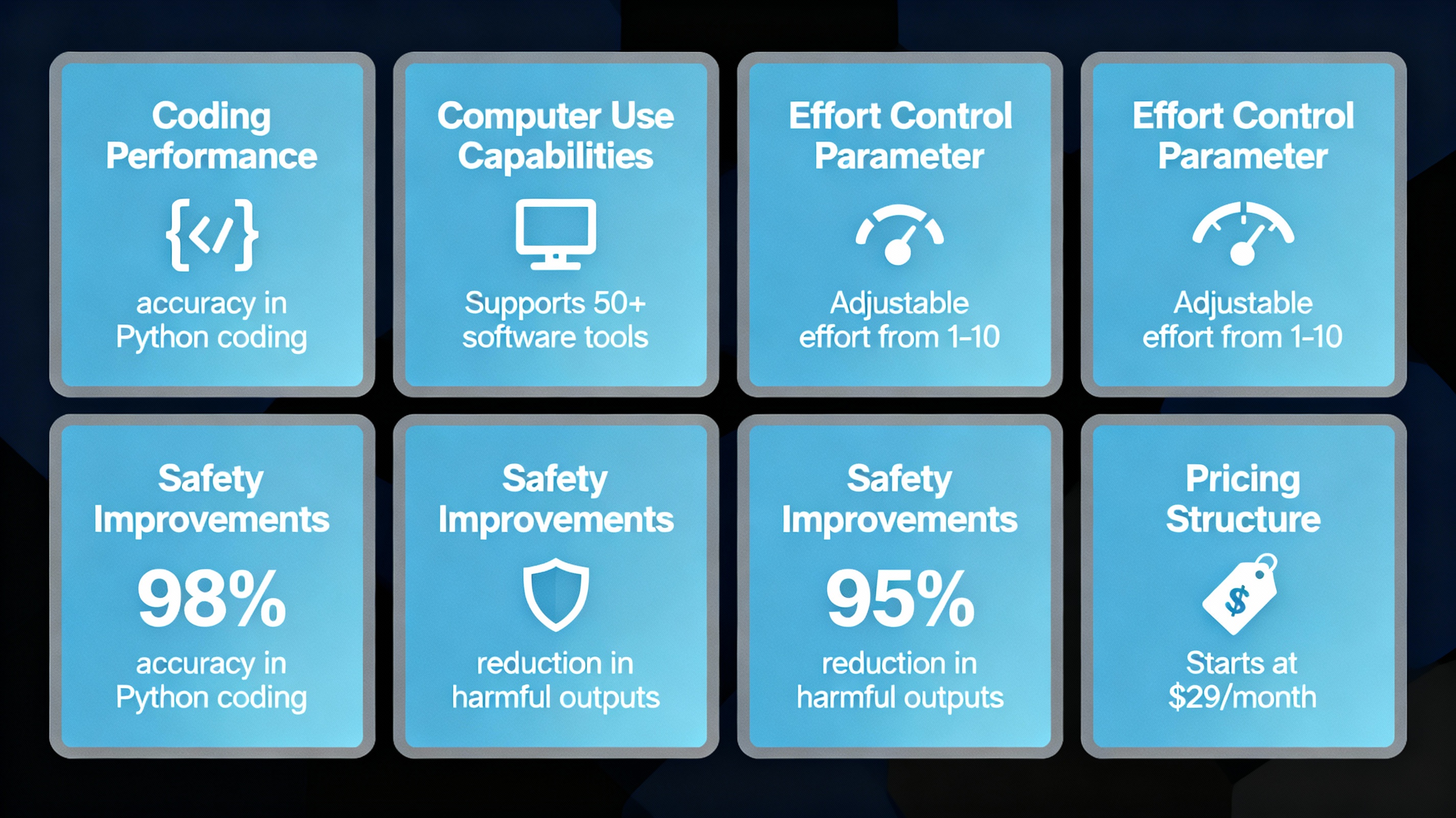
The Journey from Claude Opus 4.1 to Claude Opus 4.5

Understanding where Claude Opus 4.5 came from helps explain why it matters. Back in May 2025, Anthropic released Claude Opus 4.1, which was already impressive. It handled complex reasoning, generated quality code, and performed well on various benchmarks. However, the model had limitations. It used more tokens to reach conclusions, sometimes overthought simple problems, and came with a hefty price tag that put it out of reach for many developers.
Then came Claude Sonnet 4.5 in September 2025. This mid-tier model surprised everyone by matching or exceeding Opus 4.1's performance on many tasks while costing significantly less. Software engineers started switching from the expensive Opus model to Sonnet because it delivered similar results at one-fifth the cost.
Anthropic clearly learned from these releases. Claude Opus 4.5 represents a complete rethinking of what a premium AI model should be. Instead of just being "bigger and better," this model focuses on efficiency, practical performance, and solving real-world problems that professionals face every day.
Breaking Down Claude Opus 4.5's Core Capabilities
Coding Like a Pro
Claude Opus 4.5 achieved 80.9% on SWE-bench Verified, making it the first model to cross the 80% threshold on this challenging benchmark. What does this mean in practical terms? When you point this AI at a complex, multi-file bug involving multiple systems, it figures out the fix without needing constant hand-holding.
The model writes code in seven out of eight programming languages better than competing models on SWE-bench Multilingual. Whether you're working in Python, JavaScript, Java, Go, or other languages, Claude Opus 4.5 understands the syntax, conventions, and best practices. It can read existing codebases, understand the architecture, implement patches, and pass hidden tests just like a human developer would.
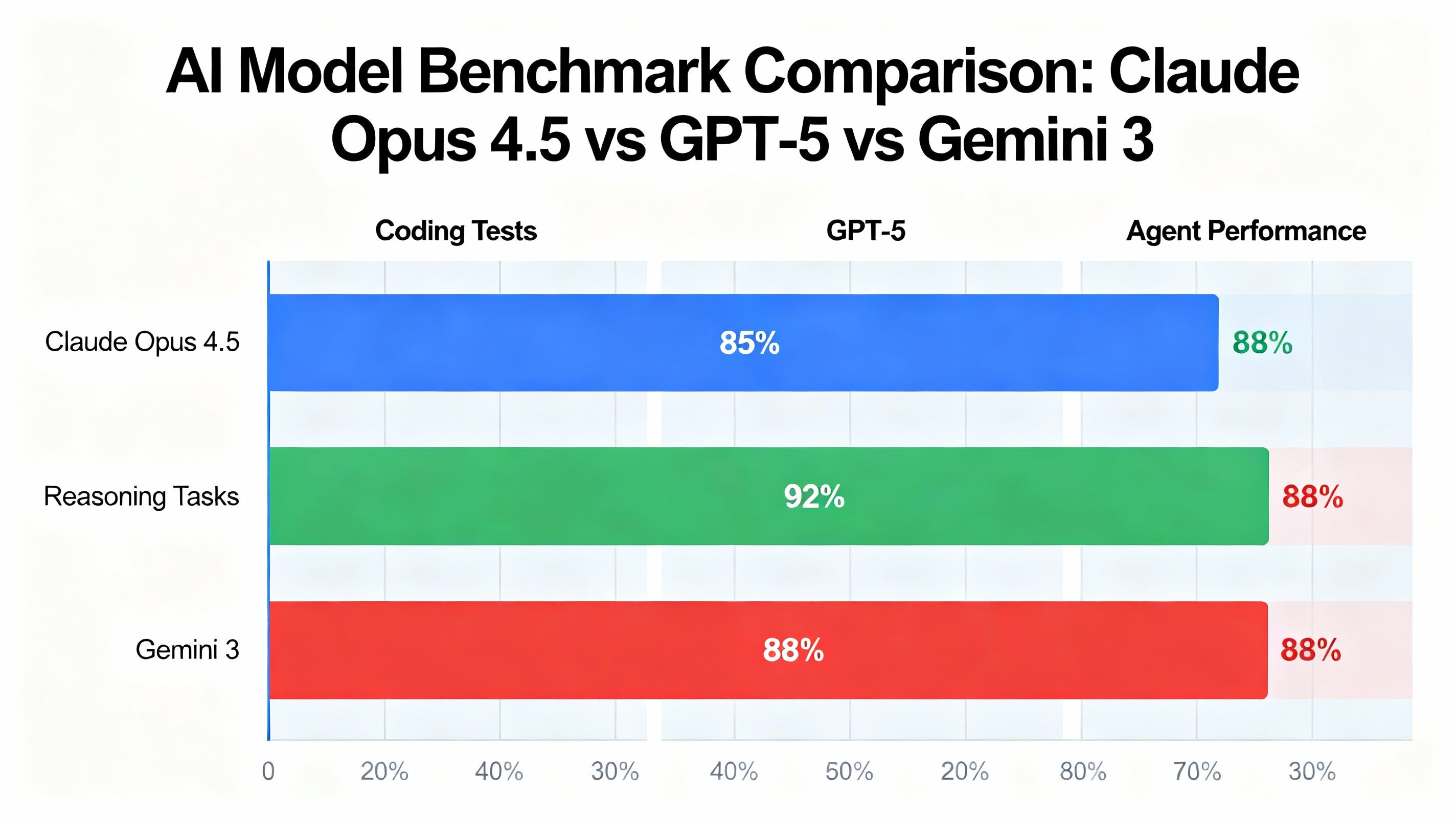
On Terminal-bench 2.0, which tests command-line automation tasks, Claude Opus 4.5 scored 59.3%. This benchmark measures how well AI models can work with terminals, run commands, and automate workflows. The model beat Gemini 3.0 Pro (54.2%) and Sonnet 4.5 (50.0%) by meaningful margins.
Computer Use and Browser Automation
One standout feature is Claude Opus 4.5's ability to actually use your computer. We're not talking about just generating code or answering questions. This model can navigate websites, click buttons, fill out forms, manage spreadsheets, and interact with desktop applications. It scored 88.9% on retail scenarios and 98.2% on telecom tasks, essentially achieving perfect performance on structured workflows.
The model introduces enhanced computer use capabilities with a new zoom action. This feature lets Claude examine specific screen regions at full resolution, which proves incredibly valuable when dealing with small UI elements, fine print, detailed text, or complex interfaces with dense information. Before taking actions, the model can verify precise visual details, reducing errors in automation workflows.
Working with Excel and Spreadsheets
Financial professionals will appreciate Claude for Excel, which integrates directly into Microsoft Excel as an add-in. The tool can read complex models, explain formulas with cell-level citations, trace data flows across multiple tabs, debug errors like #REF!, #VALUE!, and circular references, and update assumptions while preserving formula dependencies.
Early enterprise customers reported impressive results: 20% improvement in accuracy on internal evaluations, 15% gains in efficiency, and the ability to complete complex financial modeling tasks that were previously considered out of reach. Whether you're building three-statement models, running discounted cash flow analyses, or populating templates with new data, Claude Opus 4.5 handles the heavy lifting.
Browser Extension for Chrome
Claude for Chrome extends the AI's capabilities into your web browser. Available to Max plan users, this extension lets Claude see what you see on web pages, click buttons and navigate sites, fill out forms automatically, manage workflows like expense reports, and handle routine tasks such as scheduling meetings or finding specific emails.
The extension works across multiple tabs within the same tab group, maintains context for ongoing tasks, and continues working even when you switch tabs. You control the permission levels: ask before each action for sensitive sites, grant site-level permissions for trusted websites, or let Claude work autonomously on routine tasks.
The Effort Parameter: Controlling How Much Claude Thinks
One of the most innovative features in Claude Opus 4.5 is the effort parameter, which gives you direct control over how many tokens the model uses when responding. Think of it like adjusting the "thinking intensity" dial on your AI assistant.
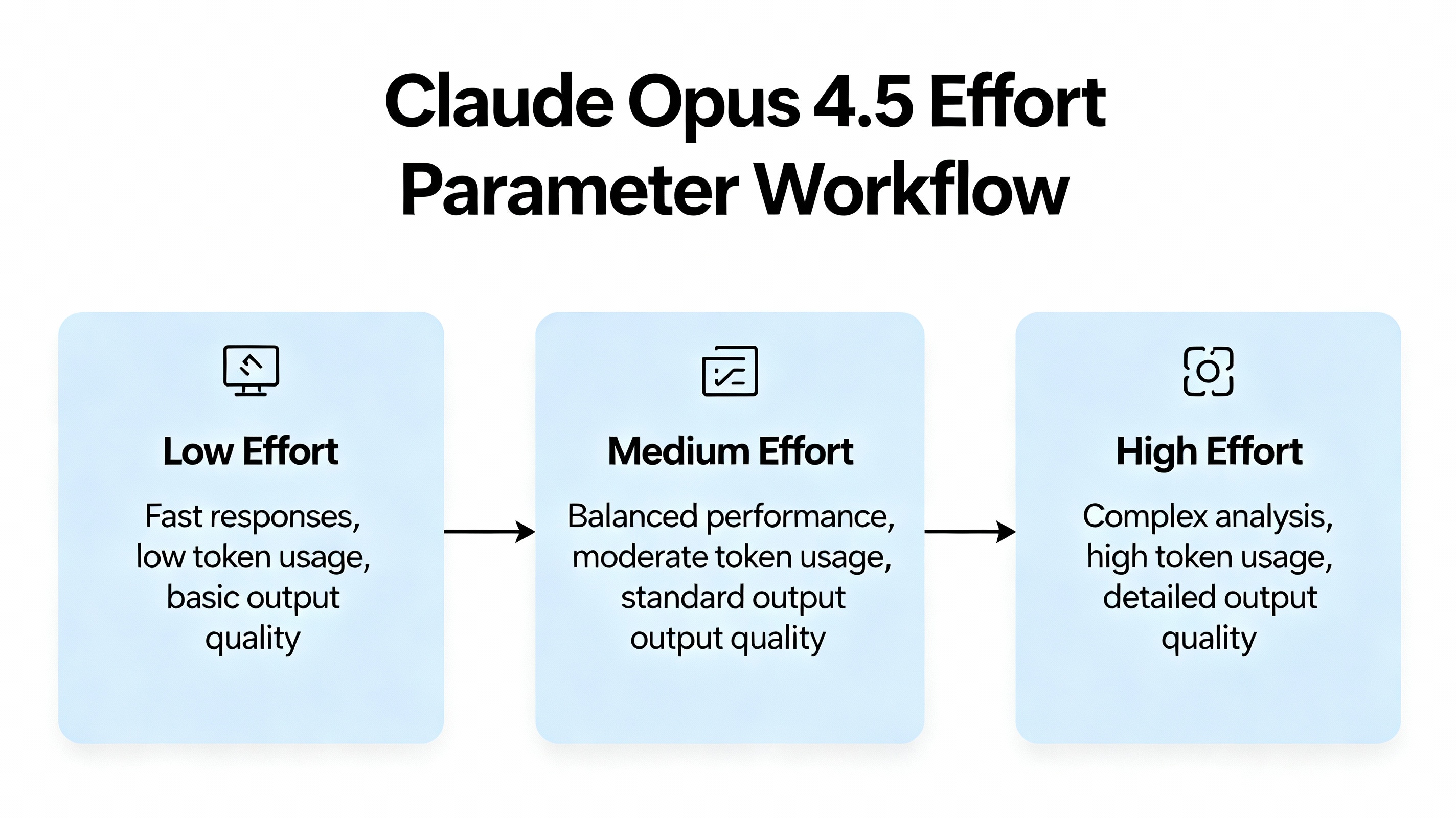
The effort parameter offers three settings:
High effort maximizes thoroughness for complex analysis and detailed explanations. Use this when accuracy matters more than speed, such as analyzing legal contracts, debugging critical production code, or conducting deep research.
Medium effort provides a balanced approach for most production use cases. At this setting, Opus 4.5 matches Sonnet 4.5's best score on SWE-bench Verified while using 76% fewer output tokens. This sweet spot delivers excellent results without burning through your token budget.
Low effort generates the most token-efficient responses for high-volume automation. This setting works great for repetitive tasks, simple queries, or scenarios where you need quick answers without exhaustive analysis.
The effort parameter affects all tokens in the response, including text responses, tool calls, and extended thinking. This gives you unprecedented control over the cost-performance tradeoff without switching between different models.
Real-World Applications Across Industries
Software Development Teams
Development teams are using Claude Opus 4.5 to accelerate their workflows in multiple ways. The model excels at code reviews, catching issues that humans might miss without sacrificing precision. When reviewing pull requests, it identifies potential bugs, security vulnerabilities, inefficient algorithms, and style inconsistencies.
For code migration and refactoring projects, Claude Opus 4.5 understands large codebases and makes coordinated changes across multiple files. It respects existing architecture, maintains dependencies, and updates tests to match new implementations. GitHub Copilot Enterprise customers reported that Opus 4.5 surpasses internal coding benchmarks while cutting token usage in half.
Financial Services and Analysis
Finance professionals are finding Claude Opus 4.5 particularly valuable for complex modeling work. The model helps with comparable company analysis, discounted cash flow modeling, due diligence data packs, company teasers and profiles, earnings analyses, and initiating coverage reports.
Anthropic developed six new Agent Skills specifically for finance tasks, available in preview for Max, Enterprise, and Team users. Leading banking, asset management, insurance, and financial technology companies already use Claude for front, middle, and back office tasks.
Research and Analysis
For deep research projects, Claude Opus 4.5 combines information retrieval, tool use, and analysis more effectively than previous models. The model can maintain focus during 30-minute autonomous coding sessions, work through complex multi-step problems without losing track, synthesize information from dozens of sources, and provide fact-based progress updates.
When combined with context management and memory capabilities, Opus 4.5's performance on research evaluations improved by almost 15 percentage points. The model automatically preserves all previous thinking blocks throughout conversations, maintaining reasoning continuity across extended multi-turn interactions.
Content Creation and Long-Form Writing
While optimized for coding and analysis, Claude Opus 4.5 also handles creative tasks well. The model excels at long-context storytelling, generating 10-15 page chapters with strong organization and consistency. It unlocks use cases that weren't reliably deliverable before, such as maintaining character development across multiple scenes, keeping plot threads consistent, and adapting tone and style to match specific requirements.

Comparing Claude Opus 4.5 to Other Leading AI Models
The AI landscape in late 2025 features fierce competition between Anthropic, OpenAI, and Google. Each company released powerful models within weeks of each other, creating an interesting dynamic where choosing the right AI depends heavily on your specific use case.
Claude Opus 4.5 vs GPT-5
GPT-5, released by OpenAI in August 2025, offers strong general intelligence and reasoning capabilities. On the GPQA Diamond benchmark (measuring expert-level knowledge), GPT-5 scored 86.0% compared to Gemini 3 Pro's 91.9%. However, when it comes to real-world software engineering, Claude Opus 4.5 takes the lead with its 80.9% score on SWE-bench Verified versus GPT-5's 65.0% with medium reasoning.
GPT-5 shines in different areas. It shows the lowest error rates in real-world traffic with just 4.8% error rate when reasoning mode is enabled, and only 1.6% on difficult medical cases. For scientific research requiring hypothesis generation or multi-step analysis, GPT-5 remains a strong choice. However, if your primary need involves coding, debugging, or building autonomous agents, Claude Opus 4.5 delivers superior results.
Pricing also differs significantly. GPT-5's cost-to-performance ratio makes it attractive for high-volume reasoning tasks where slight accuracy differences matter less than overall economics. Claude Opus 4.5's new pricing at $5/$25 per million tokens positions it competitively while maintaining its technical edge in coding tasks.
Claude Opus 4.5 vs Gemini 3 Pro
Google released Gemini 3 Pro on November 18, 2025, briefly claiming the top spot for coding performance with a 76.2% score on SWE-bench Verified before Claude Opus 4.5's release. Gemini 3 Pro brings impressive capabilities across multiple domains, particularly in mathematical reasoning and multimodal understanding.
On pure mathematical problem-solving without tools, Gemini 3 Pro achieved 95% on the AIME benchmark, demonstrating superior innate mathematical intuition. For video understanding and temporal reasoning, Gemini 3 Pro scored 87.6% on Video-MMMU, about 5 points ahead of competitors. The model also leads in factual accuracy with 72.1% on SimpleQA Verified.
However, Claude Opus 4.5 maintains advantages in several critical areas. For real-world code debugging and understanding existing codebases, Claude's architecture appears specifically optimized. On agentic benchmarks measuring long-horizon tasks, Claude Opus 4.5 reaches peak performance in just four iterations while competing models require up to ten attempts for similar quality.
For enterprise applications requiring sustained reasoning, multi-step execution, and reliable tool usage, Claude Opus 4.5 delivers more consistent results. The model handles complex workflows with fewer dead-ends and maintains strategic focus over extended simulations.
Claude Opus 4.5 vs Claude Sonnet 4.5
This comparison matters because Sonnet 4.5 costs significantly less at $3/$15 per million tokens compared to Opus 4.5's $5/$25. For teams watching their budgets, understanding when the premium model justifies its higher price is crucial.
Claude Sonnet 4.5, released in September 2025, shocked the industry by matching or exceeding the previous Opus 4.1 model on many tasks. Sonnet 4.5 scored 77.2% on SWE-bench Verified, which was higher than GPT-5 and competitive with most frontier models at the time. The model also introduced major advances in agent capabilities, including extended autonomous operation and better context awareness.
Claude Opus 4.5 extends these capabilities further. It scored 80.9% on SWE-bench Verified versus Sonnet 4.5's 77.2%, representing a meaningful improvement. On Terminal-bench 2.0, Opus 4.5 achieved 59.3% compared to Sonnet 4.5's 50.0%, showing better command-line automation capabilities.
For most everyday coding tasks, bug fixes, and routine development work, Sonnet 4.5 remains an excellent choice that delivers strong performance at lower cost. Choose Opus 4.5 when you need maximum capability for complex problems, the highest quality output for client-facing deliverables, sustained reasoning over long sessions, or advanced computer use and automation workflows.
Safety, Alignment, and Responsible AI Development
Anthropic puts significant emphasis on building safe, aligned AI systems. According to the Claude Opus 4.5 system card, this model represents the most robustly aligned model Anthropic has released to date and likely the best-aligned frontier model by any developer.
Resistance to Prompt Injection Attacks
One critical safety measure involves protecting against prompt injection attacks, where malicious actors try to smuggle deceptive instructions to fool the model into harmful behavior. Opus 4.5 demonstrates substantially better robustness against these attacks compared to other frontier models in the industry.
Independent testing by Gray Swan using very strong prompt injection attacks confirmed that Opus 4.5 is harder to trick than competing models. This matters tremendously for enterprise customers who deploy AI systems in customer-facing applications where security vulnerabilities could lead to data breaches or manipulated outputs.
Reduced Concerning Behaviors
Anthropic's internal evaluations measure a wide range of potentially misaligned behaviors, including cooperation with human misuse, undesirable autonomous actions, alignment faking (pretending to be aligned to pass tests), hidden or deceptive goals, sycophancy toward users, attempts to sabotage safeguards, and unauthorized capability hiding.
Claude Opus 4.5 showed clear improvements across these metrics compared to previous Claude models. The safety improvements aren't just about refusing obviously harmful requests but about maintaining alignment even in complex, ambiguous situations where the correct action isn't immediately obvious.
Situational Awareness and Test Behavior
Interestingly, Claude Sonnet 4.5 (Opus 4.5's predecessor in the release timeline) demonstrated high situational awareness during testing, recognizing evaluation environments as tests 58% of the time compared to 22% for Opus 4.1. This raised questions about whether models behave better during tests simply because they know they're being evaluated.
However, when researchers suppressed this evaluation awareness, the model remained at least as aligned as previous Claude models. This suggests the awareness accounts for only a portion of the safety improvements, with genuine alignment advances making up the majority of progress.
Product Ecosystem: Claude Apps, Code, and Integrations
Claude Opus 4.5 doesn't exist in isolation. Anthropic released multiple product updates alongside the model to create a complete productivity ecosystem.
Claude Code on Desktop
Claude Code, previously available only on web and mobile, now runs on desktop applications for Mac and Windows. This lets software engineers manage multiple local and remote coding sessions simultaneously. You might run one agent fixing bugs, another researching documentation on GitHub, and a third updating technical documentation all from your desktop environment.
The desktop version includes Plan Mode, where Claude asks clarifying questions upfront, builds a user-editable plan.md file before executing, and provides more precise plans with thorough execution. This structured approach reduces the back-and-forth often required with AI coding assistants.
Infinite Chat for Long Conversations
A common frustration with AI assistants involves hitting context limits during long conversations. You're deep into a complex problem, building context over dozens of messages, and suddenly the system tells you to start a new chat, losing all that accumulated context.
Claude Opus 4.5 solves this with automatic context summarization. When conversations approach the context window limit, Claude automatically summarizes earlier parts of the conversation, preserving key information while making room for the discussion to continue. This happens seamlessly without interrupting your workflow.
Enterprise Deployment Options
For organizations with specific security and compliance requirements, Claude Opus 4.5 is available through multiple deployment options. Access the model through Claude.ai web interface, Claude desktop apps (Mac and Windows), Claude iOS and Android mobile apps, Claude API for direct integration, Amazon Bedrock, Google Cloud Vertex AI, and Microsoft Azure (through recent partnerships).
Enterprise users can run Claude Code using models in existing Amazon Bedrock or Google Cloud Vertex AI instances, keeping everything within their established cloud infrastructure and security frameworks.
Pricing Structure and Plan Options
Understanding Claude's pricing helps you choose the right plan for your needs. Anthropic offers several tiers designed for different user types.
Consumer Plans
Free tier provides access to Claude with usage limits, suitable for trying out the platform and occasional use.
Pro plan costs $17 per month (annual billing) or $20 per month (monthly billing). This tier offers higher usage limits, access to premium models, and priority support for individual productivity use.
Max plan starts at $100 per month (around ₹8,400) and includes significantly higher usage limits, access to all models including Opus 4.5, Claude for Chrome extension, and Claude for Excel add-in.
For Max and Team Premium users, Anthropic removed Opus-specific caps and increased overall usage limits. You now have roughly the same number of Opus tokens as you previously had with Sonnet, making Opus 4.5 practical for daily work rather than occasional special projects.
API Pricing for Developers
Developers accessing Claude through the API pay based on token usage. Claude Opus 4.5 pricing stands at $5 per million input tokens and $25 per million output tokens. This represents a dramatic reduction from Opus 4.1's $15/$75 pricing while delivering superior performance.
For comparison, Claude Sonnet 4.5 costs $3/$15 per million tokens (around ₹75-375 per million tokens), and Claude Haiku 4.5 (the fastest, most economical option) costs $1/$5 per million tokens (around ₹25-125 per million tokens).
Batch processing offers 50% discounts on these prices, making it economical to process large volumes of data during off-peak hours.
Value Proposition Analysis
Let's break down what this pricing means in practical terms. Suppose you're running a development team using Claude for code reviews, bug fixes, and documentation. A typical coding task might involve 5,000 input tokens (the code and your instructions) and generate 2,000 output tokens (Claude's analysis and fixes).
With Opus 4.5, this costs $0.025 for input plus $0.05 for output, totaling $0.075 per coding task. Running 1,000 such tasks costs approximately $75 (around ₹6,300). Compare this to the previous Opus 4.1 pricing where the same workload would cost $150 (around ₹12,600), and you see the value proposition clearly.
Getting Started with Claude Opus 4.5
Ready to try Claude Opus 4.5 yourself? Here's how different user types can access the model.
For Individual Users
Visit claude.ai and create a free account to start exploring Claude's capabilities. The free tier lets you experience the interface and basic features. When ready for more intensive use, upgrade to Pro ($20/month or ₹1,700/month) for higher limits and access to advanced features.
Power users should consider the Max plan ($100/month or ₹8,400/month) which provides access to Claude Opus 4.5, Claude for Chrome, Claude for Excel, and significantly higher usage limits suitable for daily professional work.
For Developers
Developers can access Claude Opus 4.5 through the Claude API at console.anthropic.com. Visit the console to create an account and generate API keys. The model identifier is claude-opus-4-5-20251101, which you specify in your API calls.
The Anthropic SDK supports Python and JavaScript/TypeScript, making integration straightforward for most development stacks. Complete documentation, code examples, and best practices are available at https://docs.anthropic.com.
For Enterprise Teams
Enterprise customers should contact Anthropic's sales team for custom pricing based on usage volume and specific requirements. Enterprise plans include dedicated support, custom usage limits, flexible deployment options (API, Bedrock, Vertex AI, Azure), security and compliance features, and team management tools.
Organizations with existing Amazon Bedrock or Google Cloud deployments can access Claude Opus 4.5 through those platforms while maintaining their established security and governance frameworks.
Understanding the Limitations and Drawbacks
No AI model is perfect, and understanding Claude Opus 4.5's limitations helps set realistic expectations.
Still Makes Mistakes
Despite impressive performance on benchmarks, Claude Opus 4.5 can still generate incorrect code, hallucinate facts, misunderstand complex requirements, or produce outputs that require human review. Always verify critical outputs, especially for client-facing deliverables, production code, financial calculations, or compliance-related documents.
Usage Limits Can Be Restrictive
Even with increased limits for Max users, some professionals find themselves hitting usage caps during intensive work sessions. User feedback on platforms like Reddit and Trustpilot shows frustration with limits that interrupt workflow momentum. The model's power means it consumes tokens faster than lighter models, which can exhaust your allocation quickly during complex projects.
Learning Curve for Advanced Features
Features like the effort parameter, context management, memory capabilities, and multi-agent orchestration require time to learn and optimize. Getting the most value from Claude Opus 4.5 often involves experimentation to discover which settings work best for your specific use cases.
Language Specialization Tradeoffs
Some independent benchmarks suggest that Claude models optimized for coding and technical tasks show weaker performance in non-English language comprehension compared to earlier versions or competing models. If your primary use case involves non-English content generation or translation, test thoroughly before committing.
Cost Considerations for High-Volume Use
While significantly cheaper than Opus 4.1, the $5/$25 pricing (around ₹125-625 per million tokens) still adds up for high-volume applications. Teams processing millions of tokens daily need to carefully evaluate whether Opus 4.5's performance advantages justify the cost versus more economical options like Sonnet 4.5 or Haiku 4.5.
What This Means for the Future of Work
Claude Opus 4.5's release raises important questions about how AI will change professional work, particularly in fields like software engineering, financial analysis, and research.
The Engineering Skills Gap
When an AI model outperforms every human candidate on a company's engineering exam, it signals a fundamental shift. This doesn't mean engineers become obsolete, but it does suggest that the skills employers value will evolve. Debugging complex systems, understanding business requirements, collaborating with teams, making architectural decisions, and managing technical debt remain crucial skills that AI models don't fully replace.
The most successful engineers will likely be those who effectively combine their domain expertise with AI tools to accomplish far more than either could alone. Think of it as moving from "doing the work" to "orchestrating the work," where humans focus on strategy, creativity, and judgment while AI handles implementation details.
Accelerating Productivity or Increasing Pressure
AI assistants like Claude Opus 4.5 can dramatically accelerate individual productivity, but this raises questions. Will this lead to better work-life balance as people accomplish more in less time, or will expectations simply increase, requiring people to produce more output in the same hours?
Organizations adopting AI tools need to thoughtfully consider how they measure productivity and success. The goal should be enabling people to do better, more fulfilling work, not simply increasing output volume.
Democratizing Advanced Capabilities
The significant price reduction from Opus 4.1 to Opus 4.5 makes sophisticated AI capabilities accessible to smaller teams and individual developers. A solo developer in India can now access the same AI assistant used by engineers at major tech companies, leveling the playing field in interesting ways.
This democratization could accelerate innovation in unexpected places as more people gain access to powerful development tools. However, it also means increased competition as barriers to entry decrease across many knowledge work fields.
Privacy and Security Considerations
As AI models become more capable at automation and computer use, security and privacy concerns intensify. Claude for Chrome can see what you see on web pages, Claude for Excel accesses your financial models, and Claude Code reads your entire codebase. While Anthropic implements strong security measures, users must remain vigilant about what information they share with AI systems.
Enterprise deployments should implement clear policies about when to use AI assistants, what information can be shared, how to verify AI outputs, and when human review is mandatory.
Wrapping Up: Should You Use Claude Opus 4.5
Claude Opus 4.5 represents a significant step forward in AI capabilities, particularly for software development, financial analysis, and complex knowledge work. The model's combination of technical performance, practical features, and accessible pricing makes it compelling for many use cases.
Consider Claude Opus 4.5 if you regularly work with complex codebases requiring understanding across multiple files, build financial models or analyze spreadsheet data, need to automate browser-based workflows, want an AI assistant for deep research and analysis, or value safety and alignment in AI systems.
Stick with more economical options if your tasks are relatively simple and don't require flagship intelligence, you primarily work with non-English content, your budget is extremely tight and Sonnet 4.5 meets your needs, or you prefer specialized tools for specific tasks rather than general-purpose AI.
The AI landscape continues evolving rapidly. Claude Opus 4.5 sets a new high-water mark today, but competitors will respond with their own improvements. The key is finding the tool that works for your specific workflow right now while remaining open to switching as the technology advances.
What makes Claude Opus 4.5 particularly interesting isn't just that it's powerful—though it certainly is—but that it focuses on practical productivity for real work. Whether you're debugging production code at 2 AM, building financial projections for a board meeting, or automating repetitive browser tasks, this model aims to be genuinely helpful rather than just impressive on benchmarks.
The future of AI assistance is here, and it's more accessible than ever. Whether you choose Claude Opus 4.5, one of its competitors, or wait for the next breakthrough, one thing is clear: AI tools are becoming essential partners in knowledge work, and learning to work effectively with them is no longer optional for professionals who want to stay competitive.







