The AI landscape of late 2025 has shifted from a race for “intelligence at any cost” to a battle of specialization and efficiency. We now have distinct winners: DeepSeek has democratized high-level reasoning with aggressive pricing, Google has captured the high-end coding market, and OpenAI is offering a tiered ecosystem for every need.
For developers and enterprises, the choice is no longer just about benchmarks—it’s about Price-to-Performance ratios. This guide analyzes the latest models (DeepSeek-V3.2 Speciale, Gemini 3.0 Pro, GPT-5, and Kimi K2) to help you decide which API to integrate.
📊 At a Glance: The 2025 Leaderboard
| Model | Primary Strength | Context | Input Cost (1M) | Output Cost (1M) | Best Use Case |
| DeepSeek-V3.2 Speciale | 🥇 Math & Logic | 131k | $0.28 | $0.42 | Complex reasoning & Math on a budget |
| Gemini 3.0 Pro | 🥇 Coding & Science | 1M+ | $2.00 | $12.00 | Heavy coding, Video/Multimodal, Large Context |
| GPT-5 | Generalist | 400k | $1.25 | $10.00 | Enterprise workflows requiring high safety compliance |
| Kimi K2 Thinking | Long-Term Agents | 262k | $0.45 | $2.35 | Autonomous research agents (long chain-of-thought) |
| gpt-oss-120b | Speed/Efficiency | 131k | $0.04 | $0.20 | High-volume production tasks |
1. DeepSeek-V3.2 Speciale: The Market Disruptor
Price: $0.28 / $0.42 per 1M tokens
Context: 131k
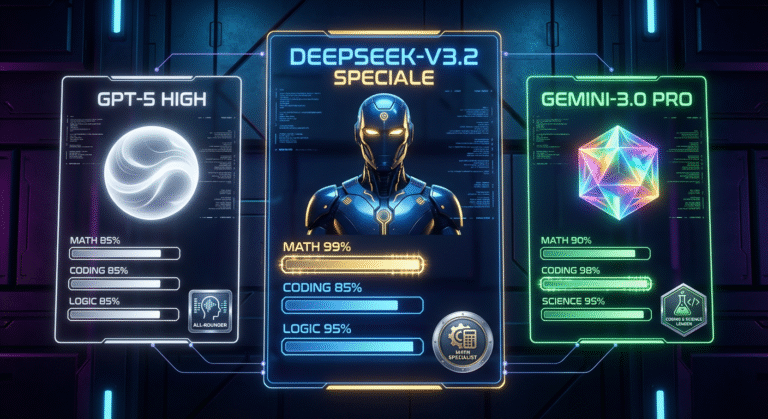
DeepSeek has completely upended the market economics. The V3.2 Speciale is a high-compute variant optimized for “agentic performance,” yet it is priced ~23x cheaper for output tokens than GPT-5.
- Performance: It beats GPT-5 on difficult reasoning workloads (AIME Math score of 96.0) and rivals Gemini 3.0 Pro.
- Tech Stack: Built on DeepSeek Sparse Attention (DSA) and optimized with Reinforcement Learning (RL), it achieves flagship intelligence without the flagship price tag.
- The “Speciale” Factor: This version is specifically tuned for “gold-medal” reasoning (IMO/IOI level), making it the smartest “cheap” model in history.
✅ When to Use DeepSeek V3.2 Speciale:
- Academic & Math Apps: When you need the highest accuracy in calculation or symbolic logic.
- Budget-Constrained Startups: You get GPT-5 level intelligence for pennies.
- Chain-of-Thought Workflows: Because it is so cheap, you can afford to let the model “think” and generate long explanations without burning your budget.
2. Google Gemini 3.0 Pro: The “Ferrari” of AI
Price: $2.00 / $12.00 per 1M tokens
Context: 1.05M (1M+)
Gemini 3.0 Pro is Google’s frontier flagship. It is the most expensive model on this list (by far), but it offers capabilities the others cannot touch—specifically in Context and Coding.
- Performance: The undisputed king of Coding (Elo 2708 on CodeForces) and Science (GPQA Diamond 91.9).
- Multimodal Native: It excels at understanding video, audio, and images alongside text.
- Context Window: With over 1 Million tokens of context, it can hold entire codebases or novels in memory.
✅ When to Use Gemini 3.0 Pro:
- Heavy Software Engineering: If you are building a coding assistant (like Cursor or Github Copilot alternatives), this is the highest-performing backend.
- Large Context Tasks: Analyzing a 500-page legal PDF or a 1-hour video file in a single prompt.
- Complex Science: For biological research or physics simulations where “hallucination” is unacceptable.
3. OpenAI GPT-5 Ecosystem: The Safe Enterprise Standard
Price (GPT-5): $1.25 / $10.00 per 1M tokens
Price (Nano): $0.05 / $0.40 per 1M tokens
Context: 400k
OpenAI has diversified. Instead of one model, they now offer a tiered system. GPT-5 is the powerhouse, while GPT-5 Nano and gpt-oss-120b target efficiency.
- GPT-5: Focuses on “User Intent” and safety. It reduces sycophancy (agreeing with the user even when they are wrong) and has strong instruction-following capabilities.
- GPT-5 Nano: The successor to 4.1-nano. At $0.05 input, it is designed for “dumb pipe” tasks where speed matters more than deep thought.
- gpt-oss-120b: An open-weight MoE model hosted by OpenAI. This is the cheapest route for production-grade simple reasoning.
✅ When to Use OpenAI Models:
- Use GPT-5 for corporate environments where safety guardrails and instruction compliance are priority #1.
- Use GPT-5 Nano for real-time chatbots, auto-complete features, or summarizing simple emails.
- Use gpt-oss-120b if you have massive volume (millions of requests) and need to keep costs near zero.
4. Kimi K2 Thinking: The Long-Horizon Agent
Price: $0.45 / $2.35 per 1M tokens
Context: 262k
Kimi K2, by MoonshotAI, is a niche but powerful player. It specializes in “Thinking”—the ability to maintain a train of thought over hundreds of turns without losing focus.
- Agentic Focus: It is optimized to use tools (browsing, coding) autonomously.
- Persistence: Where other models “drift” after 20 turns, Kimi K2 stays on track for 200-300 tool calls.
✅ When to Use Kimi K2:
- Autonomous Research Agents: If you want an AI to “Go research this topic for 3 hours and write a report,” Kimi K2 is architected to handle that sustained focus.
🏆 Final Verdict: Which Model Should You Choose?
Scenario A: “I need the smartest AI for Math/Logic, but I have a budget.”
👉 Winner: DeepSeek-V3.2 Speciale.
It beats GPT-5 in benchmarks and costs 95% less. It is the best value proposition in the industry right now.
Scenario B: “I am building a Coding Tool or analyzing massive files.”
👉 Winner: Gemini 3.0 Pro.
You pay a premium ($12/output), but its 1M context window and superior coding scores (CodeForces) make it the only viable choice for heavy engineering tasks.
Scenario C: “I need a fast, cheap chatbot for my website.”
👉 Winner: GPT-5 Nano or gpt-oss-120b.
Do not waste money on Pro models for simple customer service. These models are lightning-fast and cost almost nothing.
Scenario D: “I need an agent that can work autonomously for long periods.”
👉 Winner: Kimi K2 Thinking.
For tasks that require multi-step planning and web browsing over long durations, Kimi’s architecture is superior.