
Meta Muse Personal AI Agent Explained: How Zuckerberg and Moxie Marlinspike Built the 24/7 Autonomous Cloud System

Meta has officially entered the autonomous agent arena with the release of Muse, a persistent, cloud-native personal AI agent designed to execute multi-step workflows, manage digital errands, conduct research, and interact with commercial services around the clock.
Unlike standard conversational chatbots that sit idle awaiting a prompt, Muse operates within a dedicated Confidential Virtual Machine (VM) running continuously in Meta’s cloud data centers. Backed by 100 million free tokens per week, deep integration with Shopify and Stripe, and a hardware-level cryptographic privacy architecture co-designed with Signal creator Moxie Marlinspike, Muse represents a calculated shift from prompt-and-response interfaces toward background agentic delegation.
⚡ Executive Key Takeaways
- The Shift from Chat to Autonomous Execution: Muse is not a chatbot text box. It is an autonomous digital worker running inside a dedicated cloud virtual machine (VM) that executes background projects over hours and days without requiring constant supervision.
- The Moxie Marlinspike Privacy Moat: Meta recruited Moxie Marlinspike (creator of Signal and architect of WhatsApp end-to-end encryption) to co-design a cryptographic Confidential VM architecture using Trusted Execution Environments (TEEs), ensuring that even Meta’s own engineers and servers cannot access user data, browsing sessions, or credentials.
- Aggressive Economic Disruption: Meta is offering 100 million tokens per week for free alongside a free virtual machine. The service monetizes via merchant micro-cuts on transactions (partnering with Stripe and Shopify) rather than charging the $20 to $200 monthly subscription paywalls common across competing AI platforms.
- The 5-Tab Dedicated Operating Surface: The standalone Muse application replaces blank prompt windows with a structured workflow layout: Chat (active commands and live status), Feed (hyper-personalized custom news written by Muse), Ideas (proactive workflow suggestions), Goals (persistent background milestones), and Library (generated artifacts, PDFs, and interactive web tools).
- The Frontier Model Lineage: Muse currently runs on Muse Spark 1.3 (internally code-named Avocado), with a massive 10× compute successor code-named Watermelon currently training on Meta’s gigawatt-scale Prometheus computing cluster in Ohio.
Official Video Companion: Watch on YouTube Shorts (@Softreviewed)
🔍 In Simple Terms: What Is Meta Muse and Why Does It Matter?
What It Does
Meta Muse is a personal digital assistant that controls its own cloud-hosted computer to accomplish real tasks on your behalf—such as researching products, booking flights, managing complex calendars, and running small business workflows.
Why It Matters
Until now, running an autonomous AI agent required either technical expertise (downloading open-source code like OpenClaw onto an expensive Mac Studio) or paying $20 to $200 per month for proprietary cloud wrappers with questionable data privacy. Meta has packaged autonomous agent computing into a free, one-tap mobile and web application with enterprise-grade cryptographic privacy.
How It Works
User Assigns High-Level Goal (Chat / Voice / WhatsApp)
                     ↓
[Sentinel Watchdogs] ──► Inbound Inspection (Blocks prompt injections & jailbreaks)
                     ↓
[Confidential Cloud VM] ──► Runs 24/7 in a Hardware-Isolated Trusted Execution Environment
                     ↓
[Execution Engine] ──► Interacts with APIs, Browsers, Shopify, & Stripe using 1Password Vault
                     ↓
[Overnight Reflection] ──► Consolidates daily experiences into persistent memory while user sleeps
                     ↓
[Proactive Output] ──► Delivers finished artifacts (PDFs, dashboards, purchased orders) to Library
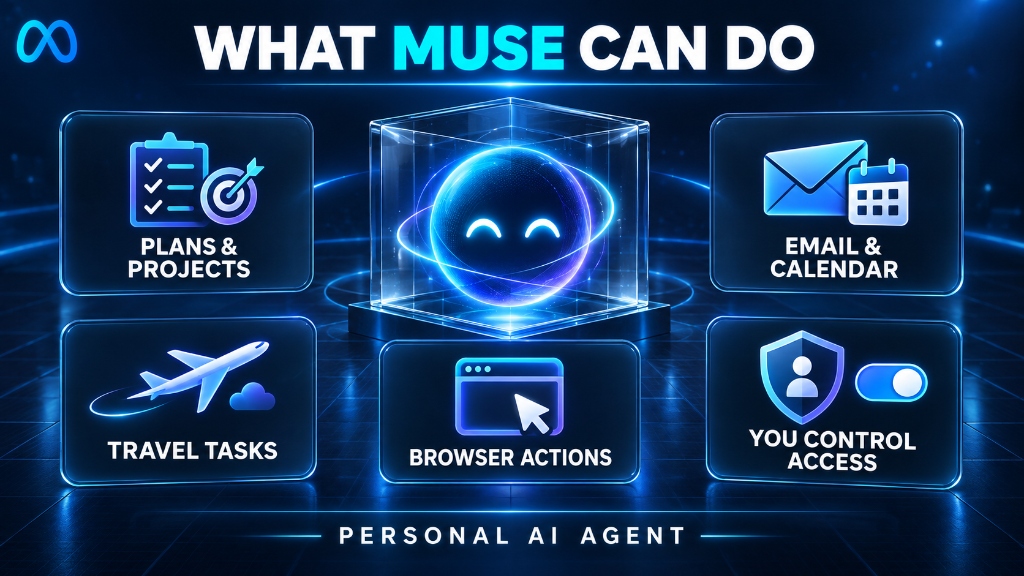
Figure 2: What Muse Can Do — Meta Muse Personal AI Agent capability map spanning Plans & Projects, Email & Calendar, Travel Tasks, Browser Actions, and Granular User Access Controls.
📱 Inside the Muse Application: The 5 Core Operating Tabs
During the official product walkthrough, Meta demonstrated that the Muse user interface intentionally abandons the intimidating “blank prompt” paradigm of legacy chatbots. Instead, it organizes autonomous workflows across five purpose-built operational hubs:
┌───────────────────────────────────────────────────────────────────────────────────┐
│                           THE 5 TABS OF META MUSE                                 │
├───────────────┬───────────────────────────────────────────────────────────────────┤
│ 1. 💬 CHAT    │ Real-time messaging with live top status: "Doing → Done → Next"   │
├───────────────┼───────────────────────────────────────────────────────────────────┤
│ 2. 📰 FEED    │ Algorithmically generated news & briefings written for your eyes  │
├───────────────┼───────────────────────────────────────────────────────────────────┤
│ 3. 💡 IDEAS   │ Proactive suggestions derived from conversations and fleet trends │
├───────────────┼───────────────────────────────────────────────────────────────────┤
│ 4. 🎯 GOALS   │ Asynchronous milestone tracker monitoring background execution    │
├───────────────┼───────────────────────────────────────────────────────────────────┤
│ 5. 📚 LIBRARY │ Permanent repository for documents, PDFs, and interactive tools   │
└───────────────┴───────────────────────────────────────────────────────────────────┘
1. The Chat Tab (Active Operational Console)
The Chat tab functions like an instant messaging conversation with a human assistant. At the top of the screen sits a real-time Status Display. Tapping this display reveals a transparent operational ledger:
* What the agent is currently doing (e.g., "Navigating airline checkout").
* What it has already completed (e.g., "Found 3 flights under $450").
* What it plans to do next (e.g., "Awaiting payment confirmation").
Crucially, any action involving financial payments, sensitive credentials, or outbound communications prompts a Human-in-the-Loop review card directly inside this conversation thread.
2. The Feed Tab (Custom Autonomous Publishing)
Rather than presenting a generic social media feed, the Feed tab contains articles, industry news, and briefings written exclusively for the user by their Muse agent. A morning briefing might summarize overnight stock market movements in enterprise SaaS, while an evening feed compiles nonfiction literature recommendations tailored to recent conversations.
3. The Ideas Tab (Proactive Workflow Discovery)
One of the primary friction points in artificial intelligence is that non-technical users struggle to formulate productive prompts. The Ideas Tab solves this by analyzing past chat context, calendar events, and fleet-wide capabilities to proactively propose projects, such as:
* “Would you like me to monitor permit applications for your upcoming mountain hiking trip?”
* “Should I build an automated recovery regimen for your back pain rehabilitation?”
* “Would you like me to sync with your family calendar to coordinate kindergarten pickups?”
4. The Goals Tab (Multi-Day Asynchronous Engine)
The Goals tab serves as the project management hub. When a user assigns a complex assignment—such as organizing a family vacation or auditing competitive ad creative on Instagram—the goal is logged with an active timeline. Users can inspect progress, view completed sub-tasks, and adjust project parameters as the agent works continuously in the background.
5. The Library Tab (Rich Interactive Artifacts)
All outputs created by Muse are automatically preserved in the Library. This includes static files (such as Markdown summaries, research reports, and formatted PDFs) as well as interactive software artifacts—including custom chess performance dashboards, financial calculators, and single-purpose web apps that can be cast directly to external screens or smartphones.
🔒 The Moxie Marlinspike Architecture: How Confidential VMs Solve the Agent Privacy Trap

The most formidable barrier preventing consumers and businesses from deploying autonomous AI agents is security. Handing an AI model administrative control over web browsers, emails, credit cards, and sensitive enterprise files introduces catastrophic risks of prompt injection, data exfiltration, and unauthorized spending.
To solve this, Meta CEO Mark Zuckerberg and AI leadership personally recruited Moxie Marlinspike—the cryptographer behind Signal and WhatsApp’s end-to-end encryption—to architect Muse’s security foundation.
┌───────────────────────────────────────────────────────────────────────────────────────┐
│                      META MUSE HARDWARE-ISOLATED TRUST LAYER                          │
├───────────────────────────────────────────────────────────────────────────────────────┤
│                                                                                       │
│  [User Device]  <═════ End-to-End Encrypted Hardware Keys (Meta Cannot Access) ═════>  │
│                                                                                       │
│  ┌─────────────────────────────────────────────────────────────────────────────────┐  │
│  │                    CONFIDENTIAL CLOUD VIRTUAL MACHINE (TEE)                     │  │
│  │                                                                                 │  │
│  │  • Dedicated Virtual Environment (Linux Kernel + Headless Browser)              │  │
│  │  • Encrypted Memory: CPU-level cryptographic memory encryption (AMD SEV-SNP)   │  │
│  │  • Ephemeral Session Sandboxes: Isolated task execution                         │  │
│  │                                                                                 │  │
│  │  ┌─────────────────────────┐           ┌─────────────────────────────────────┐  │  │
│  │  │   INBOUND SENTINEL      │           │          OUTBOUND SENTINEL          │  │  │
│  │  │ Scans incoming web data │           │ Intercepts leaks, credentials,      │  │  │
│  │  │ for prompt injections   │           │ and triggers Human-in-the-Loop gate │  │  │
│  │  └─────────────────────────┘           └─────────────────────────────────────┘  │  │
│  │                                                                                 │  │
│  │  ┌───────────────────────────────────────────────────────────────────────────┐  │  │
│  │  │              1PASSWORD-BACKED SECURE CREDENTIAL VAULT                     │  │  │
│  │  │ Agent executes logins without exposing raw plaintext passwords to LLM    │  │  │
│  │  └───────────────────────────────────────────────────────────────────────────┘  │  │
│  └─────────────────────────────────────────────────────────────────────────────────┘  │
└───────────────────────────────────────────────────────────────────────────────────────┘
1. Cryptographic Trusted Execution Environments (TEEs)
Muse does not run on shared multi-tenant software containers. Every user is allocated a Confidential Virtual Machine running inside a hardware-isolated Trusted Execution Environment (TEE).
* Zero Host Visibility: Even systems engineers, administrators, or hypervisor processes inside Meta’s data centers cannot inspect or dump the contents of the virtual machine’s RAM.
* Locally Held Keys: Cryptographic decryption keys originate from the user’s client device, creating an end-to-end security boundary analogous to WhatsApp’s messaging protocol.
* Public Verification: Meta has committed to publishing reproducible binary builds and opening the architecture to independent third-party security audits.
2. Dual-Watchdog Sentinel Agents
Muse incorporates dedicated secondary AI models termed Sentinel Agents that continuously inspect data crossing the VM boundary:
* Inbound Sentinel: Analyzes external web pages, emails, and third-party documents before they reach the main agent, stripping away hidden malicious prompt injections (e.g., hidden instructions attempting to force password exports).
* Outbound Sentinel: Intercepts outgoing data packets. If the agent attempts to transmit sensitive financial details, address information, or personal medical context, the Sentinel halts execution and issues a mandatory human authorization challenge.
3. Integrated 1Password Vault & Least Privilege
To prevent the underlying language model from directly ingesting sensitive authentication strings, Meta partnered with 1Password. Muse accesses approved web portals using tokenized credentials stored inside an isolated vault. Furthermore, all external connectors operate under the Principle of Least Privilege: connecting your email account grants read-only permission by default; granting draft or send permissions requires explicit, step-by-step confirmation.
🛍️ The E-Commerce Revolution: Native Shopify and Stripe Integration
During early testing, e-commerce merchants began receiving automated communications from Shopify indicating that their product catalogs were being indexed directly into Meta’s Muse ecosystem.
This integration transforms Muse from an informational search assistant into an active procurement agent:
User: "Order an all-terrain stroller under $400 with 4+ star reviews"
                          ↓
[Muse Autonomous Engine] Searches Shopify Merchant Network & Verified Stores
                          ↓
[Filter & Compare] Validates specs, return policies, shipping times, and pricing
                          ↓
[Purchase Card Generated] Presents single-click approval card in Chat Tab
                          ↓
[User Approves] ──► 1Password Vault injects tokenized card ──► Stripe processes order
Because Meta monetizes through transaction facilitation rather than gating software behind monthly subscription fees, independent Shopify store owners gain immediate distribution across millions of active Muse agents without requiring custom advertising setup.
🍉 Frontier Compute: Avocado, Muse Spark 1.3, and the Upcoming Watermelon Model
The cognitive engine powering Muse is undergoing rapid iterative development under Meta’s Superintelligence Labs.
[Avocado Pre-Train] ──► Foundation research run establishing agent reasoning baselines
         ↓
[Muse Spark 1.3]    ──► Current production model (Optimized for coding, tools & discretion)
         ↓
[Watermelon]        ──► Frontier model (10× compute, trained on Ohio Prometheus gigawatt cluster)
         ↓
[Muse Glimmer 30B]  ──► Open-weight edge model optimized for always-on local device workflows
1. Muse Spark 1.3
The currently deployed production model, Muse Spark 1.3, is the refined iteration of the internal pre-training run code-named Avocado. Spark 1.3 is tailored specifically for:
* Long-Horizon Tool Execution: Writing and executing Python code inside headless environments to solve complex analytical problems.
* Contextual Discretion: Trained from the ground up to recognize sensitive personal information (such as health conditions or financial constraints) and achieve user objectives without unnecessarily disclosing private details to external third parties.
2. The 10× Compute Frontier: Watermelon
During his conversation on the Sources podcast, Mark Zuckerberg confirmed that Meta’s next-generation model—internally code-named Watermelon—is nearing completion.
* Scale & Compute: Watermelon was trained using approximately 10 times the compute budget of Muse Spark.
* Hardware Backbone: Powered by Meta’s Prometheus multi-gigawatt computing cluster in Ohio, Watermelon is engineered to compete directly with frontier models such as Claude 3.7 Sonnet and OpenAI’s GPT-5 series across autonomous coding, reasoning, and multi-agent collaboration benchmarks.
3. Muse Glimmer 30B (Open-Weights Strategy)
To reinforce Zuckerberg’s philosophical commitment outlined in “The Future is for Everyone,” Meta developed Muse Glimmer, a 30-billion parameter open-weight model optimized for always-on local agent workflows. This allows developers, privacy advocates, and institutions to run autonomous agent loops locally without routing data through centralized cloud infrastructure.
📊 Competitive Showdown: Meta Muse vs DIY OpenClaw vs Proprietary Agents
To understand how Meta Muse reshapes the artificial intelligence software market, examine how its cloud-native architecture compares against both DIY open-source implementations and proprietary commercial offerings:
| Architectural Metric | Meta Muse Personal Agent | DIY Local Agents (OpenClaw / Hermes) | Proprietary Commercial Agents |
|---|---|---|---|
| Hosting Infrastructure | Cloud-native Confidential VM (TEE) | Local hardware (Mac Mini / Mac Studio) | Standard cloud containers (AWS / GCP) |
| Setup Complexity | Zero (One-tap mobile & web access) | High (Requires Git, terminal, Python, ports) | Low (Standard web interface) |
| Hardware Investment | $0.00 (Zero local hardware requirements) | $600 to $2,500+ (Apple Silicon hardware) | $0.00 (Cloud-hosted) |
| Pricing & Quota | 100 Million Free Tokens/Week | Zero subscription, but user pays raw API bills | $20 to $200 per month paywalls |
| Data Privacy Guarantee | Hardware-level memory encryption (TEE) | 100% Local (Safe from clouds, exposed to malware) | Server-side logs accessible by vendor |
| Credential Management | 1Password Tokenized Vault | Plaintext local configuration files | Vendor-managed browser cookies |
| Execution Horizon | 24/7 Asynchronous Background Loops | Runs only while local machine is awake | Typically times out after 10–15 minutes |
| E-Commerce Capabilities | Native Shopify & Stripe checkout | Custom browser scrapers (fragile) | External browser extension plugins |
| Fleet Learning | Anonymized Cross-Fleet Intelligence | Isolated to single user machine | Proprietary reinforcement learning |
💰 The Economic Playbook: Why 100 Million Free Tokens/Week Destroys SaaS Moats
The most aggressive element of Meta’s market entry is its pricing structure. While competitors charge $20 to $100 per month for limited agent interaction quotas, Meta provides 100 million tokens per week entirely free of charge.
The Real-World Value of 100 Million Tokens
In practical operational terms, 100 million tokens per week equates to:
* Processing roughly 75 million words of text every seven days.
* Conducting thousands of comprehensive web searches, multi-page document syntheses, and continuous background monitoring checks.
* Maintaining persistent 24/7 virtual machine uptime without incurring compute charges.
Why Is Meta Giving Away Massive Compute?
Meta’s monetization thesis fundamentally differs from venture-backed AI startups:
1. Transaction Velocity: By integrating with Stripe and merchant networks like Shopify, Meta captures micro-fees on commercial transactions executed by the agent, shifting monetization from software subscriptions to economic commerce.
2. Advertising Synergy: For small business owners, Muse connects directly into Meta’s advertising platform (Facebook and Instagram), automatically generating creative assets, optimizing audience targeting, and analyzing conversion metrics.
3. Ecosystem Lock-In: Distributing high-capability agent infrastructure for free eliminates the financial incentive for consumers to maintain secondary $20/month chatbot subscriptions.
⚖️ Practical Decision Guide: When to Use Meta Muse Over Other Agents
┌───────────────────────────────────────────────────────────────────────────────────┐
│                           AGENT SELECTION MATRIX                                  │
├───────────────────────────────────────────────────────────────────────────────────┤
│                                                                                   │
│  USE META MUSE WHEN:                                                              │
│  ✔ You need a 24/7 digital assistant that runs while your devices are powered off │
│  ✔ You want automated product purchasing via verified Shopify & Stripe merchants │
│  ✔ You want zero setup overhead without managing GitHub repos or local Python     │
│  ✔ You require cryptographically audited privacy where the cloud provider is blind│
│  ✔ You want access to 100M free weekly tokens for heavy document synthesis        │
│                                                                                   │
│  CHOOSE LOCAL DIY AGENTS (OPENCLAW / MAC STUDIO) WHEN:                            │
│  ✔ Your compliance policies strictly forbid any external cloud execution          │
│  ✔ You need physical access to local hard drives and offline network shares       │
│  ✔ You want 100% uncensored local models with custom system fine-tunes            │
│                                                                                   │
│  CHOOSE SPECIALIZED ENTERPRISE AGENTS (CLAUDE CODE / GITHUB COPILOT) WHEN:        │
│  ✔ You are performing deep monorepo refactoring across private corporate codebases│
│  ✔ Your primary requirement is deterministic unit test generation and CI/CD piping│
│                                                                                   │
└───────────────────────────────────────────────────────────────────────────────────┘
❓ Frequently Asked Questions (FAQ)
What is Meta Muse?
Meta Muse is an autonomous personal AI agent that operates inside an encrypted cloud virtual machine to execute digital tasks, conduct research, book travel, and manage projects 24/7 on your behalf.
Is Meta Muse free to use?
Yes, Meta provides 100 million tokens per week alongside cloud virtual machine access for free, monetizing via merchant transaction micro-fees and optional high-tier compute subscriptions.
How do I access and use Meta Muse?
Meta Muse is accessible across iOS, Android, web browsers via muse.ai, and through direct messaging interfaces within WhatsApp.
Can Meta see my personal data inside Muse?
No, Muse executes inside hardware-level Confidential Virtual Machines (TEEs) co-designed with Moxie Marlinspike, using cryptographic memory encryption that prevents Meta engineers from viewing your data.
How does Muse differ from Meta AI?
Meta AI is a standard prompt-and-response conversational chatbot, whereas Muse is a persistent autonomous worker that maintains an ongoing virtual computer to complete long-term projects in the background.
Is Meta Muse open source?
The primary cloud service is managed by Meta, but Meta is releasing Muse Glimmer (a 30B parameter model) as open weights to enable local on-device agent execution.
How does Muse handle payments and logins safely?
Muse utilizes an integrated 1Password vault to authenticate into external platforms and requires explicit human approval via the Chat tab before finalizing any financial transaction.
What model powers Meta Muse?
Muse currently runs on Muse Spark 1.3, with its 10× compute frontier successor—code-named Watermelon—slated for release following training on Meta’s Ohio Prometheus cluster.
🎯 The Bottom Line
Meta’s introduction of Muse marks the transition of artificial intelligence from conversational novelties to autonomous utility. By fusing Moxie Marlinspike’s hardware-isolated privacy, 100 million free tokens per week, and native Shopify merchant integration, Meta has dismantled the technical and financial barriers that previously kept agentic computing locked inside developer subcultures.
Whether evaluated as an administrative assistant, an e-commerce procurement engine, or an automated research analyst, Muse demonstrates that the future of personal computing is not a blank chat box—it is an autonomous agent operating quietly, securely, and continuously on your behalf.