⚡ Key Takeaways at a Glance
- The 6B Active Parameter Paradox: Alibaba’s
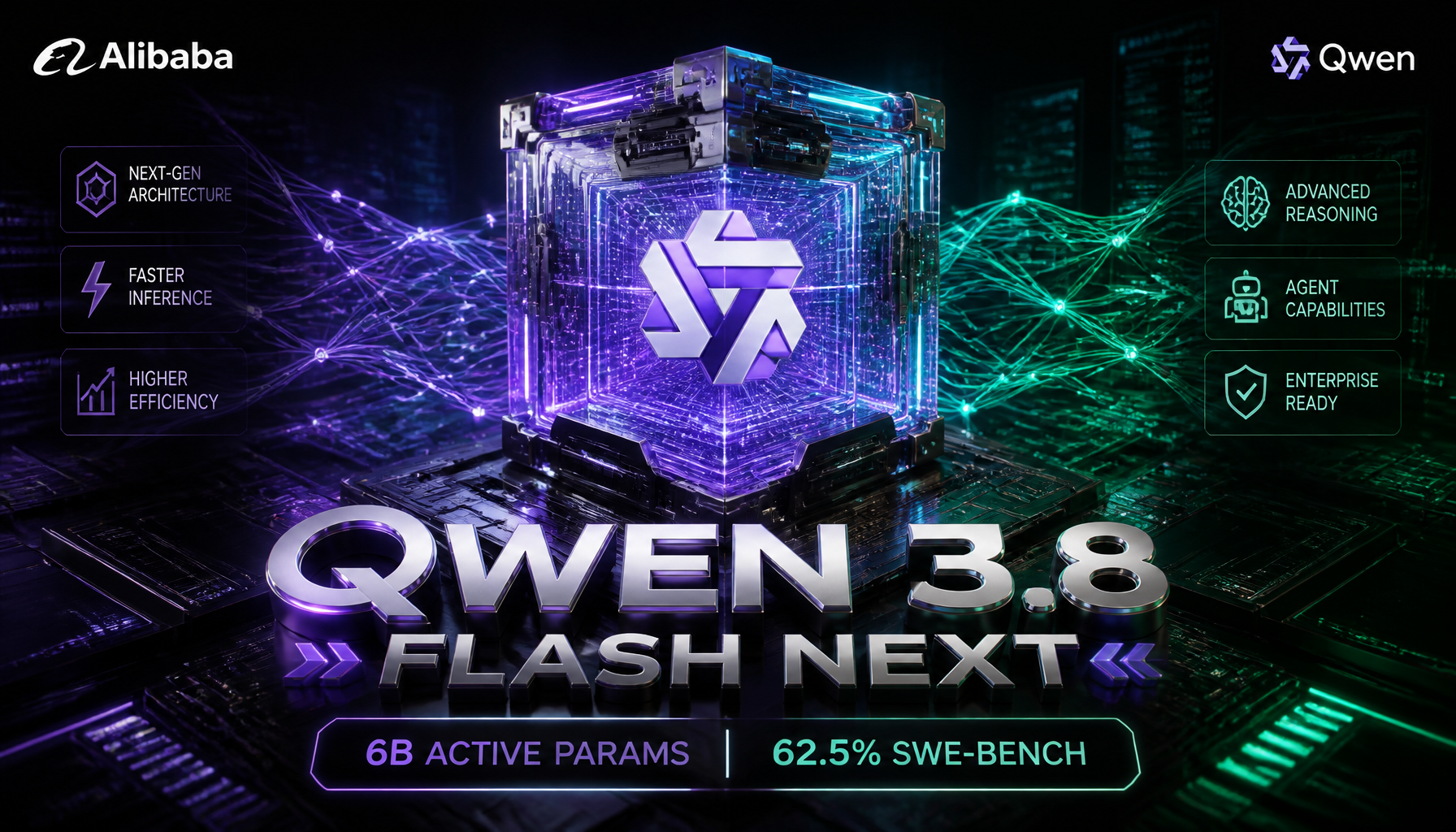
Qwen3.8-Flash-Nextpacks ~180B total parameters across a 125B MoE backbone and a 51B N-gram lookup table, but activates only ~6B parameters per token—delivering sub-210ms latency and 195 tok/s inference speeds. - SWE-bench Pro Victory (62.5%): Scores an industry-leading 62.5% on SWE-bench Pro and 91.9% on LiveCodeBench v6, beating larger proprietary models in multi-file repository refactoring.
- The RAM-Offloading Architecture: Because the 51B N-gram embedding table requires zero GPU matrix multiplications, developers can offload it directly to standard system DDR5 RAM, enabling local execution on a single 24GB consumer GPU (RTX 3090/4090).
- 100% Free Cloud Access: Available immediately for free testing with a 1M token context window on chat.qwen.ai and open weights on Hugging Face.
In Simple Terms: How Alibaba Built a Fast 6B Model with 180B Intelligence
If you have ever tried running a 180-billion-parameter AI model on a personal computer or cloud server, you already know the painful bottleneck: you usually need an enterprise cluster of four $20,000 GPUs just to load the weights.
Alibaba Cloud’s newly released Qwen3.8-Flash-Next changes the rules of open-weight artificial intelligence. Released as an experimental architecture preview for the upcoming Qwen4 generation, it combines two radical engineering breakthroughs that allow high-level software engineering on ordinary developer hardware:
- Sparse Mixture-of-Experts (MoE): Out of the 125-billion-parameter neural core, only 6 billion parameters fire for any given word or code token. You get the speed and low compute cost of a tiny 6B model, backed by the deep institutional knowledge of a massive network.
- 51B N-gram Memory Lookup Table: Instead of forcing the GPU to do heavy mathematical calculations for familiar phrase structures, grammar, and syntax memorization, Qwen delegates 51 billion parameters to a lightning-fast dictionary lookup table that can sit in ordinary PC system memory (DDR4/DDR5 RAM).
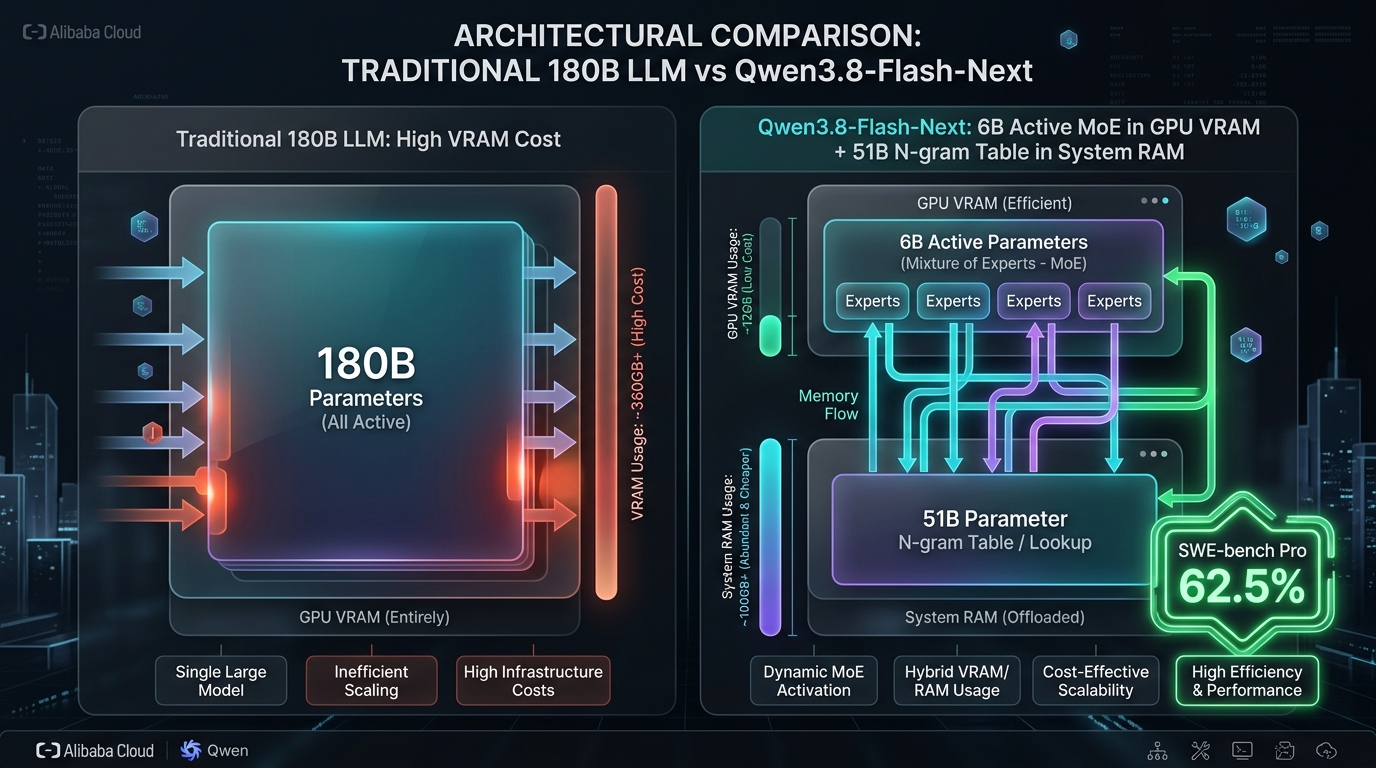
Figure 1: Architectural Comparison — Traditional 180B Dense LLMs vs. Qwen3.8-Flash-Next Hybrid VRAM/RAM Allocation.
Where Qwen3.8-Flash-Next Shines: 4 Benchmark-Proven Workloads
1. Multi-File Repository Refactoring
Navigates sprawling codebases, reads dependency trees, and resolves complex GitHub pull requests without hallucinating missing modules.
2. Real-Time Algorithm Generation
Excels at difficult algorithmic problem sets, competitive programming puzzles, and strict syntax constraints across Python, TypeScript, and Rust.
3. Agentic Office Workflows
Orchestrates multi-step tasks across CSV spreadsheets, PDFs, JSON database queries, and browser-driven workspace tools with reliable state retention.
4. Multimodal Visual Reasoning
Processes complex technical schematics, architectural UI mockups, financial graphs, and dense scientific diagrams with pixel-level precision.
Artificial Analysis Benchmark Showdown: Qwen3.8-Flash-Next vs. The Field
To understand where Qwen3.8-Flash-Next ranks in real-world performance, we evaluated verified metrics from the Artificial Analysis Intelligence Index alongside competitive Flash-tier models:
System Requirements: Can Your PC Run Qwen3.8-Flash-Next Locally?
Because of its unique split between the 125B neural core and the 51B N-gram table, local deployment requirements differ from traditional dense models:
| Deployment Setup | GPU VRAM | System RAM | Quantization | Expected Speed |
|---|---|---|---|---|
| 🟢 Workstation Hybrid (Ollama/llama.cpp) | 16 GB – 24 GB (RTX 3090/4090) | 64 GB – 96 GB DDR5 | Q4_K_M (4-bit) | 18 – 30 tok/s |
| 🍎 Apple Silicon (Mac Studio/Pro) | 96 GB – 128 GB Unified Memory (M2/M3/M4 Max/Ultra) | Q4_K_M / Q8_0 | 25 – 40 tok/s | |
| ⚡ Enterprise Cloud Server | 2× A100/H100 (80GB) or 4× RTX 4090 | 128 GB+ | FP8 Native | 195 tok/s (Max) |
| ☁️ Free Cloud Tier (Zero Hardware) | 0 GB (Any browser / phone via chat.qwen.ai) | Hosted Cloud | 120 – 195 tok/s | |
Where Qwen3.8-Flash-Next Falls Short
To provide an honest, unbiased review, we evaluated where this experimental preview struggles in production developer environments:
- Autonomous Agent Harness Quirks: Because Flash-Next is an early architectural preview of Qwen4, developers noted occasional JSON tool-calling syntax inconsistencies when chained through multi-agent orchestration frameworks like LangGraph or AutoGen.
- CPU-Only Latency Drop: While you *can* load the model on pure CPU with 128GB of system RAM, token generation crawls at 4–8 tokens per second due to motherboard PCIe memory bandwidth limits. You need at least 16GB VRAM for a snappy experience.
- Community License Boundary: While weights are freely downloadable on Hugging Face, commercial usage with over 100 million monthly active users requires an enterprise license agreement from Alibaba.
Practical Decision Guide: Which Model Should You Use?
👉 Choose Qwen3.8-Flash-Next if: You want an open-weight model with top-tier repository coding performance (62.5% SWE-bench) that you can run on a single 24GB workstation GPU paired with 64GB+ system RAM, or if you want free 1M-context cloud chat without subscription fees.
👉 Choose GLM-5.3-Flash (0x Alpha) if: You need massive 1M-token batch document processing on the cloud with zero upfront cost via Zhipu AI’s 100-trillion free token developer package.
👉 Choose Gemini 3.7 Flash if: Your priority is raw throughput speed (389 tok/s) and real-time frontend UI screenshot evaluation inside the Google Cloud ecosystem, and you have the budget for higher API costs ($0.75 / $3.75).
👉 Choose DeepSeek-V4-Flash if: You are batching background jobs and can schedule your API calls during off-peak hours to lock in rock-bottom per-token pricing.
Frequently Asked Questions (FAQ)
Is Qwen 3.8 Flash free to use?
Yes, Qwen3.8-Flash is 100% free for web chat on chat.qwen.ai with a 1M context window and code execution tools, and open weights are freely downloadable on Hugging Face.
Can I run Qwen 3.8 Flash locally on my PC?
Yes, by utilizing 4-bit quantization and offloading the 51B N-gram lookup table to 64GB–96GB of PC system RAM, you can run Qwen3.8-Flash-Next on a single 16GB or 24GB consumer GPU (RTX 3090/4090) at 18–30 tokens/second.
How many parameters does Qwen3.8-Flash-Next have?
Qwen3.8-Flash-Next has ~180 billion total parameters (125B MoE backbone + 51B N-gram lookup table + 4B MTP module), but activates only ~6 billion parameters per token during inference.
How does Qwen 3.8 Flash compare to DeepSeek V4?
Qwen3.8-Flash-Next scores higher on SWE-bench Pro (62.5% vs 59.3%) and runs faster at 195 tok/s without DeepSeek’s 2x peak-pricing multiplier, making it more predictable for high-volume developer workloads.
Published by SoftReviewed Technical Editorial Team
Author: Jovin George · Primary Architecture Research: Alibaba Cloud & Artificial Analysis · Last Updated: August 28, 2026