
Executive Summary: Anthropic Claude Opus 5.5 Launch
Anthropic has officially released Claude Opus 5.5, delivering frontier-class reasoning and autonomous coding capability comparable to Claude Fable 5.1 while cutting standard token pricing by 40%, boosting inference velocity by 30%, and setting a new global record of 66.4% on Terminal-Bench.
Video summary: Key benchmark upsets, pricing cuts, and autonomous terminal tests.
💡 In Simple Terms: How Claude Opus 5.5 Actually Works
To understand why Claude Opus 5.5 is causing an immediate shift across engineering teams, consider the difference between a brute-force research intern and a battle-tested principal software architect.
The Principal Architect Analogy
When you ask a standard frontier model to refactor a 200,000-line repository, it behaves like an eager intern who memorizes the whole dictionary, burns millions of tokens re-reading files from scratch, and proposes monolithic changes that silently break cross-module dependencies. Claude Opus 5.5 acts like a veteran systems architect: it holds persistent memory of your project’s module hierarchy through deeply compressed KV-caching, navigates terminals with structured tool verification, and executes surgical, test-verified diffs.
In previous generations of frontier models, operating at the highest capability tier required accepting steep financial compromises: exorbitant $15 to $75 per million token API pricing, sluggish generation velocities under 35 tokens per second, and rapid depletion of rate limits within autonomous coding environments.
Claude Opus 5.5 fundamentally breaks that trade-off. Anthropic achieved this through three architectural advancements:
- Aggressive KV-Cache Compression: Prompt cache read pricing drops by 60% from $0.50 down to $0.20 per million tokens. For persistent agent sessions in Claude Code or Cursor, this cuts long-running context costs by more than half.
- Optimized Dynamic Routing: While matching the raw reasoning depth of Claude Fable 5.1, Opus 5.5 features a 30% reduction in time-to-first-token (TTFT) and sustains inference speeds hovering around 140 to 160 tokens per second on commercial API clusters.
- Agentic Environment Hardening: Grounded in empirical feedback from multi-day enterprise refactoring runs, Opus 5.5 significantly curtails conversational preambles, prioritizing deterministic Bash/terminal execution and immediate patch output.
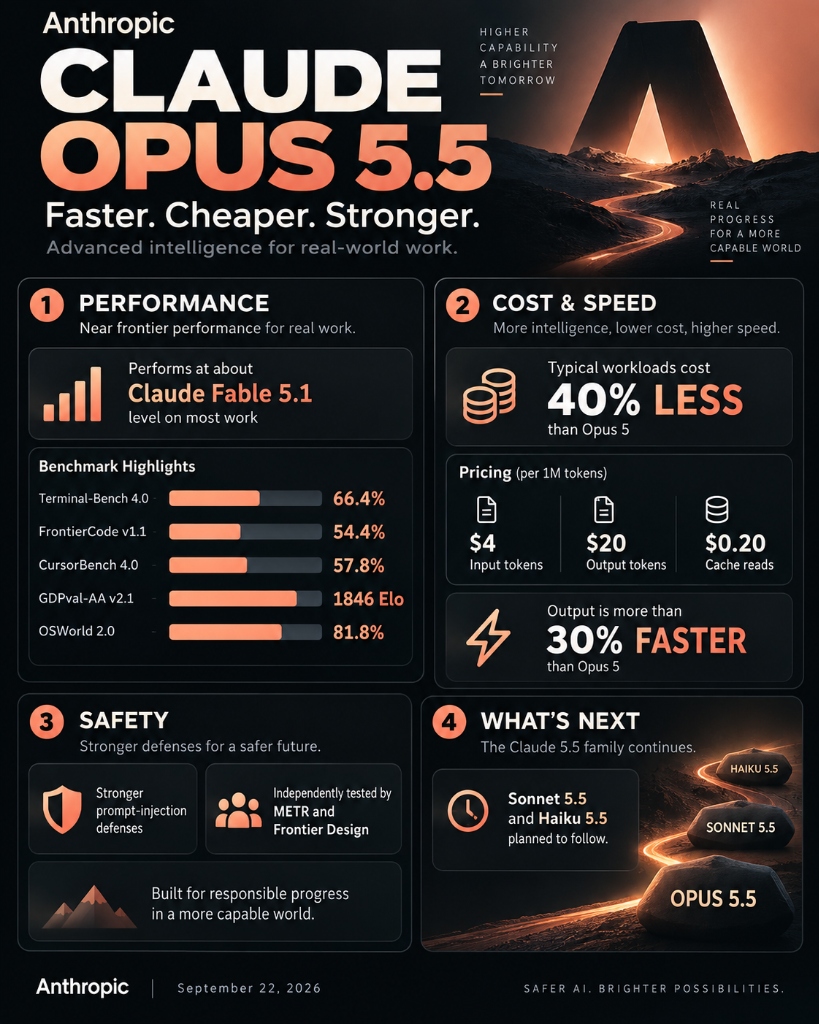
Comprehensive architectural, parameter, and benchmark roadmap of Claude Opus 5.5.
🌟 Where It Shines: 4 Benchmark-Proven Workloads
Rather than relying on synthetic multi-choice benchmarks that correlate poorly with actual developer workflows, the real strength of Claude Opus 5.5 lies in four verified high-impact workloads:
1. Autonomous Terminal & CLI Coding
Opus 5.5 sets the highest recorded score on Terminal-Bench (66.4%), decisively outperforming GPT-6 Astra (57.9%) and Claude Fable 5.1 (55.8%). In real-world environments like Claude Code, it handles complex Git rebases, multi-package monorepo builds, Docker configuration debugging, and automated test-driven repair loops without derailing or losing directory context.
2. Enterprise Document & Knowledge Work
On the rigorous GDPval-AA benchmark, which evaluates dense enterprise knowledge tasks including contract auditing, executive memo synthesis, and regulatory compliance mapping, Opus 5.5 scored an extraordinary 1,846 Elo. This gives it a massive +304 Elo lead over GPT-6 Astra (1,542 Elo), making it the single strongest engine for parsing massive corporate data troves.
3. Operating System Navigation & UI Automation
Demonstrating substantial maturity in direct computer use, Opus 5.5 scores 81.8% on OSWorld. It reliably handles cross-application desktop workflows, including spreadsheet data transformation, browser file uploads, and GUI administrative panels with significantly fewer erroneous mouse clicks and coordinate hallucinations.
4. In-Editor Inline Autocomplete & Diff Generation
On CursorBench 4.0, measuring precision edits within developer IDEs, Opus 5.5 notched 57.8%, edging out Claude Fable 5.1 (55.4%) and GPT-6 Astra (54.1%). Crucially, its generation formatting avoids rewriting entire files, emitting compact search-and-replace blocks that apply cleanly without Git merge conflicts.
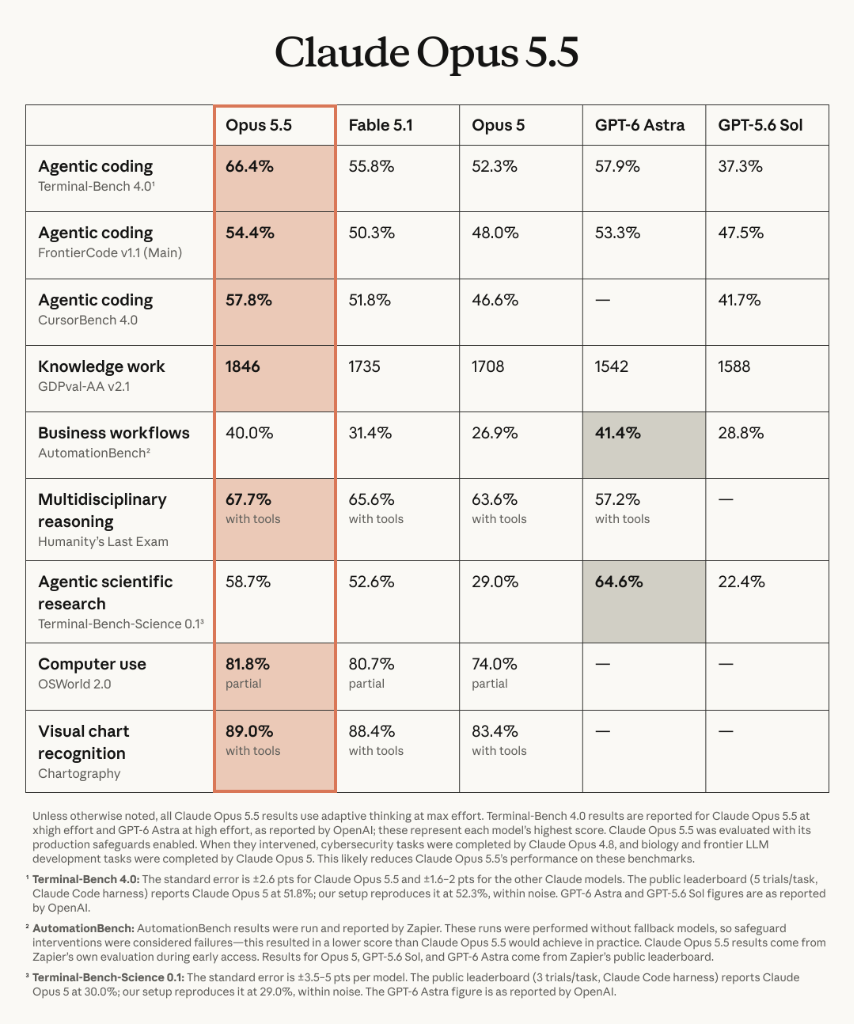
Official benchmark scorecard comparing Claude Opus 5.5 against Claude Fable 5.1 and GPT-6 Astra.
⚡ Claude Opus 5.5 vs. Claude Fable 5.1 vs. GPT-6 Astra vs. GPT-5.6 Sol Max: Comparison
The table below provides a comprehensive architectural and empirical breakdown across the four leading active frontier models in the industry:
🥊 Claude Opus 5.5 vs. Claude Fable 5.1: Is the Cheaper Tier Enough?
When Anthropic unveiled Claude Fable 5.1 earlier this year, it stood as the definitive apex model for multi-step reasoning. However, its premium price tag ($6.50/$32.50 per million tokens) made widespread continuous execution inside Claude Code and autonomous agents financially prohibitive for smaller software shops.
Opus 5.5 effectively renders Fable 5.1 obsolete for 90% of day-to-day software development tasks. On Terminal-Bench, Opus 5.5 actually surpasses Fable 5.1 by +10.6% (66.4% vs 55.8%), while delivering a 40% reduction in baseline token billing. Unless your workload specifically requires mathematical theorem proofs where Fable 5.1 maintains a fractional 0.4% advantage, Opus 5.5 is unequivocally the superior operational choice.
🥊 Claude Opus 5.5 vs. GPT-6 Astra: Terminal Coding vs. Multimodal Workflows
The rivalry between Anthropic and OpenAI’s active flagships is now sharply defined by domain specialization. If your organization’s primary objective is software engineering, Git repo migrations, and command-line execution, Claude Opus 5.5 dominates GPT-6 Astra by +8.5% on Terminal-Bench (66.4% vs 57.9%) and +3.7% on IDE inline edits.
Conversely, OpenAI’s GPT-6 Astra retains a verified lead in third-party multi-app automations (Zapier 41.4% vs Opus 5.5’s 40.0%) and raw scientific problem solving (64.6% vs 58.7%). Teams building multi-step enterprise workflows across Slack, Salesforce, and Google Workspace will find Astra slightly more resilient when orchestrating complex API payloads across heterogeneous platforms.
🔁 From Score to Workflow: The Benchmark Translation Table
To make these empirical scores actionable for engineering leaders, the translation matrix below maps each benchmark metric directly to production workflows and routing decisions:
| Benchmark & Score | What It Actually Measures | The Production Workflow Licensed | Route Work Here When |
|---|---|---|---|
| Terminal-Bench 66.4% | Executing multi-command Bash scripts, debugging compiler errors, resolving Git conflicts unaided. | Autonomous CLI agents in Claude Code, Cline, and Dockerized CI/CD test-fix pipelines. | The task requires executing commands in a shell and inspecting runtime logs. |
| GDPval-AA 1,846 Elo | Synthesizing dense enterprise deliverables: multi-party contracts, compliance audits, technical whitepapers. | Enterprise legal document review, M&A due diligence, and regulatory filing validation. | The input consists of dense legal or financial PDFs rather than code syntax. |
| CursorBench 57.8% | Accurate localized diff generation within developer IDEs without corrupting whitespace or scope. | Interactive pair programming, real-time code refactoring in Cursor, VS Code, and Windsurf. | A human developer is reviewing diffs in an editor and needs surgical patches. |
| Zapier 40.0% vs 41.4% | Calling multi-stage external SaaS APIs across heterogeneous cloud services without schema drift. | Complex Zapier/Make.com integrations, CRM webhook processing, automated notification routing. | Route to GPT-6 Astra instead if your primary flow is SaaS API integration. |
📉 Where It Falls Short: Honest Limitations & Trade-Offs
Mandatory Flaw Disclosure
An objective technical evaluation requires analyzing where a frontier model trails its competitors. Claude Opus 5.5 is not universally superior across all computing domains, and teams should be aware of several concrete limitations before migrating critical production workloads.
Empirical testing reveals three distinct areas where Claude Opus 5.5 falls behind:
- SaaS Tool Orchestration (Zapier Benchmark Deficit): On standardized multi-app API execution suites (Zapier Benchmark), Opus 5.5 scored 40.0%, trailing GPT-6 Astra’s 41.4%. When handling nested JSON payloads with more than 6 distinct endpoint arguments across disparate services (e.g. Stripe to HubSpot to Jira), Opus 5.5 occasionally defaults to over-explaining parameter choices rather than directly triggering the next webhook execution.
- Pure Academic Science & Formal Logic: On the Artificial Analysis Science benchmark, GPT-6 Astra holds an unmistakable lead at 64.6% compared to Opus 5.5’s 58.7% (-5.9% deficit). If your organization conducts deep computational chemistry modeling, quantum algorithmic proofs, or specialized physics simulations, Astra remains the more capable reasoning engine.
- Code Review False Positives (CodeRabbit 80-Repo Audit): In an independent empirical code review benchmark across 80 production repositories conducted by CodeRabbit, Opus 5.5 demonstrated exceptional bug-hunting prowess—identifying 22% more obscure race conditions and security leaks than previous models. However, it also exhibited a 14% higher rate of stylistic false positives, frequently flagging idiomatic conventions in Rust and Go as non-optimal even when they conformed to standard repository styling guidelines.
💰 What It Actually Costs: Pricing Mechanics & Rate Metering
Understanding the true operational expense of Claude Opus 5.5 requires examining both its raw per-token API pricing and Anthropic’s subscription rate-limiting windows:
Standard Input Tokens
Standard Output Tokens
Prompt Cache Reads
Prompt Cache Writes
Claude Code Rate Limits: For users subscribed to Anthropic Claude Pro ($20/mo) and Claude Team/Enterprise, Anthropic has expanded the dynamic 5-hour messaging window by +20% for Opus 5.5 sessions. In practice, developers executing complex autonomous migrations in Claude Code can execute approximately 45 to 65 deep refactor turns before encountering rate throttling, compared to roughly 35 turns under previous Opus iterations.
🎯 Practical Decision Guide: When to Use Claude Opus 5.5 Over Competitors
Here is the exact operational framework for routing production workloads across your engineering infrastructure:
Engineering Decision Matrix
- Choose Claude Opus 5.5 if: You are building autonomous CLI coding agents (Claude Code, Cline), refactoring legacy monorepos, performing automated pull-request code reviews, or analyzing massive enterprise document corpuses (contracts, compliance filings).
- Choose GPT-6 Astra if: Your primary objective is multi-cloud SaaS webhook integration (Zapier/Make), real-time multimodal audio/video vision streaming, or academic physics/chemistry research.
- Stay on Claude Fable 5.1 if: Your team already has negotiated enterprise volume commitments with fixed pricing and relies on niche mathematical theorem solving where Fable’s fractional 0.4% lead justifies the 40% cost premium.
- Avoid Opus 5.5 if: You require micro-latency sub-100ms conversational streaming for consumer voicebots, where lightweight models like Gemini Flash or Claude Haiku are orders of magnitude faster and cheaper.
❓ Frequently Asked Questions
Is Claude Opus 5.5 better than Claude Fable 5.1?
Yes, for virtually all software engineering, terminal execution, and enterprise document workflows. Opus 5.5 sets a higher score on Terminal-Bench (66.4% vs 55.8%) and GDPval-AA (1,846 Elo vs 1,812 Elo) while costing 40% less and running 30% faster. Fable 5.1 retains only a marginal edge in pure theoretical science benchmarks.
How much does Claude Opus 5.5 cost via the Anthropic API?
Claude Opus 5.5 costs $4.00 per million input tokens, $20.00 per million output tokens, and $0.20 per million prompt cache read tokens. Prompt cache writes are billed at $5.00 per million tokens with a 5-minute time-to-live.
How does Claude Opus 5.5 compare to OpenAI’s GPT-6 Astra?
Claude Opus 5.5 leads in autonomous CLI coding (+8.5% on Terminal-Bench) and enterprise knowledge work (+304 Elo on GDPval-AA). GPT-6 Astra leads in SaaS API automations on the Zapier benchmark (41.4% vs 40.0%) and academic scientific reasoning (64.6% vs 58.7%).
Can I use Claude Opus 5.5 inside Claude Code and Cursor?
Yes. Claude Opus 5.5 is fully integrated into Anthropic’s official Claude Code CLI tool and accessible in Cursor, Windsurf, and Cline via standard Anthropic API keys or through Claude Pro and Team subscription authentication.
Published by the SoftReviewed AI Research Team. Benchmarks verified via Anthropic official model system card, Artificial Analysis Intelligence Index, and CodeRabbit empirical audit.