

Quick Summary (Key Takeaways)
SILICON
LAUNCHED
When I first read reports that Google was launching AI chips into space, I assumed it was another promotional concept demo. But as I pulled the actual research paper authored by Travis Beals and Blaise Agüera y Arcas at Google Research, the engineering rationale became clear.
Our current path of building land-based AI data centers is colliding with physical reality. Hyperscale training clusters already consume gigawatt-scale power grids, require millions of gallons of drinking water for cooling towers, and face multi-year delays waiting for local utility hookups.
Google Project Suncatcher represents a radical architectural pivot: rather than fighting power grids and environmental restrictions on the ground, move the accelerators directly into orbit where sunlight is intense, constant, and free.
What Is Google Project Suncatcher?
Google Project Suncatcher is an exploratory initiative led by Google Research in partnership with satellite builder Planet Labs to test the viability of operating distributed AI data centers in low-Earth orbit. The project combines Google's proprietary Tensor Processing Unit (TPU) silicon with compact satellite buses and free-space optical laser communications.
The mission moved from theory to reality on October 1, 2026, when a Falcon 9 rocket launched from Vandenberg Space Force Base carrying the prototype Suncatcher spacecraft on SpaceX's Transporter-18 rideshare mission.
Ground Data Center Crunch ──► Falcon 9 Transporter-18 ──► Low-Earth Dawn-Dusk Orbit ──► 4× Trillium TPUs Online
  [Power & Water Caps]           [SpaceX Launch]               [Permanent Sunlight]             [Gemma AI Runs]
Inside a satellite chassis roughly the size of a standard home refrigerator sits a specialized compute payload: four Google Trillium TPUs powered by onboard solar panels generating approximately one kilowatt of clean electricity.
The Team Behind the Mission: From Google Research to Orbit
The initiative is steered by Travis Beals, Senior Director of Paradigms of Intelligence at Google Research, alongside veteran technologist Blaise Agüera y Arcas and Google's Chief Technology Officer James Manyika.
Their technical blueprint, documented in the paper Towards a future space-based, highly scalable AI infrastructure system design (indexed under arXiv:2511.19468), explores whether hundreds of modular satellites flying in tight formation could eventually replace traditional multi-acre server warehouses.
What makes this project distinct from earlier aerospace compute tests is the silicon. Rather than using slow, vintage radiation-hardened processors that lag commercial hardware by a decade, Google chose to send their cutting-edge data center Trillium accelerators into the void.
Why Put AI in Space? The Terrestrial Energy Wall
Space-based computing addresses the massive resource appetite of modern artificial intelligence models. Training and running frontier neural networks requires unprecedented amounts of electricity and cooling resources, creating serious friction with local communities and utility grids.
Terrestrial Reality:   Solar Radiation ──► Atmospheric Loss (Clouds/Dust) ──► Day/Night Cycle ──► 15-25% Effective Yield
Orbital Reality:       Raw Solar Rays  ──► Zero Atmosphere ───────────────► 24/7 Sun SSO ──────► Up to 8× Solar Energy
The 8× Solar Advantage in Dawn-Dusk Orbit
On the surface of the Earth, solar panels face three crippling handicaps:
1. The Day/Night Cycle: Half of every 24-hour day produces zero solar generation, requiring massive battery banks or fossil-fueled grid backup.
2. Atmospheric Attenuation: Dust, water vapor, ozone, and cloud cover scatter up to 30% to 50% of incoming sunlight before it hits the ground.
3. Weather Disruptions: Storms and seasonal variations cause unpredictable swings in generation capacity.
In low-Earth orbit, satellites can be positioned in a dawn-dusk sun-synchronous orbit (SSO) at roughly 650 kilometers altitude. In this orbital plane, the satellite rides along the terminator line—the perpetual boundary between day and night on Earth.
Because the satellite remains bathed in continuous sunlight without night cycles, and because solar irradiance in space reaches an unfiltered 1,361 Watts per square meter, Google's engineers calculate that solar panels in this orbit yield up to 8 times more cumulative energy per square meter than identical panels deployed in sunny terrestrial locations like Arizona.
Eliminating the Water and Carbon Footprint of Hyperscale AI
Terrestrial data centers do not just consume electricity; they drink water. Large cooling facilities evaporate millions of gallons of water daily to keep high-density chip racks from overheating. In drought-stressed areas, data centers have sparked protests and regulatory caps on new construction.
An orbital AI satellite uses zero water. It releases zero local carbon emissions during operation. It requires no land clearing, no concrete foundations, and no controversial high-voltage transmission lines through residential neighborhoods.
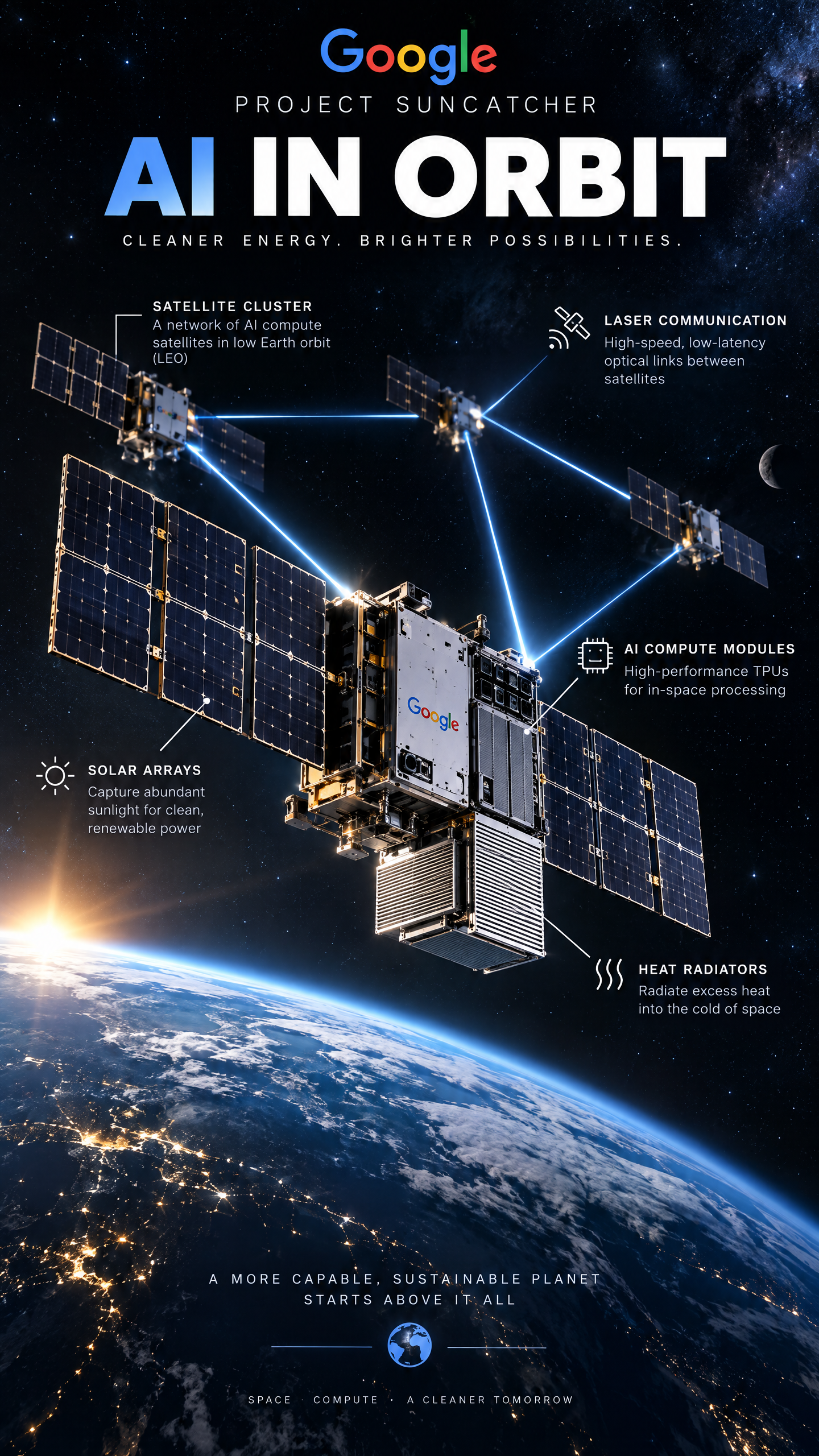
Google Project Suncatcher Orbital Architecture Overview
Inside the Satellite: Hardware Specs and SpaceX Launch
The Suncatcher prototype represents an unprecedented test of consumer and enterprise data center silicon operating in the harsh vacuum of space.
Satellite Chassis:    Planet Labs Refrigerator-Sized Modular Bus
Compute Core:         4× Google Trillium TPUs (TPU v6e Architecture)
Power Generation:     Deployable 1,000 W Solar Array
Thermal System:       Embedded Heat Pipes + Radiative External Panels
Downlink Network:     X-Band Radio to Svalbard Station (Norway)
Google Trillium TPUs: Commercial Silicon in Space
Google’s Trillium chips (TPU v6e) are built for machine learning inference and training. In Earth data centers, these chips operate inside climate-controlled rooms with chilled liquid cold plates.
To verify whether these chips could withstand space before launching, Google partnered with the Crocker Nuclear Laboratory at the University of California, Davis. Researchers blasted the Trillium TPUs with a 67 mega-electron-volt (MeV) proton beam, simulating the intense ionizing radiation of the Van Allen belts and solar cosmic rays.
The testing confirmed that the chips survived radiation doses equivalent to more than three times a full five-year orbital mission without suffering catastrophic latch-ups or permanent physical degradation.
Planet Labs Chassis and the Transporter-18 Falcon 9 Rideshare
Rather than engineering a custom satellite from scratch, Google collaborated with Planet Labs, a company with over a decade of experience operating the world's largest commercial constellation of Earth-imaging CubeSats.
The prototype was integrated into Planet's bus architecture, equipped with deployable solar wings, attitude control thrusters, and communication antennas. On October 1, 2026, SpaceX Falcon 9 lifted the payload into orbit on the Transporter-18 mission, subjecting the satellite to launch vibrations reaching up to 100 Gs on internal components without damage.
The "Hello World" In-Orbit Test: Gemma Generates a Space Haiku
Unlike passive hardware test missions, Google achieved an immediate functional milestone shortly after orbital insertion:
- Engineers transmitted an inference prompt from ground control to the satellite.
- The onboard system booted an open-weights Gemma model directly on the orbiting Trillium TPU.
- As the satellite crossed over the Arctic, it established a ground link with the satellite tracking station in Svalbard, Norway.
- Down came the first AI-generated text produced by proprietary data center silicon in orbit:
"Blue marble below.
Data streams in silent grace.
Starlight feeds my core."
While a three-line poem is a modest computation, it proved that modern neural network weights, memory buses, and tensor cores can function reliably in zero gravity and cosmic radiation.
How Google Project Suncatcher Operates in 4 Stages
How to Cool AI Chips in Space: The Brutal Thermodynamics of Vacuum
Cooling AI processors in orbit is fundamentally harder than cooling them on Earth because a vacuum has no air molecules to carry heat away. Space-based compute must rely entirely on radiative heat dissipation, which limits how long chips can run continuously.
On Earth:   Processor Heat ──► Liquid Cold Plate ──► Radiator Fan / Tower ──► Air Convection (Fast & Easy)
In Space:   Processor Heat ──► Solid Heat Pipe   ──► External Metal Panel ──► Infrared Radiation (Slow & Area-Bound)
Convection Is Dead: Relying Strictly on Radiative Heat Rejection
On Earth, cooling is easy because we are surrounded by an ocean of air. Fans blow cool air across heatsinks, carrying thermal energy away through convection. In advanced facilities, liquid loops circulate water through cooling towers where evaporation sheds megawatts of heat.
In the vacuum of space, convection does not exist. There are no gas molecules to touch the chip and carry its heat away.
Heat can only escape through one physical mechanism: thermal radiation, governed by the Stefan-Boltzmann law:
In plain English, the rate at which a satellite can dump heat into space depends strictly on two factors:
1. The surface area (A) of its external radiators.
2. The temperature (T) of those radiators raised to the fourth power.
Because modern AI chips generate intense heat in a tiny square-inch area, the thermal energy must travel through copper heat pipes and spread across massive external metal radiator panels facing away from the sun.
The 20-Minute Duty Cycle Limit: Why Continuous AI in Orbit Is Hard
Because the current prototype satellite has a compact refrigerator-sized body, its radiator surface area is constrained.
When a Trillium TPU runs full computational inference, it generates thermal energy faster than the small radiators can dump it into the vacuum. As a result, the satellite currently operates under a strict duty cycle:
- It can run a single TPU at full capacity for approximately 20 minutes at a time.
- It must then throttle down or enter a thermal rest cycle to let the radiators shed the accumulated heat into deep space.
For space AI to scale up to massive models like Gemini Ultra or Llama 4, satellites will require enormous deployable radiator panels similar to the solar arrays seen on the International Space Station. That added physical mass directly increases launch costs.
Free-Space Optics and Laser Meshes: Connecting Data Centers at 17,000 MPH
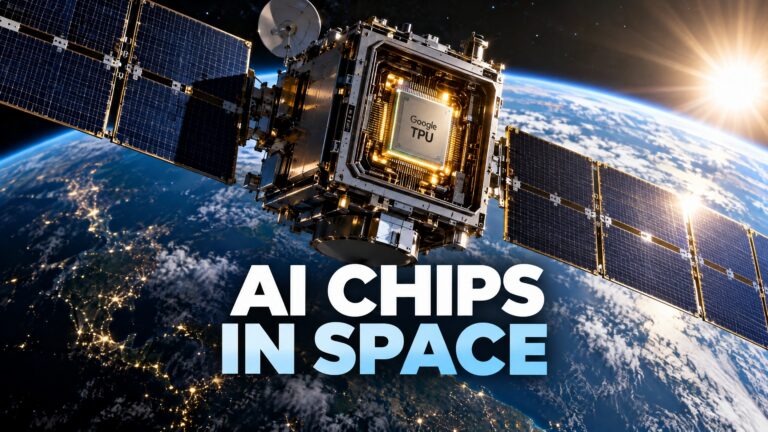
To build a true data center in space, satellites cannot work as isolated silos. They must communicate with each other at terabit speeds using free-space optical laser links while flying in tight orbital formation.
Satellite A (TPU Node 1) <════ Laser Optical Link (Multi-Terabit) ════> Satellite B (TPU Node 2)
  [~100m - 200m Distance]                 [Speed of Light in Vacuum]               [No Glass Attenuation]
Modern AI training relies on distributed parallelism: splitting a model across dozens of chips that must constantly exchange weight updates with sub-microsecond latency. On Earth, this is achieved using thick copper InfiniBand cables or fiber optic strands inside a server rack.
You cannot run fiber cables between satellites moving through orbit. Instead, Google's paper proposes free-space optics (FSO)—using precision-steered laser beams that shoot through the vacuum between satellites.
The 2027 Formation Test: Two Satellites Sharing Weights
Because laser beams travel 30% faster in a vacuum than through glass fiber cables, orbital laser links actually offer lower theoretical latency than terrestrial fiber.
However, aiming a laser at another satellite flying at 17,000 miles per hour (7.5 km/s) requires extreme pointing accuracy. In 2027, Google and Planet plan to launch their second mission: two interconnected satellites that will test laser communication cross-links, attempting to distribute model weights between orbital nodes for the first time.
In Google’s long-term theoretical paper, they model clusters of 81 satellites flying in close proximity (100 to 200 meters apart in a 1-kilometer radius cluster), synchronized via autonomous machine learning station-keeping algorithms.
Comparison: Space-Based AI vs. Terrestrial Hyperscale Data Centers
To understand whether orbital compute makes sense, we need to compare the operational realities of building on Earth versus launching into orbit:
Orbital vs. Terrestrial AI Architecture Comparison
Orbital AI (Project Suncatcher)
Terrestrial Hyperscale
Economic Feasibility: When Does Launching AI Beat Building on Earth?
Space-based computing will become commercially viable only when rocket launch costs drop to roughly $200 per kilogram. At that inflection point, the expense of launching hardware into orbit matches the compounding costs of acquiring land, building electrical substations, and purchasing grid power on Earth.
Launch Cost Curve:   Space Shuttle ($10,000/kg) ──► Falcon 9 ($2,500/kg) ──► Starship Target ($200/kg)
Economic Threshold:  [Prohibitive]                  [Prototypes Only]        [Commercial Parity with Earth]
The $200/kg Threshold: Why Starship Is the Key Deciding Factor
During the Space Shuttle era, lifting one kilogram of cargo into low-Earth orbit cost roughly $10,000. Under those economics, launching heavy computer racks and massive solar arrays was impossible.
SpaceX’s partially reusable Falcon 9 brought launch costs down to approximately $2,500 to $3,600 per kilogram. That cost reduction made prototype moonshots like Project Suncatcher viable for research laboratories.
However, Google’s economic modeling in their system design paper shows that true economic parity with terrestrial data centers requires launch costs to reach $100 to $200 per kilogram.
This target is precisely what fully reusable next-generation heavy-lift vehicles like SpaceX's Starship are designed to achieve by the early 2030s. When launch costs hit $200/kg:
- The amortized cost of launching hardware into space is cheaper than negotiating multi-gigawatt utility power contracts on Earth.
- Orbital facilities avoid long-term electricity bills entirely because solar power in space is free and near-continuous.
- Hyperscalers bypass 4- to 7-year regulatory delays required to build nuclear plants or high-voltage sub-stations on the ground.
The New AI Space Race: Google vs. SpaceX vs. Blue Origin
Google is not the only tech giant exploring orbital computing. An escalating race is unfolding between cloud hyperscalers, satellite operators, and national space agencies:
Google:     Trillium TPU Silicon + Planet Labs Spacecraft + 2027 Laser Mesh
SpaceX:     Vertical Starlink Fleet + Starship Heavy Lift + Constellation Filings
Bezos/AWS:  Project Sunrise / TeraWave Constellation + New Glenn Heavy Rocket
China:      ADA Space & Guoxing Aerospace Computing Satellites in Orbit
- SpaceX and xAI: Elon Musk is in a unique position. SpaceX already operates over 6,000 active Starlink satellites in low-Earth orbit. Recent commercial filings reveal plans to integrate compute capabilities directly into Starlink V3 constellations, powered by xAI models and launched on Starship.
- Jeff Bezos and Blue Origin: Blue Origin has filed for orbital infrastructure constellations under Project Sunrise and TeraWave, aiming to pair Amazon Web Services (AWS) cloud architecture with the New Glenn rocket.
- China’s ADA Space: Chinese aerospace firm ADA Space and Guoxing Aerospace have already launched AI compute demonstration satellites to process remote sensing data directly in orbit before downlinking results.
Frequently Asked Questions About Google Project Suncatcher
How do you cool AI chips in space?
In the vacuum of space, chips cannot use fans or air convection. Cooling relies entirely on thermal conduction and infrared radiation. Thermal energy travels from the TPU processor through solid copper heat pipes to large exterior metal radiator panels that radiate heat into the cold background of space following the Stefan-Boltzmann law.
Why not just build more solar farms on Earth?
Terrestrial solar farms suffer from atmospheric scattering, cloud cover, and the night cycle, yielding power for only 6 to 8 peak hours per day. A satellite in a dawn-dusk sun-synchronous orbit receives uninterrupted sunlight 24 hours a day with zero clouds, producing up to 8 times more cumulative electrical energy per square meter.
When will Google Project Suncatcher be operational?
Project Suncatcher is currently in early prototype testing. The first satellite launched on October 1, 2026. A second mission testing inter-satellite optical laser communications is scheduled for 2027. Commercial multi-satellite operational clusters are not expected until the 2030s, dependent on low-cost heavy launch vehicles like Starship.
Can space data centers replace ground data centers for real-time ChatGPT queries?
Not in the near term. Ground-to-satellite radio links introduce 20 to 80 milliseconds of propagation latency, and uplink bandwidth is limited. Orbital data centers are far better suited for batch model training, planetary observation processing (Planet Labs imagery), and scientific simulations than instant consumer chatbot conversations.
My Final Verdict: Revolutionary Moonshot or Thermodynamic Trap?
Google Project Suncatcher is an authentic engineering moonshot addressing one of computing's hardest structural limits: our terrestrial energy ceiling.
What Works Today:     Proven TPU Durability (UC Davis Protons) + First Gemma Haiku in Orbit
The Immediate Gap:    Strict 20-Minute Duty Cycles Due to Radiative Vacuum Heat Buildup
The Deciding Factor:  Starship Launch Economics ($200/kg) by 2030
By proving that commercial Trillium TPUs can withstand rocket vibration and cosmic radiation without requiring archaic radiation-hardened chips, Google and Planet Labs have cleared the first major hurdle.
However, the laws of thermodynamics cannot be bypassed. Until aerospace engineers solve high-surface-area radiative cooling without introducing crippling orbital mass and atmospheric drag, space data centers will remain restricted to short duty-cycle runs and specialized space-native workloads.
If next-generation heavy rockets bring launch costs down toward $200 per kilogram by the 2030s, Project Suncatcher will look like the beginning of an era. Until then, it is an inspiring engineering laboratory proving that the future of computing is no longer bound to the surface of our planet.