

When Anthropic launched its official training platform, I immediately logged in to test whether Claude Academy free courses live up to the hype or simply repackage basic documentation. With 28 interactive courses in the catalog at academy.claude.com, it is surprisingly easy to start in the wrong spot and burn a full week on repetitive material.
I took the core modules myself so you do not have to guess. The platform provides completely free, structured training paths for both non-technical professionals and software developers, complete with digital credentials you can showcase directly on LinkedIn.
- 100% Free: You only need a standard Claude login. No credit card or paid subscription is required to complete courses and earn badges.
- Two Clear Lanes: Beginners should focus on Claude 101 and AI Fluency Foundations. Builders should focus on Claude Code 101 and Building with the Claude API.
- Skip the Duplicates: The Amazon Bedrock and Google Cloud Vertex AI courses are almost identical to the standard API track. Skip them unless your employer explicitly requires them.
- Digital Badges: Anthropic awards free verifiable completion badges for LinkedIn upon passing module quizzes. These are distinct from paid Pearson VUE certifications.
🎬 Video Walkthrough: Claude Academy Overview
Before exploring the individual course syllabi, watch my 60-second visual breakdown covering the course counts, learning paths, and how to avoid the cloud duplicate trap:
What Is Claude Academy and Is It Truly Free?
Claude Academy (academy.claude.com) is Anthropic's dedicated education hub. Unlike informal video playlists or fragmented blog posts, it is a structured learning management platform designed to teach you how to prompt, build, and deploy AI safely.
When testing the platform, the first detail I verified was the payment barrier: there is none. You do not need to enter billing details, provide payment cards, or maintain an active Claude Pro subscription for the core curriculum.
Sign Up (Claude Account) ──► Pick Course ──► Complete Interactive Lessons ──► Pass Quiz ──► Claim LinkedIn Badge
Every lesson is broken down into bite-sized interactive modules with short conceptual overviews, hands-on prompt challenges, and end-of-module knowledge checks.
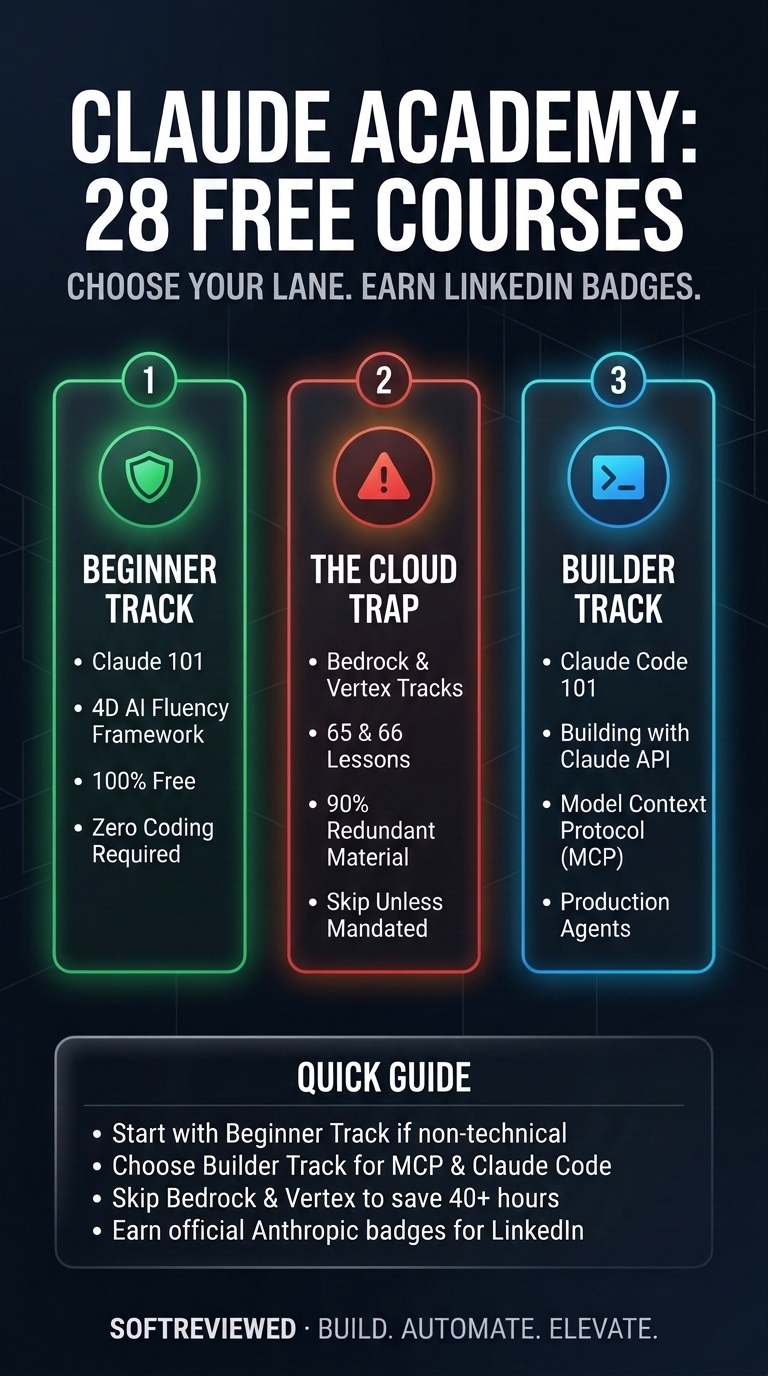
Figure 1: The three-track roadmap for Claude Academy courses, highlighting beginner paths and the cloud duplicate warning.
The Two Main Claude Academy Learning Tracks
Most people make the mistake of attempting all 28 courses in sequential order. Anthropic designed the catalog for two distinct audiences: business professionals who use Claude in their daily workflow, and developers writing code or integrating APIs.
Here is how the two primary learning tracks compare:
| Feature | Track 1: Everyday AI Fluency | Track 2: Developer & Agent Builder |
|---|---|---|
| Target Audience | Writers, marketers, managers, analysts | Developers, software engineers, DevOps |
| Prerequisites | Zero coding knowledge | Basic Python, JSON, and terminal experience |
| Primary Courses | Claude 101, AI Fluency Foundations | Claude Code 101, Building with Claude API |
| Core Skills | 4D framework, Projects, Artifacts | Tool use, JSON schemas, MCP, CLI agents |
| Total Lessons | ~40 lessons | ~80 lessons |
| Credential | Foundational Completion Badges | Technical Developer Completion Badges |
Core Beginner Courses: The 4D AI Fluency Framework
If you do not write software, your entire journey should consist of three foundational modules:
Claude 101 (13 Lessons) ──► AI Fluency Foundations (14 Lessons) ──► Capabilities & Limitations (13 Lessons)
1. Claude 101 (13 Lessons)
This module establishes how Claude processes prompts, manages conversational memory, and produces outputs. It details how to structure instructions using XML tags, how to attach reference documents into Projects, and how to use Artifacts for real-time document drafting and code previewing.
2. AI Fluency: Framework and Foundations (14 Lessons)
This was my favorite module in the beginner track. Anthropic introduces their proprietary 4D Framework, which gives you a clear mental model for working with generative models:
- Delegation: Deciding what tasks AI should execute versus what humans must supervise.
- Description: Writing clear, context-rich instructions with explicit constraints.
- Discernment: Evaluating outputs critically to catch hallucinations and logic gaps.
- Diligence: Testing edge cases, fact-checking sources, and refining instructions iteratively.
3. AI Capabilities and Limitations (13 Lessons)
This module breaks down the underlying physics of large language models without overwhelming math. You learn why models occasionally invent facts, how context windows truncate earlier instructions during extended conversations, and how attention mechanisms prioritize prompt elements.
Core Developer Courses: Building Agents and Using MCP
For technical professionals, Anthropic provides deep architectural training on agentic coding and programmatic integration:
Claude Code 101 (12 Lessons) ──► Building with Claude API (67 Lessons) ──► Intro to MCP
1. Claude Code 101 (12 Lessons)
Anthropic released Claude Code as a dedicated command-line agent that lives directly in your terminal. This course guides you through configuring the CLI tool, granting safe execution permissions, and directing Claude to search repositories, run test suites, and refactor codebases autonomously.
2. Building with the Claude API (67 Lessons)
This is the heavyweight anchor of the developer path. Spanning 67 comprehensive lessons, it walks you through: * Structured JSON outputs with strict schema enforcement. * Client-side tool calling and function invocation. * System prompt architecture and prompt caching to reduce token expenses. * Vision processing and document analysis at scale.
3. Intro to Model Context Protocol (MCP)
Anthropic's Model Context Protocol has become the industry benchmark for linking AI models to local databases, enterprise APIs, and custom desktop tools. This course explains how client-server connections work, how to register tool schemas, and how to safeguard sensitive credentials.
The Cloud Duplicate Trap: Why You Should Skip Bedrock and Vertex Tracks
As you browse the course catalog, you will notice two massive course tracks: * Claude on Amazon Bedrock (65 lessons) * Claude on Google Cloud Vertex AI (66 lessons)
I spent time auditing these syllabi, and here is my advice: skip them unless your current employer requires AWS or GCP cloud certifications.
Over 90% of the concepts, API payloads, and prompt strategies in these two tracks are identical copies of the standard Building with the Claude API track. The only difference is the deployment endpoint and IAM permission wrappers. Taking all three will waste roughly 30 hours of study time on redundant explanations.
Anthropic Badges vs Paid Certifications: What You Actually Earn
When you complete a course track on Claude Academy and pass the module quizzes, Anthropic awards an official Digital Completion Badge:
Complete Course ──► 80%+ Quiz Score ──► Digital Badge ──► One-Click LinkedIn Share
- Official Digital Badge: Displays your full name, issue date, and an Anthropic verification URL. You can attach it directly to your LinkedIn profile under Licenses & Certifications.
- Not an Accredited Degree: These badges verify practical skill completion, not an academic university degree.
- Separate From Paid Exams: Anthropic also runs a formal certification program through Pearson VUE for enterprise cloud architects and partner engineers. Those proctored exams require testing fees, whereas Claude Academy completion badges are completely free.
Step-by-Step Guide: How to Enroll and Get Started Today
Getting started takes less than two minutes:
- Visit the Portal: Open
https://academy.claude.comin your browser. - Log In: Click Sign In and authenticate using your existing Claude account credentials.
- Choose Your Starting Track:
- If you are non-technical, enroll in Claude 101.
- If you are a developer, enroll in Claude Code 101.
- Complete the Interactive Exercises: Follow along in the workspace and execute prompt challenges.
- Pass the Final Knowledge Check: Score 80% or higher to unlock your verifiable LinkedIn credential.
Frequently Asked Questions About Claude Academy Free Courses
Do I need a paid Claude Pro subscription to access the academy?
No. All 28 courses on Claude Academy are accessible using a standard free Claude account. You do not need to provide payment details or purchase monthly credits to complete lessons.
How long does it take to complete Claude 101?
Most learners finish Claude 101 in approximately 60 to 90 minutes. It contains 13 short lessons that you can easily complete in a single evening.
Can I share Claude Academy badges on LinkedIn?
Yes. Upon passing a course track's final quiz, the platform generates a verified digital badge with a direct Add to LinkedIn button that imports the credential into your profile.
What is the difference between Claude Academy and Pearson VUE exams?
Claude Academy provides free, self-paced courses with digital completion badges. The Pearson VUE exams are formal, proctored professional certifications designed for enterprise partners and cloud architects, requiring exam fees and scheduled testing sessions.