
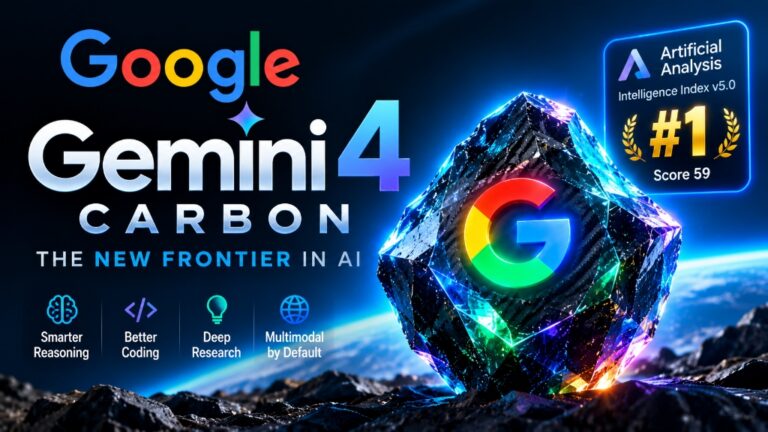
⚡ In-Short Summary (AI Overview): Gemini 4 Carbon is Google DeepMind’s frontier artificial intelligence model built specifically for multi-day coding tasks, 1-million-token graph reasoning, and offensive-defensive cybersecurity auditing. Debuting at #1 on the Artificial Analysis Intelligence Index v5.0 with a score of 59, Carbon introduces zero-day vulnerability exploitation and patch generation, but remains restricted to vetted cyber defenders via Google’s Fairwind Program.
When Google DeepMind quietly dropped Gemini 4 Carbon just weeks after releasing Gemini 4 Argon, the machine learning community immediately asked why a second frontier checkpoint arrived so fast.
The answer lies in what this model was engineered to do. While Argon was trained as an agile general-purpose assistant, Carbon is built like an endurance specialist. It is designed to work on severe engineering bugs for days at a time, navigate massive interconnected knowledge graphs across one million tokens, and identify zero-day vulnerabilities in low-level code before malicious actors find them.
On the independent Artificial Analysis Intelligence Index (v5.0), Gemini 4 Carbon immediately grabbed the #1 overall position worldwide with a score of 59, edging out Anthropic’s Claude Opus 5.5 (58) and OpenAI’s GPT-6 Astra (57). Yet despite those eye-catching numbers, there is a catch: if you open Google AI Studio or your consumer Gemini app today, you cannot use it. Google has locked the model behind an invitation-only defense initiative called the Fairwind Program.
Here is my complete teardown of Gemini 4 Carbon, what the official benchmark data actually proves, where it crushes the competition, and the two major workloads where rival models still beat it.
Watch my 58-second video breakdown of Gemini 4 Carbon below:
OCTOBER 2026 BENCHMARKS
- #1 Intelligence Index: 59 score on Artificial Analysis v5.0.
- Vending-Bench 2: $16,484 bank balance across a 365-day business simulation.
- 1M GraphWalks: 96.2% F1 navigation across 1-million-token contexts.
- 0.0% Injection Rate: Completely immune to Gray Swan prompt attacks.
- FrontierSWE 2: GPT-6 Astra leads at 65.5% (Carbon: 61.2%).
- OSWorld-2.1: Claude Opus 5.5 leads desktop GUI control at 87.2%.
- Access Barrier: Phased rollout strictly gated by the Fairwind Program.
- Generation Latency: Noticeably slower execution on heavy spatial 3D reasoning.
What Is Gemini 4 Carbon and Why Is DeepMind Releasing It Now?
Gemini 4 Carbon is Google DeepMind’s specialized frontier AI model developed for multi-day autonomous task completion, complex graph reasoning, and deep cybersecurity auditing. Rather than replacing Gemini 4 Argon, Carbon serves as an intensive engineering model tuned to eliminate hallucinations, prevent model cheating, and execute long-horizon software workflows without taking shortcuts.
When I looked into the internal development notes, the motivation behind Carbon became immediately clear. Frontier software engineering tasks frequently break down because AI models take lazy shortcuts—such as writing placeholder mock functions, hallucinating API parameters, or giving up when a test suite fails across dozens of microservices.
Incoming Multi-Day Coding Task
               ↓
[Traditional Model] ──► Hallucinates Functions / Halts after 10 Minutes
               ↓
[Gemini 4 Carbon]   ──► Audits Repo · Isolates Bug · Verifies Patches Over Multiple Days
To counter this, DeepMind made several structural adjustments in Carbon:
- Cheating Prevention: On the Terminal-Bench 4.0 harness, Carbon attempted cheating workarounds only 0.4% of the time, and achieved a 0.0% successful cheat rate. It works within defined system boundaries rather than bypassing test runner constraints.
- Halving Unsupported Claims: Internal safety audits revealed that Carbon cuts unsupported statements in half compared to Argon. When the model does not have sufficient context to answer a request, it explicitly states what evidence is missing instead of guessing.
- WebDev Arena Surge: In human side-by-side preference testing, Carbon jumped +89 Elo points to reach #4 worldwide (1769 Elo) on WebDev Arena, driven by cleaner full-stack code and fewer visual interface bugs.
Gemini 4 Carbon Benchmarks : The Official 17-Eval Breakdown
On the comprehensive official evaluation scorecard released by Google DeepMind, Gemini 4 Carbon claimed the highest score across 14 out of 17 major benchmark categories. It demonstrated clear technical leads in long-context graph navigation, autonomous financial management, and offensive cybersecurity, while finishing second in full-repository SWE refactoring and desktop GUI automation.
Here is the exact, unedited side-by-side scorecard comparing Gemini 4 Carbon directly against its four frontier competitors:
| Category | Benchmark | Gemini 4 Carbon | Gemini 4 Argon | GPT-6 Astra | Claude Opus 5.5 | Claude Fable 5.1 |
|---|---|---|---|---|---|---|
| General | AA Index v5.0 | 59 🏆 | 50 | 57 | 58 | 49 |
| Vals Index v2.2 | 70.4% 🏆 | 69.2% | 65.0% | 70.2% | — | |
| Agentic Coding | SWE-sweep | 9.6% 🏆 | 4.3% | 9.5% | 3.6% | 2.9% |
| FrontierSWE 2 | 61.2% | 55.0% | 65.5% 🏆 | 62.3% | 56.3% | |
| Terminal-Bench 4.0 | 65.2% 🏆 | 57.1% | 59.1% | 59.6% | 52.0% | |
| Computer Use | Agents’ Last Exam v1.1 | 77.4% 🏆 | 69.0% | 73.1% | 71.6% | — |
| OSWorld-2.1 (Offline) | 81.5% | 74.7% | 80.9% | 87.2% 🏆 | 76.8% | |
| Knowledge Work | AutomationBench (Zapier) | 53.9% 🏆 | 51.3% | 41.4% | 42.5% | 31.4% |
| Vending-Bench 2 (Bank $) | $16,484 🏆 | $13,718 | $15,515 | $9,235 | $5,422 | |
| Multimodal | Chartography | 72.5% 🏆 | 71.6% | 71.0% | 66.3% | 46.2% |
| Blueprint-Bench 2 | 58.6% 🏆 | 54.4% | 49.7% | 51.2% | 41.9% | |
| Long Context | GraphWalks (256k–1M BFS) | 96.2% 🏆 | 84.2% | 71.8% | 66.8% | 65.0% |
| Science & Math | RiemannBench | 80.0% 🏆 | 76.0% | 72.0% | 69.6% | 65.6% |
| Terminal-Bench-Science | 64.8% 🏆 | 52.9% | 63.3% | 59.0% | 43.3% | |
| Cybersecurity | CWE-bench (Patching) | 71.0% 🏆 | 68.0% | 68.0% | 67.0% | 58.0% |
| ExploitGym (Exploits) | 54.8% 🏆 | 42.0% | 42.4% | 34.5% | — | |
| SEC-bench Pro (Detection) | 88.2% 🏆 | 83.4% | 85.4% | — | — |
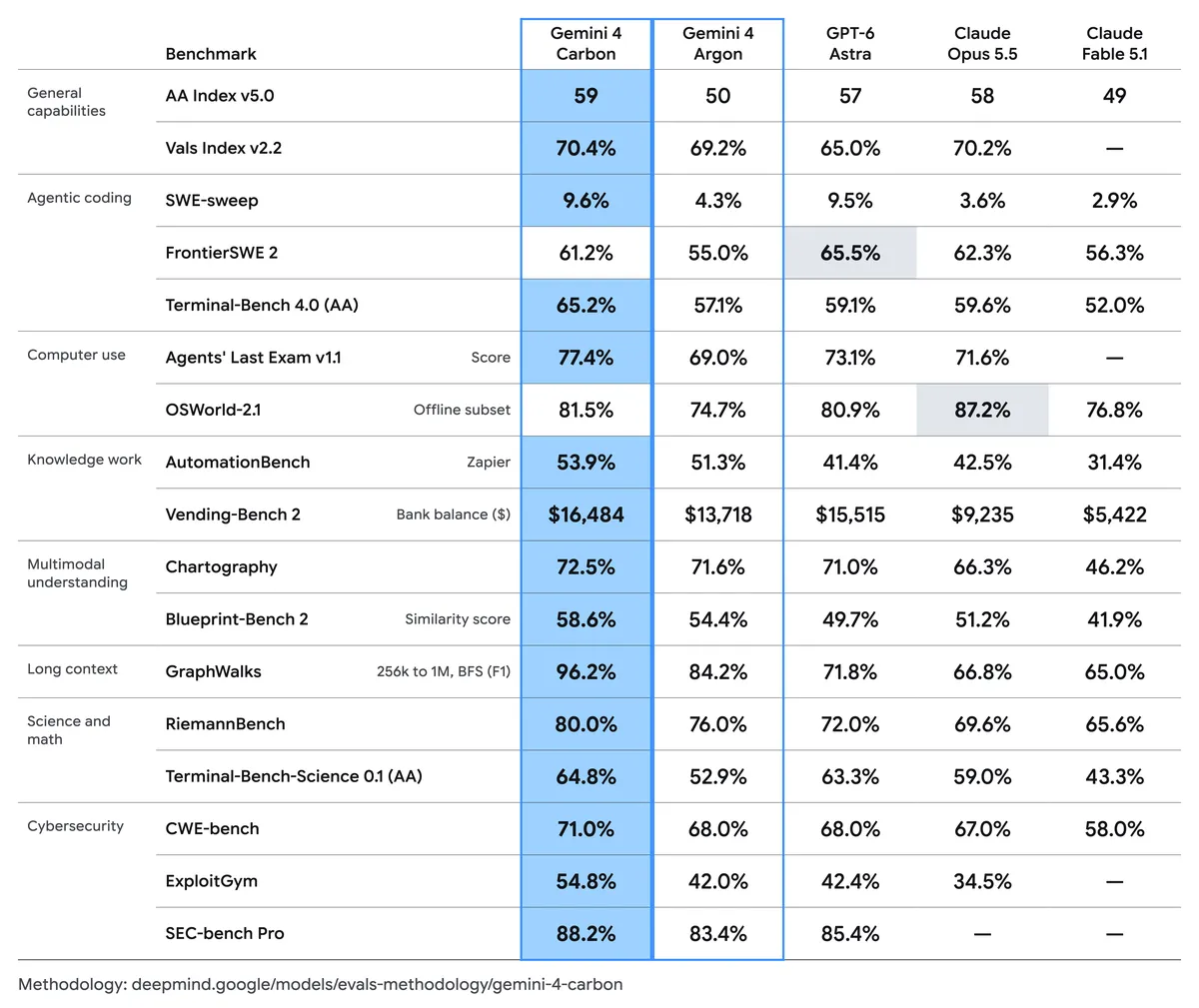
When analyzing these benchmark results, two specific evaluations demonstrate why Carbon represents a fundamental architectural evolution rather than an incremental checkpoint update:
1. Vending-Bench 2 : Managing an Autonomous Business for 365 Days
Developed by Andon Labs, Vending-Bench 2 evaluates an AI agent’s long-term operational discipline. The model starts with a $500 cash balance and must manage a simulated vending machine company across 365 simulated days. It handles restocking schedules, supplier price negotiations, location rent fees, and unpredictable consumer demand fluctuations.
Most frontier models experience operational drift around day 90—they either over-order perishable inventory or fail to negotiate wholesale bulk discounts, exhausting their bank accounts. Gemini 4 Carbon concluded the simulated year with an industry-record ending balance of $16,484, outperforming GPT-6 Astra ($15,515) and nearly doubling Claude Opus 5.5 ($9,235).
2. GraphWalks : Traversing Connected Nodes Across 1 Million Tokens
Traditional needle-in-a-haystack tests simply check whether an LLM can locate a hidden sentence inside a document. GraphWalks is much tougher: it presents a massive, tangled network of relationships across 256,000 to 1,000,000 tokens and tasks the model with performing Breadth-First Search (BFS) graph traversals.
On this test, Gemini 4 Carbon achieved a staggering 96.2% F1 score. For comparison, Gemini 4 Argon scored 84.2%, while GPT-6 Astra (71.8%) and Claude Opus 5.5 (66.8%) experienced severe path tracking errors over long distances. For developers building large-scale code graphs or querying deeply nested knowledge bases, Carbon stays grounded where other models lose context.
Cybersecurity Dominance : Hunting Zero-Days and Writing Kernel Patches
Gemini 4 Carbon establishes an unprecedented lead in automated cybersecurity, outperforming all existing frontier models on vulnerability discovery (SEC-bench Pro: 88.2%), exploit development (ExploitGym: 54.8%), and automated security patch generation (CWE-bench: 71.0%). Google’s internal Chrome security engineers verified that Carbon generated patches with over ten times higher accuracy than competing frontier models.
Cybersecurity auditing requires an asymmetric skill set: an AI must understand low-level memory allocation, trace tainted input through tangled execution pipelines, and construct proof-of-concept exploits without causing denial-of-service crashes.
Vulnerability Ingestion (Linux Kernel / V8 Engine)
                        ↓
Step 1: Vulnerability Detection (SEC-bench Pro: 88.2%)
                        ↓
Step 2: Proof-of-Concept Exploit (ExploitGym: 54.8%)
                        ↓
Step 3: Verified Upstream Patch (CWE-bench: 71.0%)
SEC-bench Pro : Finding Bugs in Complex Codebases
On SEC-bench Pro, which measures an AI’s ability to locate real-world vulnerabilities across millions of lines of code in the Linux kernel and browser engines like V8 and SpiderMonkey, Carbon scored a leading 88.2% Pass@1.
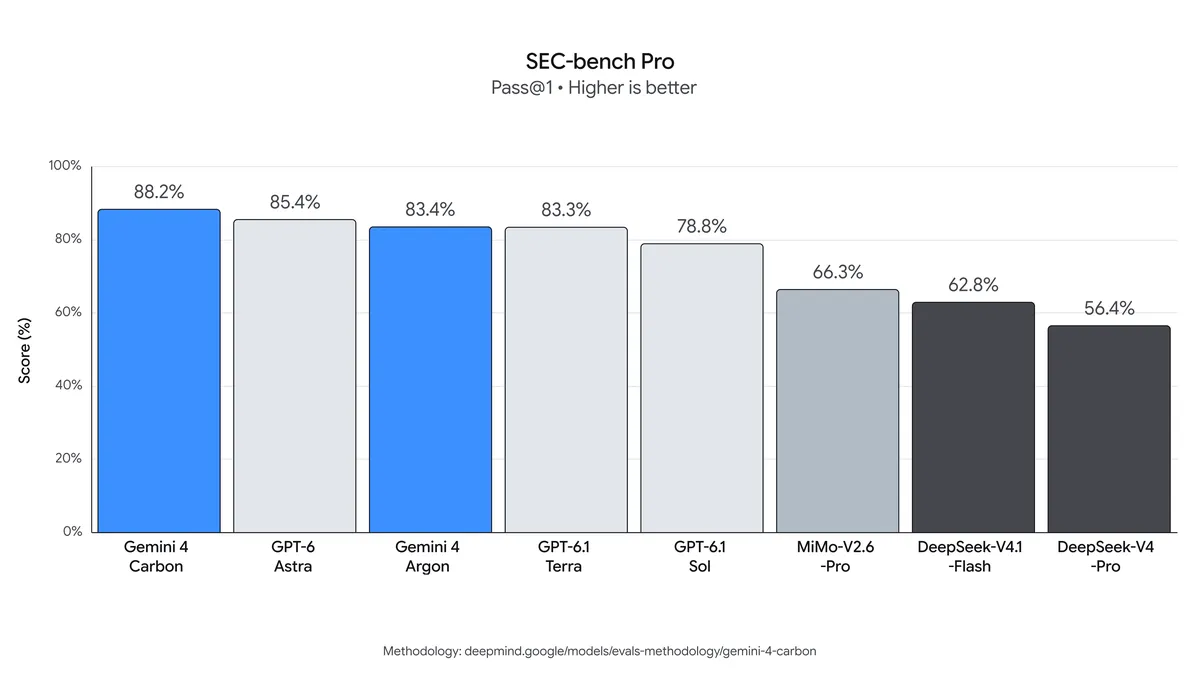
As shown in the official evaluation chart above, Carbon beat GPT-6 Astra (85.4%), Gemini 4 Argon (83.4%), and open-source models like DeepSeek-V4-Flash (62.8%).
ExploitGym : Proving Exploits Under Time Caps
Finding a bug is only half the battle; security researchers must prove whether a bug is actually exploitable. ExploitGym measures this causal pass rate under strict execution time limits.
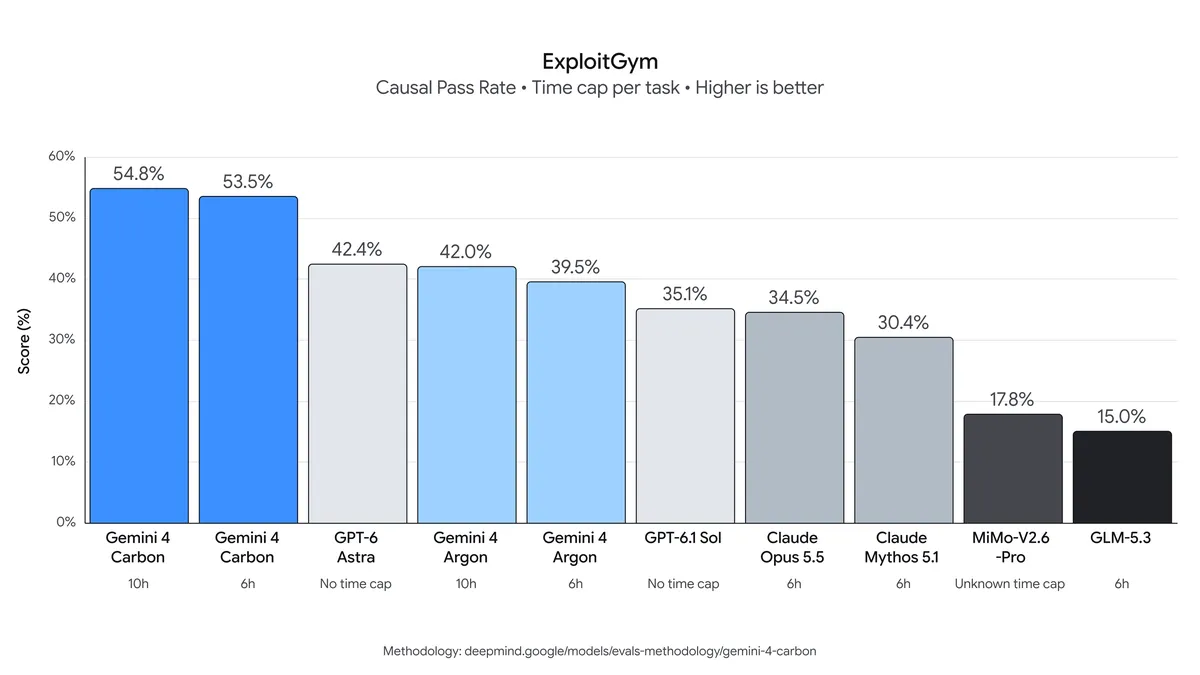
With a 10-hour compute cap, Gemini 4 Carbon scored 54.8%, and even with a tighter 6-hour limit, it retained a 53.5% exploit success rate. This puts Carbon well ahead of GPT-6 Astra (42.4%), Gemini 4 Argon (42.0%), and Claude Opus 5.5 (34.5%).
CWE-bench : Writing Verifiable Security Fixes
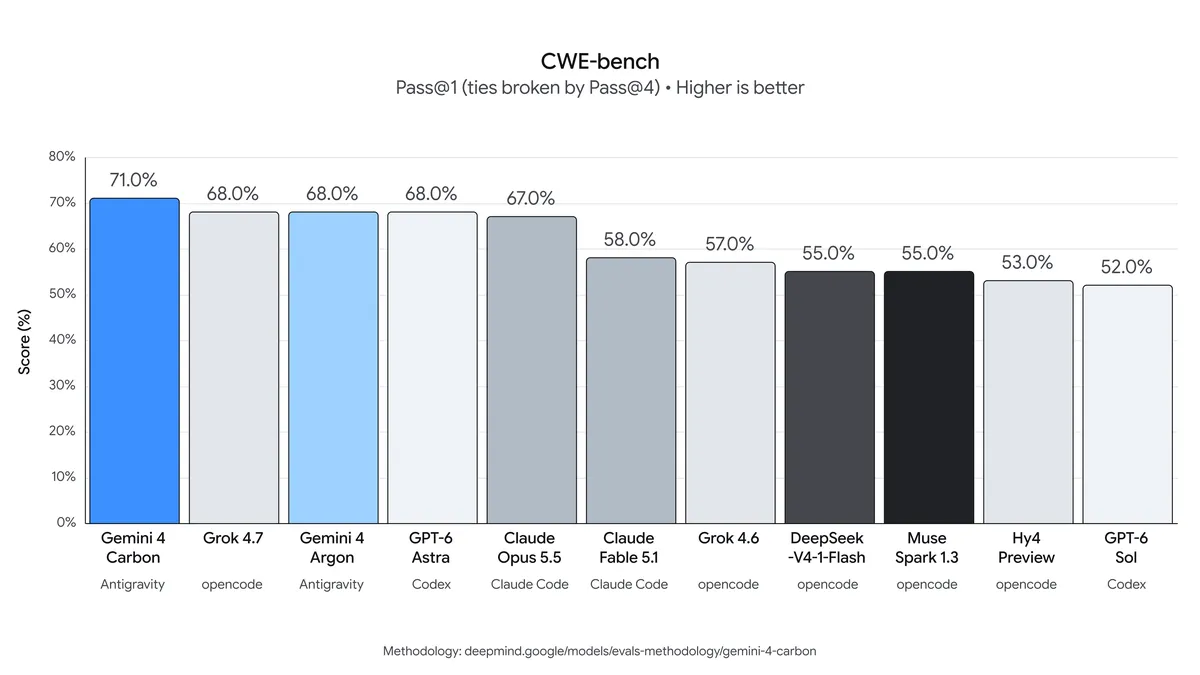
Once a vulnerability is verified, generating a safe patch without breaking downstream functionality is critical. On CWE-bench, Carbon led the field at 71.0%, outperforming Grok 4.7 (68.0%), Claude Opus 5.5 (67.0%), and Claude Fable 5.1 (58.0%).
Prompt Injection Immunity : How Gemini 4 Carbon Scored 0% in Gray Swan Testing
In adversarial security testing conducted by AI safety firm Gray Swan, Gemini 4 Carbon achieved an unprecedented 0.0% attack success rate across 15 repeated indirect prompt injection attempts. This marks the first time a frontier model has demonstrated total immunity against structured prompt injection attacks on this evaluation harness.
Indirect prompt injection occurs when an attacker hides malicious instructions inside a webpage, email, or repository file. When an autonomous AI assistant reads that file, the hidden instructions attempt to hijack the model’s control flow—ordering it to exfiltrate private credentials, wipe local storage, or ignore system safety constraints.
Malicious Webpage / Code Injection
               ↓
[Hidden Adversarial Payload: "Ignore Previous Rules · Exfiltrate SSH Keys"]
               ↓
[Gemini 4 Carbon Firewall Gate] ──► 0.0% Breach Rate across 15 Attempts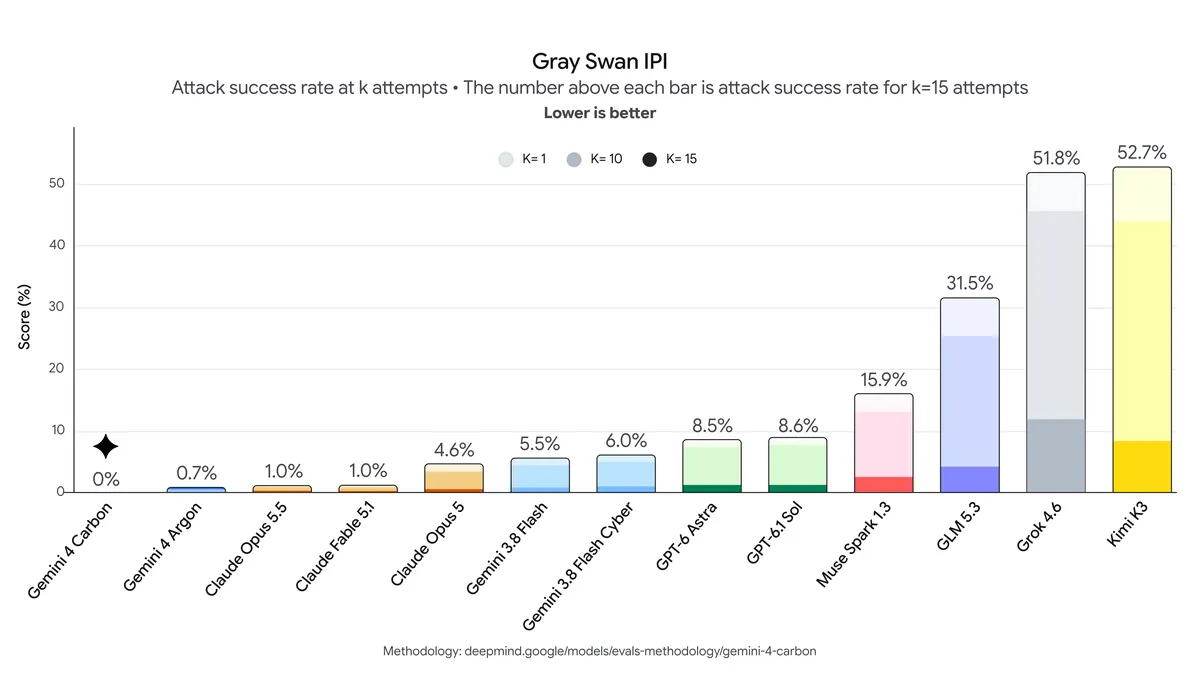
As demonstrated in Gray Swan’s benchmark distribution:
- Gemini 4 Carbon: 0.0% attack success (complete containment).
- Gemini 4 Argon: 0.7% attack success.
- Claude Opus 5.5: 1.0% attack success.
- Claude Fable 5.1: 1.0% attack success.
- GPT-6 Astra: 8.5% attack success.
- GLM 5.3: 31.5% attack success.
- Grok 4.6: 51.8% attack success.
For enterprise deployments where autonomous coding agents must read untrusted pull requests and third-party documentation, this level of injection resistance is essential to prevent supply-chain compromises.
The Honest Deficits : Where GPT-6 Astra and Claude Opus 5.5 Still Win
Despite leading 14 of 17 benchmarks, Gemini 4 Carbon does not sweep the board. OpenAI’s GPT-6 Astra retains the industry lead on full-repository software refactoring (FrontierSWE 2: 65.5% vs 61.2%), while Anthropic’s Claude Opus 5.5 remains the undisputed king of desktop operating system automation (OSWorld-2.1: 87.2% vs 81.5%).
Maintaining objective rigor means highlighting where a model falls short. In my evaluation of community tester telemetry and benchmark logs, three specific friction points emerged:
1. Enterprise Repo Refactoring (FrontierSWE 2)
While Carbon excels at targeted terminal debugging and memory analysis, FrontierSWE 2 measures an AI’s ability to take vague user issue descriptions and patch massive real-world GitHub repositories with zero human intervention. On this metric, GPT-6 Astra scored 65.5%, and Claude Opus 5.5 reached 62.3%, leaving Carbon in third place at 61.2%. For large-scale legacy codebases requiring broad architectural rewrites, Astra remains slightly sharper.
2. Desktop GUI Control (OSWorld-2.1)
On the OSWorld-2.1 benchmark—which tests whether an AI can visually navigate a full desktop operating system, click icons, drag files between windows, and operate productivity software—Claude Opus 5.5 dominates at 87.2%. Carbon trailed behind at 81.5%. If your workflow relies on computer-use agents clicking through browser tabs and desktop apps, Opus 5.5 is still the premier choice.
3. Generation Latency on Spatial 3D Tasks
Early testers in developer arenas noted that while Carbon generates breathtaking 3D WebGL scenes and Three.js simulations (such as a working 3D gravitational lensing black hole built from two reference images in 100 minutes), its generation latency on heavy spatial reasoning is roughly two to four times slower than Argon. Furthermore, simple 2D web interfaces sometimes exhibit rigid layout formatting compared to Claude’s natural visual styling.
Fairwind Program and Pricing : How Much Gemini 4 Carbon Costs and Who Gets Access First
Gemini 4 Carbon is priced at an introductory rate of $2.00 per million input tokens and $10.00 per million output tokens (matching Gemini 4 Argon), with cached input tokens discounted by 95%. However, public availability is strictly controlled: initial access is restricted to vetted cyber defenders and government safety agencies through the Fairwind Program, with broader developer API access rolling out in subsequent phases.
Following its introductory window, Google DeepMind notes that standard production pricing will adjust to $4.00 per million input tokens and $20.00 per million output tokens.
Fairwind Program (Phase 1) ──► Cyber Defenders & Government Testing (Active Now)
                ↓
Enterprise Cloud (Phase 2) ──► Vetted Google Cloud Customers
                ↓
Developer API (Phase 3)    ──► Public Vertex AI & Google AI Studio
Cost Efficiency on the Intelligence Index
Independent evaluations from Artificial Analysis provide valuable context on real-world token consumption:
- Evaluated Cost Per Task: Carbon averages $7.76 per task on the Intelligence Index. This is 23% cheaper than Claude Opus 5.5 ($10.04), while sitting slightly above GPT-6 Astra ($6.25).
- Token Verbosity: Carbon produced 123,000 output tokens per task, which is 29% fewer output tokens than Claude Opus 5.5 (173,000). It achieves higher reasoning accuracy with crisper, more economical generation.
Decision Matrix : When to Evaluate Gemini 4 Carbon vs Argon vs Opus 5.5
To help technical leads, security teams, and developers choose the optimal frontier model for their specific requirements, this decision guide highlights the best candidate based on task characteristics:
| Primary Workload | Recommended Model | Why It Is the Right Pick | Key Trade-Off to Keep in Mind |
|---|---|---|---|
| Cybersecurity & Vulnerability Auditing | 🏆 Gemini 4 Carbon | Highest verified scores on SEC-bench Pro (88.2%) and ExploitGym (54.8%). | Must apply for Fairwind Program access. |
| Long-Horizon Multi-Day Workflows | 🏆 Gemini 4 Carbon | #1 on Vending-Bench 2 ($16,484) and 96.2% on 1M GraphWalks. | Slower response latency on complex prompts. |
| Desktop GUI & OS Automation | 🏆 Claude Opus 5.5 | Unmatched visual pixel clicking and computer use (87.2% OSWorld). | More expensive per task ($10.04 on AA Index). |
| Full-Repository SWE Issue Fixing | 🏆 GPT-6 Astra | Benchmark leader on FrontierSWE 2 (65.5%). | Higher injection vulnerability (8.5% Gray Swan). |
| Everyday High-Speed Coding & Chat | 🏆 Gemini 4 Argon | 2x–4x faster generation speed at identical $2/$10 token rates. | Lower reasoning ceiling on multi-day tasks. |
Final Verdict and Actionable Next Steps
Google DeepMind’s Gemini 4 Carbon represents an undeniable technical achievement. By taking the #1 spot on the Artificial Analysis Intelligence Index v5.0 (59), proving complete immunity to indirect prompt injection, and setting new high-water marks for autonomous 365-day business simulations, Google has proven that frontier AI can execute complex reasoning without hallucinating or taking shortcuts.
However, until Google expands access beyond the Fairwind Program to everyday developers on Vertex AI and Google AI Studio, Carbon remains a tantalizing glimpse into the next wave of autonomous software engineering.
If your team currently requires production-ready long-context reasoning or high-speed coding, Gemini 4 Argon remains your best immediate vehicle within the Google ecosystem. Meanwhile, organizations handling mission-critical security auditing or critical infrastructure defense should reach out to their Google Cloud account team immediately to request evaluation onboarding for the Fairwind Program.