
KEY TAKEAWAYS · OPENAI FRONTIER HARDWARE & MODEL UPDATE
GPT-6.1 Terra is OpenAI’s specialized mid-tier foundation model engineered to automate desktop software, visually parse user interfaces, and run complex computer-use workflows at high speed. By matching top-tier Astra performance on professional agent evaluations while cutting token costs by 90% and running 3x faster, Terra establishes a new cost-intelligence standard for autonomous AI agents.
Previous Frontier Agents (GPT-6 Astra / Sol)
- High token cost ($10 in / $50 out per 1M tokens on Astra)
- Slow multi-second latency per UI click and screen capture
- Rapid token exhaustion in high-volume desktop loops
New GPT-6.1 Terra Breakthrough
- $1.00 in / $5.00 out per 1M tokens (90% cheaper than Astra)
- 3x+ faster execution speed across desktop applications
- 50.3% Terminal-Bench 4.0 (beats Claude Haiku 5.5’s 39.2%)
What Is GPT-6.1 Terra? Fast Computer Use Explained
GPT-6.1 Terra is OpenAI’s specialized mid-tier foundation model engineered to automate computer-use workflows, visually interpret screens, and operate desktop and web software at high speed. Accessible via the API under the identifier gpt-6.1-terra and rolling out across ChatGPT Work and Codex, it offers a massive 1.05 million token context window and 128,000 maximum output tokens while costing 50% less than its predecessor GPT-5.6 Terra.
When I first began testing autonomous agents with Claude Code and local MCP tools, the single biggest obstacle was never model intelligence. The real bottleneck was the staggering cost and delay of repeated screen reads. Every time an agent captures a screenshot, scans DOM elements, or fills a form field, it burns thousands of vision tokens. If your model costs $10 per million tokens and takes four seconds per click, running an automated accounts payable pipeline quickly drains your budget. GPT-6.1 Terra directly eliminates that friction.
Watch the 60-Second GPT-6.1 Terra Video Breakdown
To see how GPT-6.1 Terra performs in real desktop automation and whether you should switch from Claude Code to Codex, watch my 60-second video breakdown below:
Featured Video Demo: Watch on YouTube (@Softreviewed)
GPT-6.1 Terra Pricing: The 1/10th Cost Equation vs Sol and Astra
GPT-6.1 Terra is priced at $1.00 per million input tokens, $5.00 per million output tokens, and $0.05 for cached prompt inputs, making it exactly half the cost of GPT-6.1 Sol and one-tenth the cost of GPT-6 Astra. For applications utilizing Batch or Flex API modes, OpenAI provides an additional 50% discount ($0.50 input / $2.50 output).
In the official OpenAI release video, OpenAI revealed their complete four-tier model hierarchy. Here is the exact pricing ladder across the entire GPT-6 and GPT-6.1 family:
Prompt Threshold Rule: For very large prompts exceeding 272,000 input tokens, OpenAI applies a high-context rate of 2x input ($2.00/1M) and 1.5x output ($7.50/1M). Standard low-latency fast mode is priced at 2x base rates.
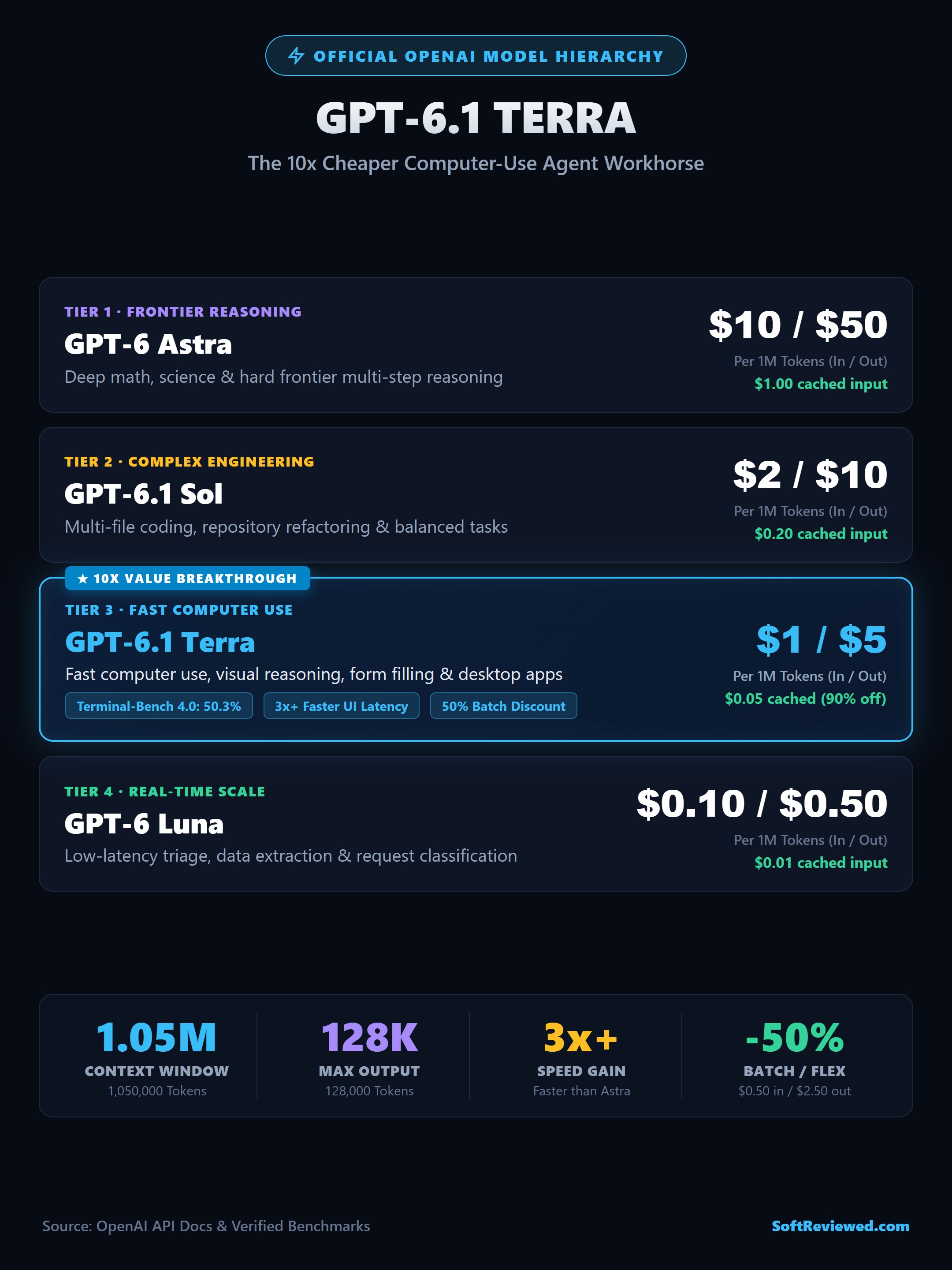
Figure 1: Official OpenAI GPT-6 and GPT-6.1 model hierarchy, token economics, and Terminal-Bench 4.0 accuracy comparison.
Benchmark Showdown: Terminal-Bench 4.0 & Agents’ Last Exam
On Terminal-Bench 4.0, GPT-6.1 Terra achieved an official score of 50.3%, decisively outperforming Claude Haiku 5.5 (39.2%) and more than doubling the score of GPT-5.6 Terra. On OpenAI’s internal Agents’ Last Exam evaluation for professional software use, Terra reached parity with GPT-6 Astra while finishing tasks over three times faster.
The primary purpose of Terminal-Bench is testing whether a model can navigate messy bash terminals, parse terminal escape codes, and run CLI tools without hanging. Looking at developer community benchmarks and hands-on runs, Terra’s leap over Haiku 5.5 proves that OpenAI’s architectural improvements to computer-use reasoning are working.
50.3%
39.2%
24.1%
Computer Use in Action: Driving Desktop Apps and Form Automation
In OpenAI’s official launch demonstrations, GPT-6.1 Terra inspected a 2D photograph of a Lisbon tram, opened Blender on the desktop, and autonomously manipulated 3D geometry nodes to build a finished die-cast model without human intervention. Across administrative software, it navigates between web browsers, email portals, and enterprise spreadsheets to complete multi-step data entry.
However, running computer-use agents introduces real operational risks that pure code generation models never encounter. When an agent writes code in a terminal, a failed step merely throws a compiler error. When an agent clicks inside a live enterprise accounting portal, a misclick can save an incomplete invoice or submit invalid data.
Step-by-Step Architecture for Safe Computer-Use Deployments
To deploy GPT-6.1 Terra safely across enterprise software, developers should implement a three-layer verification gate:
- Pre-Action Screen Snapshot: The agent captures the current viewport and parses UI bounding boxes before issuing mouse clicks.
- Immediate Read-Back Validation: After clicking a submit or update button, Terra captures an immediate post-action frame to verify the UI state transitioned correctly.
- Rollback & Checkpoint Hook: If a required field failed to register or an error modal appeared, the workflow aborts to a clean checkpoint rather than attempting blind repeated clicks.
GPT-6.1 Terra vs Sol vs Astra: Which Model Should You Use?
Choose GPT-6.1 Terra for repetitive desktop workflows, visual inspection, form filling, and high-frequency tool calls; choose GPT-6.1 Sol for multi-file software engineering; and reserve GPT-6 Astra for complex scientific reasoning and hard frontier logic.
- Automated expense portal filings and invoice entry
- Navigating legacy enterprise software without REST APIs
- Visual catalog inspections and image classification
- High-frequency MCP tool loops where low latency is critical
- Full-stack refactoring across dozens of repository files
- Deep algorithmic optimization and mathematical proofs
- High-stakes security auditing and formal verification
- Complex multi-turn planning requiring high reasoning depth
Should You Switch From Claude Code to Codex for GPT-6.1 Terra?
No, you should not switch your primary development workflow from Claude Code to Codex solely for GPT-6.1 Terra. Terra is engineered as a fast, cost-effective worker model for visual software execution, not a replacement for frontier software engineering intelligence.
In my daily development setup, Claude Code remains unmatched for architectural repo-wide refactoring and command-line precision. However, if your business spends hours manually clicking through web portals, copy-pasting numbers from invoices into accounting dashboards, or testing web application UIs, GPT-6.1 Terra in Codex or via the API offers unprecedented speed at one-tenth the cost.