
KEY TAKEAWAYS · GOOGLE DEEPMIND WORLD MODEL ARCHITECTURE
Google Genie 4 is Google DeepMind’s breakthrough foundation world model that generates playable, action-controllable 3D environments on the fly from text or image prompts. Unlike standard video generators that output passive video clips, Google Genie 4 pairs a Gemini Omni visual diffusion engine with a real-time Gemini 3.8 Flash supervisory loop, delivering native synchronized audio, live prompt steering, and egocentric character control at 24 to 30 frames per second.
Fixed 5 to 10 second pre-rendered MP4 clips with zero user agency
No internal physics, collision awareness, or spatial memory
Silent visual renders requiring separate third-party audio post-production
Playable 3D worlds: Real-time keyboard, mouse, and first-person control
Native multimodal audio: Synced ambient noise, music, and spoken dialogue
Live steering: Change weather, lighting, and NPCs via text while running
What Is Google Genie 4? DeepMind’s World Model Explained
Google Genie 4 is Google DeepMind’s real-time interactive world model that generates playable, physics-grounded 3D environments from text prompts and single images. By combining Gemini Omni’s visual generation with Gemini 3.8 Flash’s cognitive reasoning, Google Genie 4 lets users step inside a prompt, steer characters using mouse and keyboard controls, speak to in-game non-player characters (NPCs), and reshape environmental conditions live at 24 to 30 frames per second.
When I first began tracking generative media back in 2024, every model suffered from the same core limitation: they produced dead pixels. You could ask for a cyberpunk city or an alpine valley, and the model would return a gorgeous four-second MP4 video clip. But the moment you wanted to turn left down an alley, open a door, or pick up a glass, the illusion shattered. You were trapped in a passive viewer seat. Google Genie 4 fundamentally shifts that dynamic from passive viewing to active, embodied participation.
Watch the 60-Second Google Genie 4 Video Breakdown
To see how Google Genie 4 transforms a single text prompt into a live, playable 3D simulation with native sound and instant steering, watch my 60-second video teardown below:
Demonstration of Google Genie 4 real-time interactive generation and live text prompt steering.
The Evolution of Google Genie: From 2D Platformers to Google Genie 4
The Google Genie research project evolved across four distinct architectural generations, scaling from an 11-billion-parameter 2D game experiment to a fully multimodal 3D world simulator. DeepMind’s team originally launched the initiative to generate infinite synthetic environments for training autonomous generalist agents without requiring manual hand-crafted video game levels.
Understanding this four-stage progression clarifies why Google Genie 4 represents such an enormous milestone for interactive entertainment and artificial general intelligence (AGI) research:
| Generation | Release Date | Primary Modality | Core Capability | Audio & Interactivity |
|---|---|---|---|---|
| Genie 1 | Feb 2024 | 2D Platformer | Learned latent actions from unlabelled gameplay | Silent; rudimentary left/right jump controls |
| Genie 2 | Late 2024 | 3D Environments | Single-image 3D world creation and short-term physics | Silent; non-real-time generation |
| Genie 3 | Jan 2026 | Real-Time 3D | First live interactive navigation with 3rd-person avatars | Silent; ~30-60 second temporal horizon |
| Google Genie 4 | Current | Multimodal 3D | Egocentric hands, camera steering, and live text prompts | Native synced audio, dialogue, and 120s coherence |
Core Google Genie 4 Capabilities: Sound, Live Steering & Physics
Google Genie 4 introduces three major operational capabilities that distinguish it from previous world models: native synchronized audio generation, real-time natural language prompt steering, and egocentric first-person manipulation. These capabilities allow creators to interact with virtual environments using natural conversation and physical manipulation rather than rigid button scripts.
1. Native Multimodal Audio Generation
In every previous world model, simulation occurred in absolute silence. If a character walked through a busy Italian kitchen, dropped a porcelain espresso cup, or ran past a waterfall, no sound was produced. With Google Genie 4, audio is not added through a secondary text-to-speech or Foley generation pipeline; it is predicted natively in lockstep with the visual frames. When Diego from the DeepMind research team demonstrated dropping a cup of coffee, the ceramic clatter and the barista’s casual vocal response (*”No worries at all, accidents happen!”*) were generated synchronously.
2. Live Prompt Steering and Interleaved Text Captions
Traditional AI tools require you to stop generation, rewrite your prompt, and wait for a brand new rendering pass. Google Genie 4 introduces live steering. As you navigate through a generated forest or medieval castle, you can type live commands like *”make it thunder”* or *”spawn an enemy dragon on top of the tower”*. The runtime engine modifies the underlying world state dynamically without resetting your character position or terminating your interactive session.
3. Egocentric First-Person Controls and Hand Dexterity
While Genie 3 focused heavily on third-person platforming avatars (like moving a small dragon toy across a bedroom), Google Genie 4 prioritizes first-person egocentric manipulation. In tests, users manipulate virtual hands to pick up kitchen utensils, assemble tools, and turn dials. This first-person perspective provides the spatial continuity required for training physical robots in virtual simulation setups.
Inside the Dual-Engine Architecture: How Google Genie 4 Runs Live
Google Genie 4 operates using a decoupled dual-engine architecture that splits pixel rendering from cognitive scene management. The generative visual engine handles real-time spatiotemporal diffusion based on Gemini Omni, while an embedded supervisory loop powered by Gemini 3.8 Flash monitors scene continuity, parses user intentions, and generates reactive dialogue.
In my analysis of Google’s engineering disclosures, the runtime workflow follows this precise four-stage data cycle:
│
▼
[Input Arbitrator: 24-30 FPS Ingestion Gate]
│
├──► [Gemini 3.8 Flash Supervisory Agent] ──► Checks State, Enforces Physics, Generates Dialogue
│ │
└──► [Gemini Omni Generative Engine] <────────┘ (Interleaved Conditioning Vectors)
│
▼
[Unified Diffusion Output: Synchronized Video Frames + Native Waveform Audio + SynthID Watermark]
Why DeepMind Embedded Gemini 3.8 Flash in the Loop
A common flaw in pure diffusion world models is catastrophic forgetting. If an agent turns around in a room, the diffusion model often forgets what was behind it, replacing a refrigerator with a blank wall. By introducing Gemini 3.8 Flash as an active observer in the runtime loop, Google Genie 4 maintains a cognitive map of the environment. Gemini Flash reads the generated visual frames, tracks the user’s overarching goals, and forces the diffusion engine to respect spatial consistency.
The 24 FPS Tradeoff: Input Latency vs Compute Scale
When Google for Developers host Logan Kilpatrick asked the research team why Google Genie 4 targets 24 to 30 frames per second rather than standard 60 FPS gaming frame rates, lead engineer Hang revealed the technical bottleneck. It is not simply a matter of throwing thousands of Tensor Processing Units (TPUs) at the model. Generating at 24 FPS creates the ideal interruptibility window: it gives the model sufficient time to ingest external keyboard and mouse strokes from the client, reconcile them with Gemini Flash, and stream the next frame without noticeable control lag.
Google Genie 4 vs Decart Oasis vs Unreal Engine: Comparative Showdown
Google Genie 4 prioritizes creative open-ended simulation and multimodal dialogue, whereas Decart Oasis focuses strictly on closed-loop robotics policies and Unreal Engine provides deterministic physical fidelity. Deciding which platform suits your workflow depends on whether your project requires real-time natural language improvisation or mathematically rigid asset permanence.
| Feature / Attribute | Google Genie 4 | Decart Oasis (Oasis 3) | Unreal Engine 5 |
|---|---|---|---|
| Core Technology | Omni Diffusion + Gemini Flash Agent | Autoregressive Video Transformer | C++ Deterministic Physics & Rasterization |
| Audio Generation | Native (Dialogue, Foley, Music) | None (Silent simulation) | Custom authored (MetaSounds / Wwise) |
| Primary Control | Keyboard, Mouse, & Live Natural Language | Action policies (Steering angle, velocity) | Game controllers, scripts, and Blueprints |
| Session Memory | Up to 2 minutes (~120 seconds) | Short-to-medium horizons | Infinite (Rigid state persistence) |
| Target Domain | Creative pre-vis, education, simulation | Physical AI, autonomous driving, robotics | Commercial gaming, architecture, cinema |
| Access Model | Project Genie (Google AI Ultra) & API | Developer API Python SDK | Free open download |
Real-World Use Cases: Why Google Genie 4 Matters for Embodied AI
Beyond gaming and film storyboarding, the primary commercial beneficiary of Google Genie 4 is embodied AI and robotics simulation. Physical humanoid robots require thousands of hours of real-world trials to learn how to manipulate fragile glassware, navigate obstacle courses, and recover from unexpected slips. Running physical hardware through edge-case trials risks millions of dollars in destroyed motors and robotic arms.
DeepMind Vice President of Research Raia Hadsell highlighted that humans navigate physical spaces using an internal forward-predictive world model. When you reach for a hot cup of tea, your brain predicts how much the cup weighs, the friction required to grasp it, and the consequence of tipping it over. By deploying Google Genie 4, robotics engineers can generate infinite permutations of kitchen counters, factory floors, and warehouse shelves in software.
In one partner trial demonstrated by Google, researchers paired **Gemini Argon** with Google Genie 4 to teach an agent how to spell words on a Scrabble board. Argon drafted multi-step logical action plans, while Genie 4 rendered the physical hand movements and verified the tile placement. If an action failed, the model regenerated the trial in milliseconds without physical human reset.
Google Genie 4 at a Glance: Architectural Breakdown
To help developers and creators visualize how Google Genie 4 coordinates real-time audio, video diffusion, and supervisory intelligence, I compiled the comprehensive visual summary below:
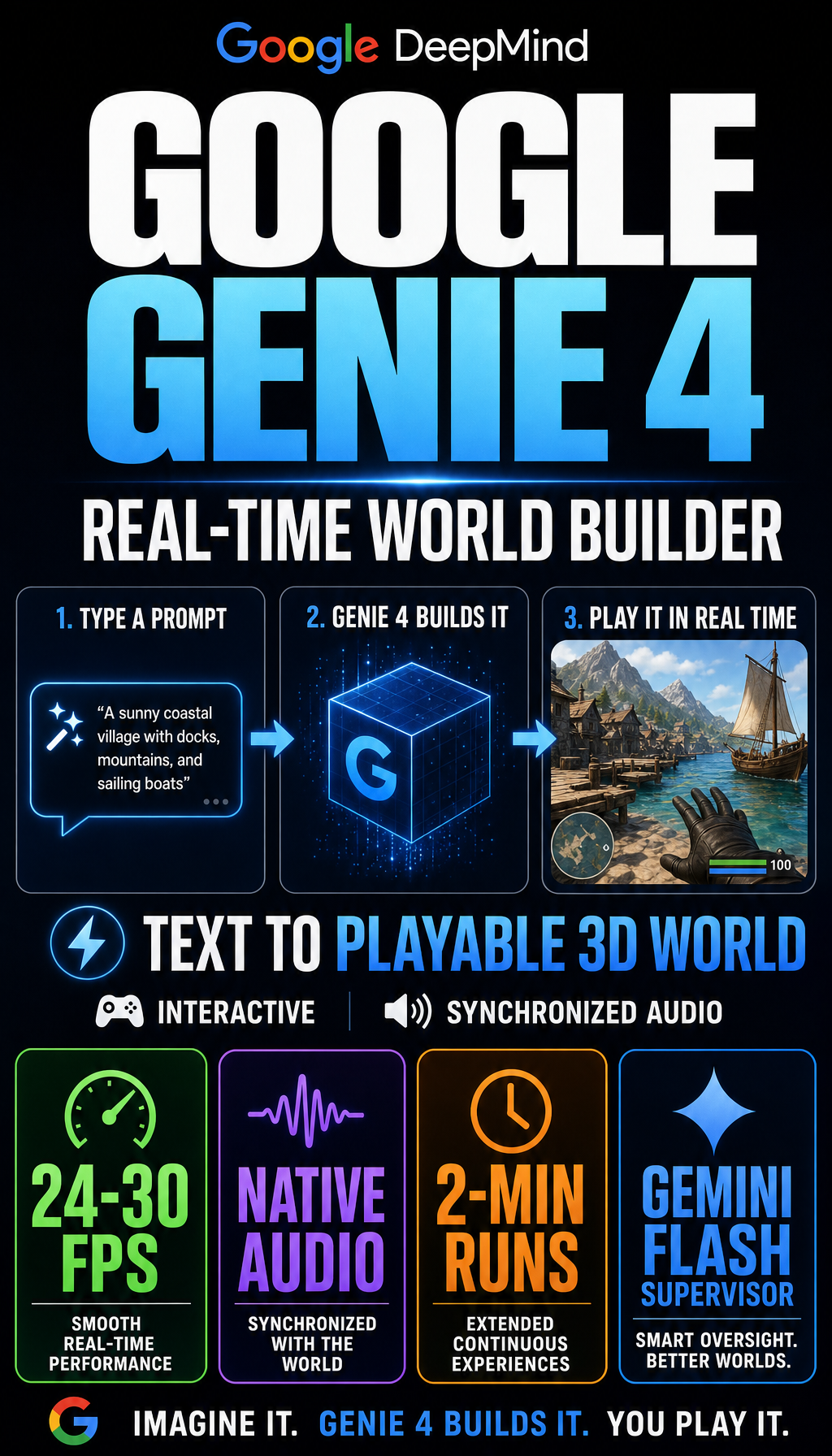
Visual breakdown of Google Genie 4 real-time interactive simulation, native audio, and supervisory reasoning.
Current Limitations: Detail Drift and Real-Time Safety Guardrails
Despite its dramatic improvements over Genie 3, Google Genie 4 still exhibits two primary technical constraints: visual detail drift over extended sessions and high computational infrastructure requirements. In extended runs past 90 to 120 seconds, textures can soften, character faces may warp slightly, and small background objects can hallucinate new positions.
To evaluate these failure points, Google DeepMind deploys **SIMA (Scalable Instructable Multiworld Agent)** to automatically play test runs inside generated Genie worlds. When SIMA encounters a broken barrier or an impossible collision boundary, the failure is logged to refine future training loss functions.
From a safety perspective, real-time photorealism introduces significant abuse risks. DeepMind addresses this through two layers:
- SynthID Watermarking: Every visual frame and audio waveform generated by Google Genie 4 is embedded with an invisible, tamper-resistant watermark to ensure AI-generated simulations cannot be falsely passed off as real-world surveillance or news footage.
- Active Scene Steering: Rather than abruptly severing user connections when an edge-case prompt is detected, the supervisory Gemini Flash agent actively steers the narrative and visual elements away from dangerous or harmful outcomes.
How to Access Google Genie 4: Rollout Roadmap and Project Genie
Google Genie 4 is rolling out in phased tiers, starting with enterprise research partners before opening to commercial subscribers via Project Genie on Google Labs and developers via Google AI Studio. Google is restricting initial access to carefully monitor compute load and real-time safety adherence.
Here is the official three-tier deployment rollout schedule:
Selected film production studios, game development houses, and academic robotics partners testing camera controls and fine-grained object interaction.
Available directly to Google AI Ultra subscribers inside Google Labs, allowing creators to generate custom interactive worlds via browser UI.
Programmatic access through the Gemini API and Google AI Studio, enabling developers to build custom interactive games, apps, and simulation workflows.
Frequently Asked Questions About Google Genie 4
Is Google Genie 4 free to use?
No. Google Genie 4 is not available as a free standalone public tool. When public consumer access launches via Project Genie on Google Labs, it will require an active Google AI Ultra subscription. Developer API pricing will be billed on a compute consumption basis through Google Cloud and Google AI Studio.
What is the difference between Google Genie 4 and Google Veo 3?
Google Veo 3 is an offline text-to-video diffusion model designed to generate cinematic, passive video clips for film editing and social content. Google Genie 4 is an action-controllable world model running live at 24 to 30 FPS, allowing users to physically navigate the environment using keyboard controls and speak to characters in real time.
Can games generated in Google Genie 4 be exported to Unreal Engine or Unity?
Not directly as 3D asset packages. Google Genie 4 generates rasterized video frames and audio streams on the fly rather than exporting traditional 3D polygon meshes, FBX character models, or C++ game scripts. However, developers frequently use Google Genie 4 for rapid prototyping and pre-visualization before rebuilding finalized scenes in game engines.
When will Google Genie 4 be available to the general public?
Google Genie 4 is currently restricted to Trusted Testers. Rollout to Google AI Ultra subscribers through Project Genie on Google Labs will begin in the coming weeks, followed by early access developer releases in Google AI Studio.