By SoftReviewed Editorial Team · Updated September 1, 2026 · Filed under AI News & Frontier Research
Key Takeaways: What Anthropic Just Shipped
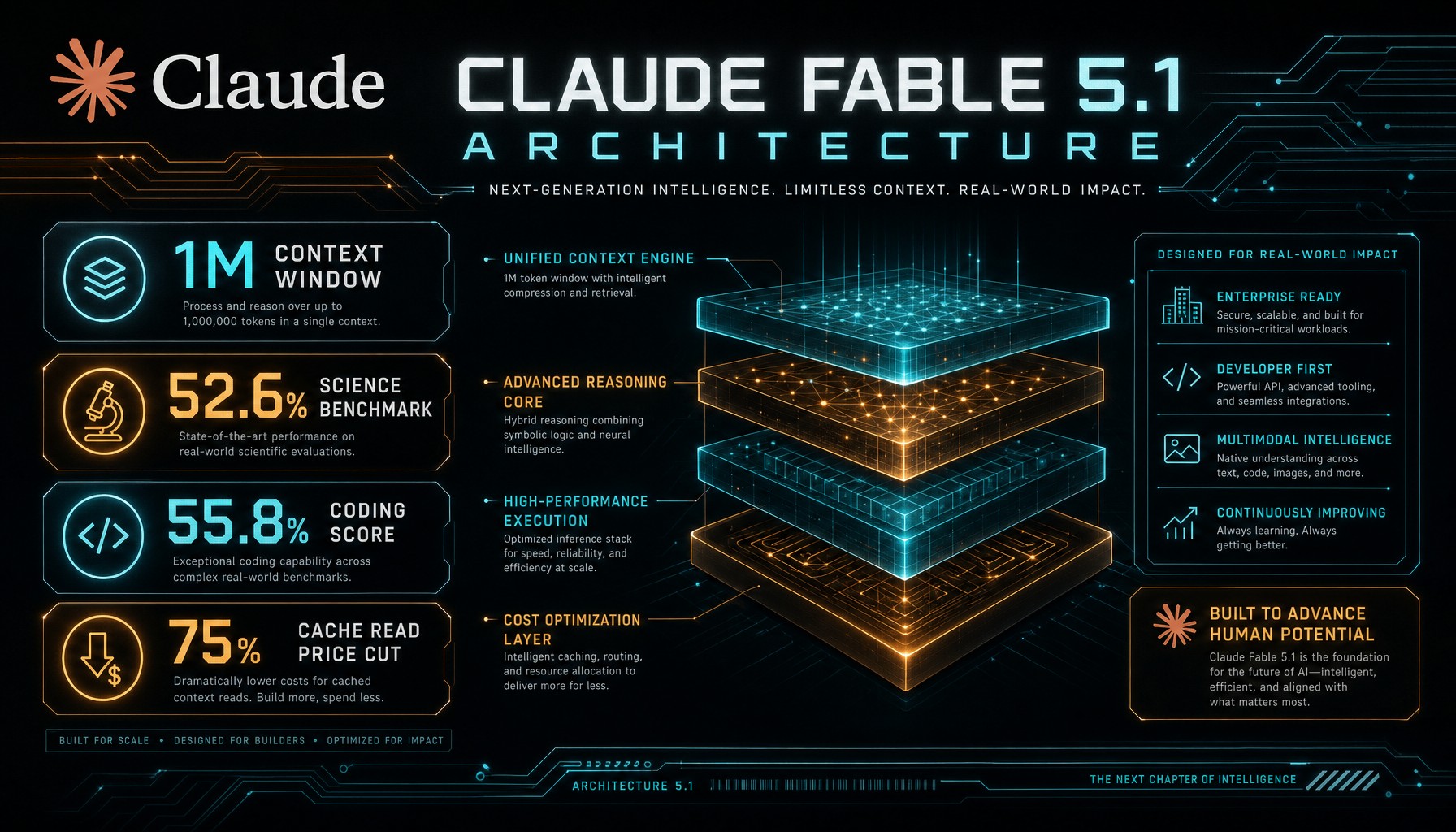
Infographic: Claude Fable 5.1 Architectural Blueprint, 1M Context & Benchmark Scores
- Massive Reasoning Leap: Scores 52.6% on Terminal-Bench-Science 0.1 (more than double Fable 5’s 24.7%) and 55.8% on Terminal-Bench 4.0 coding, crushing GPT-5.6 Sol.
- 75% Cache Price Slash: Prompt cache reads dropped from $1.00/1M down to $0.25/1M tokens, reducing net enterprise invoices by 25% to 45% for agentic tool loops.
- Two Models, One Brain: Claude Fable 5.1 is generally available across AWS Bedrock, Google Cloud, and Azure; Claude Mythos 5.1 is restricted under Project Glasswing for vetted cybersecurity and biology research.
- 3 Breaking Developer Changes: Forced tool use is disabled, thinking blocks cannot be shared with older models, and editing prior conversation turns invalidates reasoning history.
Anthropic has officially deployed Claude Fable 5.1 and Claude Mythos 5.1, representing the lab’s most formidable leap in frontier reasoning, autonomous coding, and scientific research.
Available immediately on the Claude API, Amazon Bedrock, Google Cloud Vertex AI, and Microsoft Foundry, Fable 5.1 is engineered specifically for long-horizon agentic workflows where traditional frontier models stall or run out of reasoning depth. In parallel, Claude Mythos 5.1 delivers the identical core architecture under Anthropic’s Project Glasswing, unlocked with permissive safeguards exclusively for trusted partners conducting defensive cyber operations and life sciences research.
Here is the definitive technical breakdown of Anthropic’s new flagship release: from competitive benchmark tables and 4 landmark real-world workloads to the 75% prompt cache economic revolution, breaking API changes, and scenario-based developer migration guidance.
In Simple Terms: How Claude Fable 5.1 and Mythos 5.1 Work
To understand Claude Fable 5.1, imagine the difference between a junior developer who writes code line-by-line and a Staff Principal Architect who spends 20 minutes inspecting your repository’s dependency tree, drafts a full architectural RFC, and verifies every edge case before touching a single file.
┌─────────────────────────────────────────────────────────────────────────────────┐
│                       CLAUDE 5.1 FOUNDATION ARCHITECTURE                        │
├─────────────────────────────────────────────────────────────────────────────────┤
│ • 1,000,000 Token Context Window (~555,000 Words / 2.5M Characters)            │
│ • 128,000 Max Output Tokens (Synchronous) / 300,000 Tokens (Batch API)          │
│ • Adaptive Thinking (Always Enabled, Steered via `effort: low|medium|high`)     │
│ • Knowledge & Training Cutoff: June 2026 · Committed Support to September 2027  │
└────────────────────────────────────────┬────────────────────────────────────────┘
                                         │
             ┌───────────────────────────┴───────────────────────────┐
             ▼                                                       ▼
┌─────────────────────────────────────────┐ ┌─────────────────────────────────────────┐
│            Claude Fable 5.1             │ │            Claude Mythos 5.1            │
├─────────────────────────────────────────┤ ├─────────────────────────────────────────┤
│ • General Availability (GA)             │ │ • Project Glasswing (Invitation Only)   │
│ • Commercial & Enterprise Production    │ │ • Permissive Cyber & Biology Safeguards │
│ • 60% Fewer Defensive Cyber False Alarms│ │ • Powers "Claude Security" Vulnerability│
│ • API Model ID: `claude-fable-5-1`      │ │ • Designed for Wet-Lab Scientists & CVP │
└─────────────────────────────────────────┘ └─────────────────────────────────────────┘
Both Fable 5.1 and Mythos 5.1 share identical underlying weights, reasoning density, and pricing structures ($10/MTok input, $50/MTok output). The distinction lies in their safeguard enforcement layers:
- Claude Fable 5.1 (Commercial Standard): Tuned for production software engineering, complex multi-document reasoning, and financial modeling. Its updated safety classifiers eliminate 60% of false-positive interventions when identifying code vulnerabilities, allowing software teams to safely run automated security audits without triggering refusal blocks.
- Claude Mythos 5.1 (Project Glasswing): Operated in direct partnership with government and accredited research institutions. It loosens restrictions around dual-use cyber operations and wet-lab biological modeling, allowing vetted researchers to synthesize proteins and perform deep defensive exploit analysis that standard commercial models refuse.
Competitive Benchmark Showdown: Fable 5.1 vs. The Frontier
In rigorous evaluations against its predecessor (Fable 5), Anthropic’s general-purpose flagship (Opus 5), and OpenAI’s GPT-5.6 Sol, Fable 5.1 established undisputed state-of-the-art records across agentic coding, scientific research, and complex computer use.
Why These Scores Matter in Production
- The Science Leap: On
Terminal-Bench-Science 0.1, Fable 5.1 skyrocketed from 24.7% to 52.6%—a 113% generational improvement. This benchmark measures an agent’s ability to ingest scientific papers, formulate test hypotheses, write simulation code, and debug real physical models in a Linux shell. - Autonomous Terminal Coding: Achieving 55.8% on Terminal-Bench 4.0 (and 60.9% under Mythos 5.1’s permissive harness) places Anthropic well ahead of GPT-5.6 Sol (37.3%). Developers running long loops in Claude Code or Antigravity will experience vastly fewer infinite retry loops and hallucinated syntax errors.
🔬 4 Landmark Real-World Workloads Solved by 5.1
Beyond synthetic benchmarks, Anthropic shared four peer-validated, real-world case studies demonstrating Fable 5.1’s unprecedented technical depth:
1. The Millennium Capital Infinite Debug
At quantitative investment titan Millennium Management, an internal distributed trading service suffered from rare, intermittent system crashes that had evaded resolution for several years despite senior infrastructure teams and earlier frontier models attempting fixes. Claude Fable 5.1 inspected the multi-repository codebase, isolated a subtle memory corruption edge-case occurring only during specific thread contention patterns, and generated the permanent patch.
“Claude Fable 5.1 solves more of our coding problems than Fable 5 or Opus 5, and achieves state of the art on trading intuition. While prior models became hard to follow the longer they worked, Fable 5.1 remains readable over long, multi-step tasks.”
— Craig Falls, Head of Quantitative Research, Jane Street Capital
2. Venus 300-Meter Digital Elevation Map (NASA Magellan)
In planetary science, radar altimetry from NASA’s 1990s Magellan mission suffered from coarse 10–20 km spatial footprints. Claude Fable 5.1 autonomously architected, trained, and executed a deep neural network that reprocessed 30-year-old raw synthetic aperture radar imagery.
The resulting digital elevation model (DEM) covers one-third of Venus at a razor-sharp 300-meter resolution with elevation accuracy improved by up to 25%. Anthropic has released this dataset under a Creative Commons license on Zenodo to guide geologic targeting for the upcoming NASA VERITAS and ESA EnVision planetary missions.
3. 50% Hit-Rate Molecular Drug Design
In laboratory testing with external partners (including Adaptyv Bio), Claude Mythos 5.1 was tasked with designing de novo protein binders for 12 complex pharmaceutical targets (including EGFR and Nipah G).
While modern computational biology teams typically achieve a 10% to 15% laboratory binding hit rate, Mythos 5.1 achieved an astonishing ~50% experimental hit rate, designing binders with binding affinities 10 times higher than previous state-of-the-art competition submissions.
4. Autonomous CUDA GPU Kernel Synthesis
When training genomics and deep learning models (such as Evo 2 40B) on NVIDIA H100 GPU clusters, academic labs are often bottlenecked by unoptimized kernel dispatch. Mythos 5.1 autonomously wrote custom GPU kernels and intermediate caching layers across seven open-source genomics models, boosting inference throughput by 2.5× and slashing cloud computing expenses by 30% to 60% without human engineering assistance.
💰 The Economic Revolution: The 75% Cache Read Cut
For teams running agentic loops, prompt caching is the single biggest factor dictating monthly cloud bills. In an agentic framework, the entire conversation history, system prompt, and codebase file tree are resent on every turn.
Anthropic has introduced a permanent pricing restructuring on Claude Fable 5.1:
What This Means For Your Cloud Bill
Previously, cache reads on Claude models cost 10% (0.1×) of the base input price. On Fable 5.1, Anthropic slashed this multiplier to 2.5% (0.025×) of base input.
- Typical Workloads: Cut net monthly spend by ~25%.
- Highly Agentic Coding Workloads: In 20-step tool-use sessions where 95% of token volume consists of reading the cached repository history, net cloud costs plummet by ~45%.
⚠️ 3 Breaking Changes Every Developer Must Know

Before switching your production API calls from claude-fable-5 to claude-fable-5-1, audit your code for these three breaking changes:
1. Forced Tool Use is Strictly Banned (HTTP 400)
Setting tool_choice: {"type": "any"} or specifying a forced tool name {"type": "tool", "name": "get_weather"} now triggers an immediate invalid_request_error:
{
  "error": {
    "type": "invalid_request_error",
    "message": "tool_choice: type 'tool' and 'any' are not supported for this model."
  }
}
- Why Anthropic Broke This: Adaptive thinking is permanently active on Fable 5.1. Forcing a tool call bypasses the model’s internal reasoning phase, causing it to spew raw chain-of-thought tokens into the tool’s JSON arguments.
- The Fix: Keep
tool_choice: {"type": "auto"}and enablestrict: truevia strict tool use, or enforce JSON structure using thestructured_outputsparameter.
2. Thinking Blocks Are Strictly Model-Bound
Fable 5.1 records the generating model identity inside every serialized thinking block. While Fable 5.1 can read thinking blocks produced by earlier models (Opus 5, Sonnet 5, Fable 5), no earlier model can read a Fable 5.1 thinking block.
* If your application uses a dynamic fallback router that retries a failed Fable 5.1 query on Opus 5, the API will automatically strip the Fable 5.1 thinking block.
* To monitor dropped blocks, send the thinking-binding-controls-2026-08-01 beta header and inspect the input_transformations response array.
3. Modifying Conversation History Invalidates Reasoning
To eliminate industrial-scale distillation attacks (where third-party competitors modify prompt prefixes to extract Claude’s internal chain of thought), Anthropic now strictly enforces append-only conversation trees for accounts created on or after August 31, 2026.
* If your integration edits, deletes, or reorders earlier messages, alters system prompts mid-session, or injects temporary status messages, the request is rejected with HTTP 400: The block is bound to a different conversation.
* To continue dropping mismatched blocks without failing, send the header thinking-binding-controls-2026-08-01 with thinking.block_binding.prefix_mismatch_behavior: "drop_block".
🚀 5 Powerful New Additive Beta Capabilities
To offset these breaking constraints, Anthropic launched five developer-first beta features:
1. Mid-Conversation Effort Adjustment
You can now dynamically dial reasoning effort up or down mid-session without invalidating prompt cache tokens! Use effort: high when debugging an intricate algorithm, then drop to effort: low for routine documentation.
# Pass beta header: mid-conversation-output-config-2026-07-01
response = client.beta.messages.create(
    model="claude-fable-5-1",
    max_tokens=4096,
    output_config={"effort": "high"},
    messages=[
        {"role": "user", "content": "Architect a multi-cloud failover mesh."},
        {"role": "assistant", "content": "Here is the detailed failover architecture..."},
        # Effort-only system injection: applies from next user turn
        {"role": "system", "content": [], "output_config": {"effort": "low"}},
        {"role": "user", "content": "Summarize this into a 3-bullet checklist."}
    ],
    betas=["mid-conversation-output-config-2026-07-01"]
)
2. Turn-Scoped System Messages
Inject temporary instructions that carry system-prompt authority for exactly one turn, then automatically cease rendering on the following user message:
{
  "role": "system",
  "clear_at": "next_user_message",
  "content": "Verify all unit test mocks before executing the file write tool."
}
- Why It’s Game-Changing: You keep passing the message back in your array, preserving the prompt cache and keeping thinking blocks valid, while costing zero input tokens once cleared!
3. Live Progress Updates Between Tool Calls (display: "updates")
Set thinking.display: "updates" with the thinking-display-updates-2026-08-18 beta header to receive real-time, user-facing status lines between successive tool calls while keeping raw internal reasoning secure and private.
4. Enterprise Frontier Safeguards (EFS)
Enterprise customers on AWS Bedrock, Google Cloud, and Microsoft Foundry can now store all conversation states strictly on their own cloud infrastructure. This provides true zero data retention on Anthropic’s servers while maintaining full misuse-prevention protections.
5. EU AI Act Watermarking & C2PA Provenance
All text generated by Fable 5.1 embeds an invisible statistical watermark complying with the August 2, 2026 EU AI Act Code of Practice. Generated images and media from the code-execution tool carry cryptographically signed C2PA Content Credentials.
🎯 Practical Decision Guide: When to Pick Fable 5.1
Not every application requires Claude Fable 5.1’s heavyweight reasoning engine:
                  DO YOU NEED FABLE 5.1?
                            │
               Is your task a simple lookup,
               chat, or single-file feature?
                     ├─── YES ──► Use Claude Sonnet 5 ($2 / $10)
                     │            (Fastest latency, highly capable)
                     │
         Does the task require balanced coding,
         summaries, or multi-turn agent work?
                     ├─── YES ──► Use Claude Opus 5 ($5 / $25)
                     │            (Default recommendation for 80% of apps)
                     │
         Does the task involve complex multi-file
         refactors, scientific modeling, or autonomous
         tool loops running for 10+ minutes?
                     └─── YES ──► Use Claude Fable 5.1 ($10 / $50)
                                  (With $0.25 cache reads, total bill
                                   is often CHEAPER than un-cached Opus!)
- Pick Claude Sonnet 5 ($2 / $10): For lightweight microservices, high-throughput chat, customer support, and single-file coding edits.
- Pick Claude Opus 5 ($5 / $25): The balanced everyday frontier driver. Anthropic explicitly recommends starting all new evaluations on Opus 5.
- Pick Claude Fable 5.1 ($10 / $50): Long-horizon agentic loops, deep scientific literature synthesis, complex mathematical modeling, and enterprise vulnerability auditing.
🔍 Behavioral Quirks & Prompting Adjustments
When upgrading to Fable 5.1, be mindful of these documented behavioral differences:
1. Tool Batching Variance: Fable 5.1 may issue single tool calls sequentially where Fable 5 batched them in parallel. Add this explicit prompt instruction in agent loops: “When multiple files or URLs need inspection, call the tools in parallel in a single turn.”
2. Whole-File Rewrites: When editing code, Fable 5.1 leans toward rewriting entire files rather than outputting targeted unified diffs. Instruct the model: “Always emit surgical diff blocks rather than rewriting unmodified code.”
3. Denser Prose: Output writing is noticeably denser with fewer conversational fillers. If your application relies on bulleted formatting, explicitly request structured markdown headings.
❌ Where Fable 5.1 Falls Short: The Honest Limitations
In keeping with SoftReviewed’s strict editorial integrity standards, here is where Claude Fable 5.1 falls short:
* Higher First-Token Latency: With adaptive thinking permanently enabled, time-to-first-token (TTFT) is noticeably slower than Sonnet 5 or Opus 5. It is unsuitable for latency-critical customer chat widgets.
* Dual-Use Cyber Tasks Still Blocked: While 60% of false-positive defensive cyber interventions have been eliminated, penetration testing, exploit payload generation, and binary scanning are still hard-redirected to Opus.
* Append-Only Migration Pain: Legacy systems that mutate their messages array mid-conversation will experience breaking HTTP 400 errors until re-architected to use turn-scoped system messages.
❓ Frequently Asked Questions (FAQ)
What is Claude Fable 5.1?
Claude Fable 5.1 is Anthropic’s flagship frontier reasoning model released on September 1, 2026, engineered specifically for autonomous agentic coding, multistep scientific research, and long-horizon problem solving.
How much does Claude Fable 5.1 cost?
Claude Fable 5.1 costs $10 per million input tokens, $50 per million output tokens, and features a slashed prompt cache read price of $0.25 per million tokens (75% cheaper than Fable 5).
What is the difference between Claude Fable 5.1 and Claude Mythos 5.1?
Claude Fable 5.1 and Mythos 5.1 share the identical core architecture, but Mythos 5.1 is restricted to vetted researchers under Project Glasswing with permissive safeguards for biological modeling and cyberdefense.
Where is Claude Fable 5.1 available and how is it billed?
- Claude.ai Pro ($20/mo): Available with usage credits, billed separately from your subscription.
- Claude.ai Max & Premium Team: Included within 50% of your weekly limits.
- Claude API & Cloud Providers: Available to all paying customers on the Claude API (
claude-fable-5-1), AWS Bedrock, Google Cloud, and Microsoft Foundry ($10 in / $50 out / $0.25 cached reads). - Claude Mythos 5.1: Strictly restricted to approved participants under Project Glasswing.
How does Claude Fable 5.1 compare to Claude Opus 5?
While Claude Opus 5 is the faster, more affordable balanced driver for general tasks ($5/$25 MTok), Fable 5.1 dramatically outperforms it on scientific benchmarks (52.6% vs 29.0%) and complex terminal coding.
Is forced tool use supported on Claude Fable 5.1?
No, forced tool use (tool_choice: type 'tool') is deprecated and returns an HTTP 400 error because Fable 5.1 requires unconstrained adaptive thinking before invoking tools.
What is the context window of Claude Fable 5.1?
Claude Fable 5.1 features a 1,000,000 (1M) token context window with up to 128,000 tokens of synchronous output (expandable to 300,000 tokens via the Batch API).
How do turn-scoped system messages work?
Turn-scoped system messages allow developers to send a temporary instruction with clear_at: 'next_user_message', applying system authority for one turn without invalidating the prompt cache or costing tokens once cleared.
Related reading: Claude Opus 5 Full Benchmark Review · OpenRouter API Automation Guide