

🤖 Nova Act vs. Competitors: Web Automation Performance
Comparing the latest AI web automation tools and their capabilities for browser-based tasks
🏆 Performance Benchmark
Nova Act achieves 94% accuracy on ScreenSpot Web Text benchmark, outperforming competitors:
🔄 Autonomy Comparison
Nova Act scores 9/10 for autonomy in executing complex web workflows independently, including handling dropdown menus and pop-ups, versus Claude Computer Use’s 8/10. Nova Act excels at navigating complex web interfaces with minimal human intervention.
🌐 Operational Scope
Nova Act specializes in browser-based automation without traditional APIs, making it ideal for web scraping and form automation. Meanwhile, Claude Computer Use focuses on desktop environment interaction with mouse, keyboard, and screen control capabilities.
⚙️ Development Approach
Nova Act offers a hybrid functionality combining plain language instructions with Python scripting and Playwright integration for sophisticated browser manipulation. Claude takes a different approach, acting more like a human computer user with direct interface interaction.
🚀 Implementation Status
Nova Act is available as a Python SDK in research preview targeting commercial applications, whereas Claude Computer Use operates in beta form. Nova’s development roadmap suggests faster progression toward enterprise-ready solutions.
💰 Cost Efficiency
Nova Lite delivers 79% of Premier’s capabilities at 52x lower cost, suggesting significant cost-performance advantages for appropriate use cases. This makes Nova particularly attractive for organizations seeking to balance performance with budget constraints.
The "Do-Bot" Era Has Arrived: Amazon Nova Act Hits General Availability
The era of the chatty AI assistant is ending; the era of the "digital employee" has begun. On December 2, 2025, Amazon Web Services (AWS) announced the General Availability (GA) of Amazon Nova Act, a service designed to do what previous AI agents could only promise: reliably control a web browser to execute complex, multi-step workflows without constant human babysitting.
While competitors like Anthropic and OpenAI have dazzled the internet with "computer use" demos, AWS has quietly focused on the one metric that matters for enterprise adoption: reliability. By claiming a task completion rate of **over 90%**—a massive leap from the industry standard of 70-80%—Amazon is signaling that Agentic AI is ready to move from the research lab to the payroll.
Powered by the custom Amazon Nova 2 Lite model, this isn't just a chatbot with a mouse. It’s a specialized worker bee trained in simulated "gyms" to navigate the messy, unpredictable web, integrating directly with tools like 1Password to solve the biggest headache in automation: security.
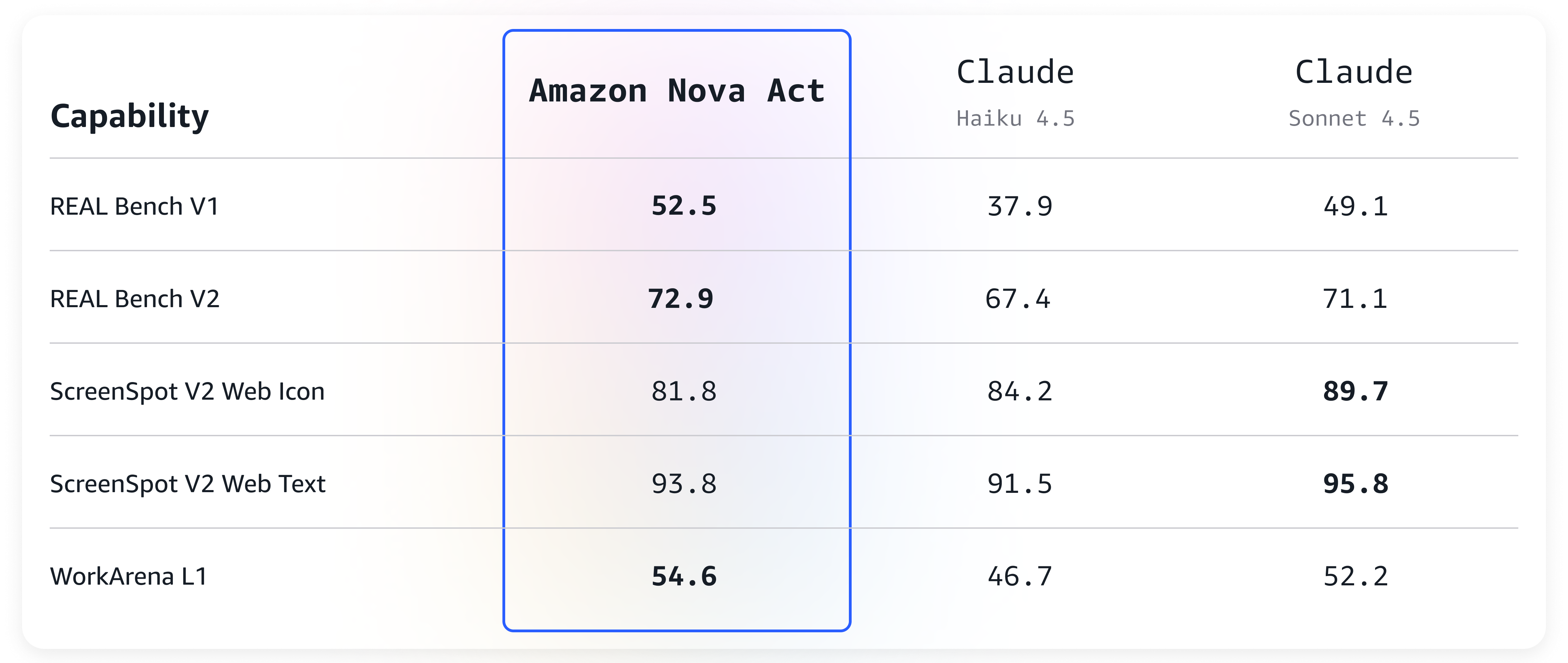
Above: The Nova Act workflow, moving from natural language requests to execution in a secure, simulated browser environment.
Fast Facts: The Nova Act Cheat Sheet
- Launch Status: Generally Available (GA) as of Dec 2, 2025.
- Region: US East (N. Virginia).
- Core Tech: Powered by Amazon Nova 2 Lite, optimized for speed and low latency.
- Reliability: >90% task success rate (verified by early adopters like Hertz).
- Pricing Model: Hourly-based pricing (pay for active agent time), NOT token-based.
- Key Integration: Native 1Password support for handling login credentials securely.
- Developer Tools: Extensions for VS Code (Kiro) and a new "Nova Act Playground" for no-code prototyping.
Inside the "Web Gyms": How Amazon Solved the Reliability Crisis
The biggest dirty secret of Agentic AI has been fragility. Traditional agents, often powered by generic LLMs, struggle when a website updates its CSS, a pop-up appears, or a "Submit" button moves two pixels to the left. They hallucinate, get stuck, or click endlessly on dead links.
Amazon’s solution is the "Web Gym."
Instead of training Nova Act on static text, AWS trained the model using Reinforcement Learning (RL) inside thousands of simulated, synthetic web environments. These "gyms" mimic real-world scenarios—e-commerce checkouts, flight booking forms, CRM dashboards—and punish the model for inefficiency while rewarding it for successful task completion.
This "vertical integration" means the model, the orchestrator (the brain planning the steps), and the actuator (the virtual mouse/keyboard) are all trained as a single unit. The result is an agent that doesn't just "guess" where to click; it "reasons" through the interface. If a pop-up blocks a button, Nova Act knows to close it. If a page loads slowly, it waits. This adaptability is what drives that 90%+ reliability figure, making it the first agent truly viable for mission-critical workflows like Quality Assurance (QA) testing and financial data entry.
Hertz: The Early Win
According to the official launch announcement, rental giant Hertz used Nova Act to automate their QA testing. The result? Processes that used to take weeks of manual clicking were reduced to hours, accelerating their shipping velocity by 5x.
The Economic Shift: Hourly Wages vs. Token Taxes
One of the most disruptive aspects of Nova Act is its business model. Competitors like Anthropic’s "Computer Use" typically bill by the token—every pixel the AI "sees" and every action it plans costs money. For a long-running browser task that might need to process megabytes of HTML and screenshots, costs can spiral uncontrollably.
Amazon has flipped this script. Nova Act introduces an hourly-based pricing model. You pay for the time the agent is active, effectively hiring a digital temp worker at a flat hourly rate. This provides predictability for finance teams and aligns incentives: AWS is incentivized to make the model faster, not chattier.
The Security Fortress: 1Password Integration
Giving an AI control of your browser is terrifying. Giving it your login credentials is insane. That has been the consensus among security professionals—until now.
In a strategic move, AWS partnered with 1Password to solve the "auth problem." As detailed in the 1Password official blog, Nova Act agents can retrieve credentials directly from a secure vault at runtime.
- No Hardcoding: Developers never paste passwords into their code or prompts.
- No Leaks: The agent authenticates without the human developer ever seeing the plaintext password.
- Audit Trails: Security teams can see exactly which agent accessed which credential and when.
This integration removes the single biggest blocker for enterprise adoption: trust.
Nova Act vs. The Field: A New Category of "Headless" Employees
| Feature | Amazon Nova Act | Anthropic "Computer Use" | OpenAI Operator |
|---|---|---|---|
| Primary Focus | Browser-based Enterprise Workflows | General Desktop Control | General Task Automation |
| Reliability | >90% (Optimized for Web) | Variable (Beta/Generalist) | High (Consumer focus) |
| Pricing | Hourly (Time-based) | Token-based (Usage) | Token/Subscription |
| Environment | Headless / Cloud-based | Local / Desktop | Browser / OS |
| Best For | QA, Data Entry, "Back office" scale | Ad-hoc complex tasks, Coding | Individual productivity |
Nova Act is clearly positioning itself not as a "copilot" for individuals, but as a fleet for enterprises. It supports "headless" mode—running invisibly in the cloud without a graphical interface—which allows companies to spin up 1,000 agents simultaneously to perform massive data migration or testing tasks overnight.
The "Dark Side": Risks of the Digital Workforce
While 90% reliability is impressive, the remaining 10% failure rate is the danger zone.
- The "Loop of Death": If an agent gets stuck in a checkout flow, it could theoretically order 500 units instead of 5 if not properly guardrailed. AWS has introduced "human-in-the-loop" checkpoints to mitigate this, but the risk remains.
- Job Displacement: This isn't just "augmenting" humans; it is directly replacing tasks currently done by QA testers, data entry clerks, and junior analysts. The "hourly wage" of a Nova Act agent is likely cents on the dollar compared to a human worker.
- The CAPTCHA War: As agents become more common, websites may ramp up anti-bot defenses (CAPTCHAs, Cloudflare challenges), creating an arms race between AWS's "web gyms" and security vendors trying to block them.
Start Your Engine: A Quick Guide to "Acting"
For developers ready to hand over the keys, the process is surprisingly standardized:
- The Playground: Visit
nova.amazon.com/actto try the "No-Code" builder. You can type "Go to Amazon.com, search for 'mechanical keyboard', and add the first result to cart," and watch the agent execute it in a live window. - The IDE: Install the Nova Act extension for VS Code (or Kiro). This lets you export your playground prompt into Python code.
- The Deploy: Use the extension to containerize your agent and deploy it to AWS. It automatically handles the provisioning of IAM roles, S3 buckets for logs, and the ECR container registry.
Frequently Asked Questions (FAQ)
Can Nova Act access my local computer?
No. Unlike Anthropic’s tool which can control your local desktop, Nova Act runs in a secure, sandboxed cloud environment (or "headless" browser). It is designed for web workflows, not for organizing your desktop folders.
Is it safe to give it my credit card info?
You should never give it raw credit card info in a prompt. Use the 1Password integration or a secure payment tokenization method. AWS specifically warns against hardcoding sensitive data.
What happens if the website changes its layout?
This is Nova Act's superpower. Because of its visual reasoning capability, it doesn't rely on brittle "XPaths" or CSS selectors. It "looks" at the page like a human. If the "Login" button moves to the right, the agent sees it and clicks it anyway.
How much does it cost?
While specific hourly rates vary by region and instance size, the billing is based on the duration of the workflow execution. You stop paying the moment the task is done.
The Future of Work is "Headless"
Amazon Nova Act represents a maturation of the AI hype cycle. We are moving away from "magical" demos that break half the time, toward "boring" industrial-grade reliability. By solving the three pillars of Reliability (Web Gyms), Cost (Hourly Pricing), and Security (1Password), AWS has effectively built the world's first scalable digital workforce.
For the enterprise, the question is no longer "Can AI do this?" but rather "How many hours of digital labor should we buy this month?"







