🎬 45-Second Video Briefing: The Indian IT Model Inversion
YouTube Short
⚡ Produced via Remotion & Jogg AI | Cloned Voice Sync
⚡ Executive Summary: The Indian IT Paradigm Inversion
Verified Industry Data
Client Price Deflation Demanded
(Persistent Systems / Reuters)
Outcome Contracts in Ops/Finance
(TCS CEO K. Krithivasan)
AI Cost-Savings Gain Share
(Cognizant + Daimler Truck Deal)
Margin Spread (Fixed vs T&M)
(Tech Mahindra CFO Disclosure)
Headcount Value Valuation Shift: 1995 vs. 2026
100% Billable Leverage
30% Compressed Footprint
👉 Why Hourly Billing (Time & Materials) Is Mathematically Broken
The Efficiency Dilemma: Under traditional Time & Materials (T&M), an IT vendor bills clients $35/hour per engineer. If generative AI and autonomous coding agents compress a 40-hour testing task into 2 hours, billing by the hour destroys 95% of the vendor’s top-line revenue for the exact same deliverable. Shifting to outcome-based and fixed-price contracts allows vendors to capture an 8% operating margin premium while giving clients 25% cost reductions.
👉 What This Means for Engineering Graduates & Urban Tech Hubs
The Campus Pyramid Collapse: Mass recruitment of 100,000+ freshers per year to sit on “benches” is permanently over. Entry-level hiring has dropped by over 45% across Bengaluru, Pune, Hyderabad, and Chennai. However, a bifurcated salary landscape has emerged: basic manual coding roles (₹3.5 LPA) are vanishing, while AI-fluent orchestrators commanding ₹8–14 LPA packages see intense enterprise demand.
💡 In Simple Terms: How AI Broke the 30-Year IT Cab Meter
For three decades, the foundational engine of India’s $250 billion IT services industry operated on a delightfully simple equation: labor arbitrage billed by the clock. If an enterprise bank in New York or an automotive conglomerate in Stuttgart required software maintenance, an Indian IT giant assigned 50 software engineers, charged $35 per billable hour, and recorded steady, predictable revenue.
🚖 The Broken Taxi Meter Analogy
Think of the traditional Time & Materials (T&M) contract as a taxi meter. The driver (the IT vendor) gets paid for every minute the cab is moving and every mile traveled. If traffic is slow or the route takes longer, the driver makes more money. Generative AI is equivalent to instant teleportation. If you teleport instantly to your destination, a meter running on time records zero dollars. To survive, the transportation company must stop selling “minutes in a car” and start selling “guaranteed arrival at your destination”—priced as a fixed ticket.
This is precisely why India’s IT sector is experiencing a commercial earthquake. Generative AI copilots, automated unit-testing pipelines, and autonomous agent loops have compressed engineering workflows that once took two weeks down to forty-five minutes. Under an hourly rate card, greater technical efficiency leads directly to lower vendor revenue. To prevent self-cannibalization, the entire commercial framework is being rewritten from input effort to delivered business outcomes.
📊 Executive Evidence: The Industry Shift on the Record
This transformation is no longer speculative boardroom forecasting; it is confirmed on the record in corporate disclosures, investor earnings calls, and multi-year master service agreements (MSAs):
1. Persistent Systems: Fighting 30% Client Deflation with Proprietary AI
CEO Sandeep Kalra to Reuters: Clients are now actively entering contract negotiations demanding the identical software deliverables for 20% to 30% less money, delivered faster with higher productivity metrics.
To defend profit margins against this pricing compression, Persistent is deploying proprietary IP suites—including SASVA, GenAI Hub, and iAURA. By packaging proprietary AI agents into the delivery cycle, the firm captures value from software acceleration rather than billing manual hours.
2. TCS: 80% Outcome Pricing Across Enterprise Services
CEO K. Krithivasan Disclosure: Over 80% of TCS contracts in finance, human resources, and business operations are now structured around outcome performance metrics—a figure that has doubled since late 2023.
Furthermore, during recent annual shareholder addresses, leadership projected a future operational balance where TCS deploys an equal proportion of AI autonomous agents alongside human personnel, powered by enterprise platforms like TCS AI WisdomNext and Cognix.
3. Cognizant + Daimler Truck: The Gain-Share Blueprint
Contractual Gain-Sharing: In a landmark multi-year digital transformation deal signed with Daimler Truck, the contract explicitly mandates a direct split of AI-driven cost savings between Cognizant and the client.
As Cognizant stated to Reuters: “With AI, the fundamentals are shifting. Clients now expect more value and measurable outcomes.” Fixed-price revenues at Cognizant have climbed to 47% ($10 billion), while Time & Materials billings have steadily contracted.
🥊 Commercial Model Comparison: T&M vs. Fixed vs. Gain-Share vs. Agent Licensing
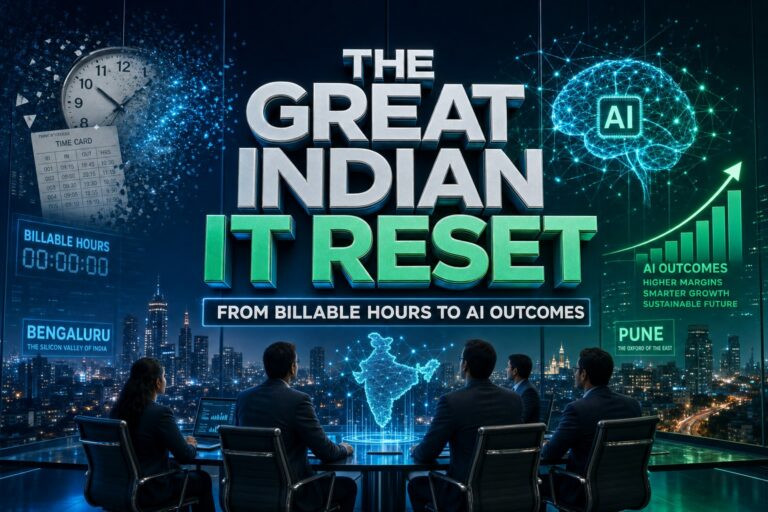
To understand why vendor balance sheets and client procurement teams are colliding, we must examine how revenue, risk, and AI productivity interact across the four major IT contracting models:
| Contract Model | Billing Driver | AI Productivity Impact | Operating Margin | Primary Risk Bearer |
|---|---|---|---|---|
| Time & Materials (T&M) | Hours logged × Hourly rate | ❌ Revenue Destruction (Fewer hours billed) | Baseline (14% – 16%) | Client (Pays for inefficiency) |
| Fixed-Price Milestone | Predetermined scope completion | ✅ High Margin Capture (Deliver in less time) | +8% Margin Premium | Vendor (Absorbs project overruns) |
| Gain-Share / Outcome | % of audited business cost reduction | ⚡ True Co-Innovation (Scales with efficiency) | 22% – 28% (High Upside) | Shared (Baseline SLA penalties) |
| Agentic Seat Licensing | Monthly recurring fee per autonomous agent | 🚀 Pure SaaS Leverage (Infinite scaling) | 35%+ (Software Margins) | Client (Token & inference costs) |
Note on Profitability: Tech Mahindra CFO Rohit Anand confirmed on record that fixed-price projects offer an operating margin gap close to 8 percentage points higher than Time & Materials deals. As automation tools lower internal delivery costs, fixed contracts allow the IT firm to capture that delta as pure profit.
🔬 The 7-Year Reality Check: AI Nonlinearity vs. Lean Headcount
While industry executives highlight soaring “Revenue per Employee” metrics, long-term empirical data reveals a nuanced underlying truth. According to financial audits and research by Unearthed Insight:
📊 The 60/40 Productivity Split
Approximately 60% of the recent revenue-per-employee increase across Indian IT majors is driven by workforce rationalization (headcount reduction, reduced bench strength, and delayed lateral backfills), while 40% stems from genuine AI-driven technical productivity gains.
Over a 7-year compound horizon (incorporating the cloud migration era and the GenAI wave), revenue-per-employee growth has remained remarkably modest across tier-1 majors: Infosys achieved a 2.47% CAGR, TCS 0.59%, and HCLTech 0.45%, while Wipro registered -1.45%. Historically, firms pulled the utilization lever—forcing existing engineers to log more billable hours while shrinking non-billed bench talent.
However, the industry has reached the mathematical ceiling of human utilization. As equity research analysts at Nuvama Global point out, the focus has permanently shifted to “Profit per Employee” and nonlinear delivery: expanding gross revenue without adding headcount in parallel.
🏙️ Socio-Economic Ripple Effects: Rewriting the Middle-Class Ladder
The human consequence of outcome-based contracting extends far beyond quarterly balance sheets. For three decades, the Indian urban middle class across Bengaluru, Pune, Hyderabad, and Chennai was substantially built by IT firms hiring 300,000 to 500,000 engineering graduates annually on stable, predictable salary paths.
❌ The Old Model: Mass Campus Pyramid
Recruit thousands of freshers from Tier-2/3 engineering colleges, place them in 3-month Java/C++ bootcamps, maintain a 15% bench buffer, and deploy them on manual testing, bug ticketing, and documentation.
✅ The 2026 Reality: High-Leverage AI Pods
Smaller, cross-functional squads of 3–5 senior architects supervising autonomous agent swarms. Entry-level hiring drops in volume by 45–50%, while candidates proficient in agent orchestration command starting packages of ₹8–14 LPA.
As Microsoft India & South Asia President Puneet Chandok noted recently: “The days of stable, long-term careers are unfortunately over… the actual threat to employment will come in the form of refusal to learn.” The promise that an engineering degree alone guarantees lifetime employment is not broken—it has simply been tied to software leverage.
📉 Where the Model Falls Short: 4 Critical Risks in Outcome Contracting
While outcome-based and gain-share contracting appears universally advantageous on paper, enterprise implementations encounter severe operational friction:
1. The Attribution Dilemma
In gain-share deals, determining what percentage of dollar savings arose from vendor AI agents versus internal client process optimizations often sparks bitter contractual disputes during quarterly reconciliations.
2. Hallucinated Code & SLA Penalties
Under fixed-outcome terms, if AI-generated code introduces security flaws or system downtime, the vendor absorbs the entire financial penalty without billable hours to buffer remediation costs.
3. Top-Line Cannibalization Dip
If an IT major automates existing multi-year T&M accounts before renegotiating them under outcome terms, top-line revenue temporarily contracts by 20%–30%, impacting quarterly market valuations.
4. Enterprise Procurement Squeeze
Sophisticated enterprise procurement departments are benchmarking vendor AI tool efficiencies (Cursor, Copilot, Claude) to aggressively force down baseline prices before agreeing to outcome incentives.
🎯 Practical Playbook: How Engineers & Graduates Can Thrive
To remain irreplaceable in an outcome-driven ecosystem, software engineers and graduating students must shift from manual syntax generation to system orchestration:
- Master Autonomous Agent Frameworks: Move beyond single-prompt chatbots. Gain fluency in agentic multi-file workflows (LangGraph, CrewAI, Claude Code, Cursor, Cline).
- Anchor in Domain Architecture: AI can write SQL queries and React components, but it cannot navigate complex regulatory frameworks in European banking or FDA medical compliance. Deep domain context is your ultimate moat.
- Embrace the “Forward-Deployed Engineer” Mindset: Modern IT delivery requires engineers who can interface directly with enterprise clients, diagnose business bottlenecks, and deploy automated agent pipelines within hours.
- Prioritize System Verification Over Writing Code: As AI generates 80% of routine code, human value concentrates in architectural review, security boundary verification, and edge-case testing.
❓ Frequently Asked Questions (FAQ)
Is the Indian IT industry dying because of AI?
No, the industry is transitioning, not dying. While revenue growth is decoupling from massive headcount expansion, gross industry revenue continues to expand as enterprises spend heavily on AI modernization, data architecture, and cloud migration.
Why are Indian IT companies laying off and cutting campus hiring?
AI has automated routine entry-level tasks. Basic testing, bug triaging, documentation, and routine boilerplate coding are increasingly executed by internal AI agents, drastically reducing the need for large unbilled benches of junior engineers.
Which Indian IT companies are leading in the AI shift?
TCS, Infosys, Persistent Systems, and Cognizant are leading commercial transformation. TCS has shifted 80% of ops contracts to outcome pricing; Persistent leverages proprietary IP like SASVA; Infosys drives digital deals via Topaz; and Cognizant is pioneering direct gain-share contracts with Fortune 500 leaders.
Why don’t Indian IT firms build foundation models like ChatGPT?
Competing with $10B frontier research labs is economically irrational for services firms. As Infosys co-founder Nandan Nilekani outlined, India’s true strategic advantage is applied AI execution—orchestrating global foundation models (Claude, OpenAI, Gemini) securely within enterprise workflows.
Will Indian IT stocks recover in FY26–FY27?
Recovery will favor firms with high fixed-price and outcome pricing leverage. Companies that successfully protect their operating margins through proprietary AI platforms and gain-share contracts will see valuation expansion, whereas firms reliant purely on hourly labor arbitrage will face prolonged margin compression.