Verified Industry Report
Executive Summary: The OpenAI vs Cursor / SpaceX Split
- The Termination Notice: OpenAI officially exercised its custom contract Change of Control provision following SpaceX’s $60 billion acquisition of Anysphere, setting a firm model shut-off date of November 12, 2026.
- The Trust Breakdown: OpenAI explicitly cited federal court records where Elon Musk admitted under oath that xAI used OpenAI model outputs for distillation and training. OpenAI refused to allow Cursor telemetry to feed xAI’s Memphis cluster.
- Upcoming Model Blacklist: Cursor is permanently barred from receiving OpenAI’s upcoming autonomous coding reasoning model, codenamed Astra, and future o-series checkpoints.
- The Sovereign 1.5T Pivot: Cursor has shifted its core development to co-training a proprietary 1.5-trillion parameter model on xAI’s 1-million H100 GPU Colossus supercomputer in Memphis, alongside default routing via Grok 4.6, Claude Opus 5, and in-house Composer 2.5.
- Developer BYOK Transition: Individual engineers and enterprises wishing to continue utilizing GPT-5.6 Sol or o1 inside Cursor must transition to Bring-Your-Own-Key (BYOK) API billing.
Watch our 47-second video breakdown of the OpenAI vs SpaceX Cursor split.
1. The Breakup: Why OpenAI Invoked the Change of Control Clause
For nearly four years, the developer ecosystem operated under a fragile symbiotic peace: Cursor (developed by San Francisco startup Anysphere) built the world’s most popular AI-first code editor, while OpenAI supplied the underlying frontier reasoning engines. Millions of software engineers built production codebases relying on native GPT-4, GPT-4o, and o-series integrations embedded directly into Cursor’s Composer panel.
On August 28, 2026, that partnership officially dissolved. OpenAI notified SpaceX and Anysphere of its formal decision to terminate its commercial model supply agreement, establishing a strict shut-off date of November 12, 2026.
OpenAI did not wait for the contract to expire naturally. Instead, leadership invoked a specific, pre-negotiated enterprise mechanism: the Change of Control clause. In commercial software agreements, change-of-control provisions grant a supplier a limited 30-to-90-day cancellation window if the customer is acquired by an unaffiliated third party—particularly a direct competitor.
When SpaceX officially completed its $60 billion all-stock buyout of Anysphere on August 14, 2026, following SpaceX’s historic public offering, Cursor transitioned from an independent tooling startup into a core asset of Elon Musk’s industrial compute ecosystem. For OpenAI, continuing to supply frontier models to an entity owned by its fiercest commercial rival became an untenable strategic vulnerability.
2. In Simple Terms: How the $60B Deal Broke the Model Supplier Dynamic
The Restaurant Analogy
Think of Cursor as the most popular restaurant in the city. Every table is packed, but for years, Cursor did not grow its own produce—it bought all its premium ingredients from a supplier named OpenAI. Suddenly, a rival restaurant conglomerate (SpaceX/xAI) buys Cursor for $60 billion, brings in its own mega-farms (the Memphis Colossus supercomputer), and announces plans to sell its own proprietary dishes (Grok-Code). OpenAI immediately stopped delivering its secret ingredients to prevent its recipes from being copied and served across the street.
The Economic Pressure That Forced the Acquisition
To understand why Anysphere accepted SpaceX’s buyout, one must examine the brutal unit economics of AI IDEs between 2023 and 2025. While Cursor achieved unprecedented commercial velocity—scaling from $1 million to over $100 million in Annual Recurring Revenue (ARR) within 12 months with just 60 employees—it was trapped in a crippling supplier squeeze.
At $500 million in top-line run-rate, Cursor was paying approximately $650 million annually in API token costs back to OpenAI and Anthropic. Power users executing agentic multi-file refactoring loops frequently consumed hundreds of dollars in API compute per month on standard $20/month Pro subscriptions. Anysphere required either massive sovereign compute infrastructure or face eventual insolvency at the hands of its own model suppliers.
3. The Distillation Accusation: What Elon Musk Admitted Under Oath
The core justification presented in OpenAI’s executive statement centers on a profound deficit of commercial trust, specifically referencing ongoing federal litigation between OpenAI and Elon Musk.
In its formal disclosure, OpenAI highlighted that during sworn legal proceedings earlier in 2026, Elon Musk admitted that xAI had utilized output data generated by OpenAI models to train and bootstrap early iterations of its Grok model. This practice—known in machine learning as model distillation—directly breaches Section 2(c) of OpenAI’s Universal Terms of Service, which strictly prohibits using model outputs to train competing artificial intelligence architectures.
⚠️ The Telemetry Siphoning Risk
Inside a modern AI code editor, every accepted tab completion, rejected diff, terminal debugging trace, and multi-file prompt represents pristine, high-value reinforcement learning (RLHF) data. OpenAI concluded that allowing Cursor—now directly controlled by SpaceX and xAI—to channel millions of daily developer interactions through native OpenAI pipes created an unacceptable risk that this data would be harvested to fine-tune xAI’s competing Grok-Code models.
4. Inside the Memphis Colossus: Cursor’s 1.5-Trillion Parameter First-Party Model
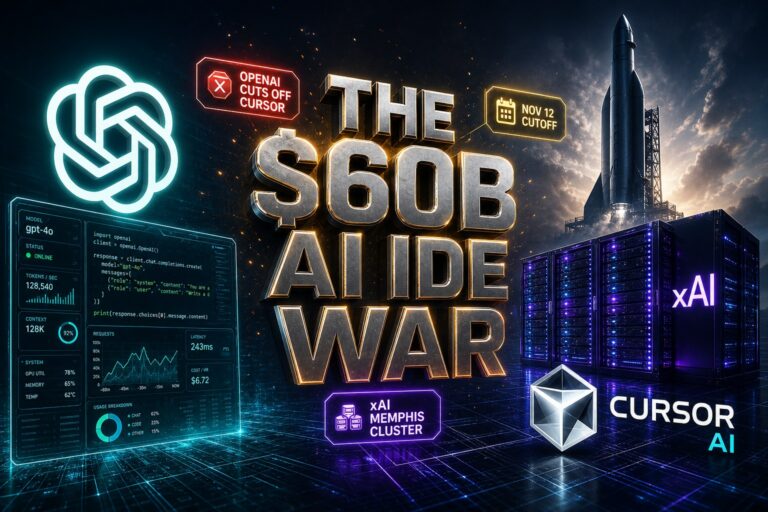
Rather than disputing the termination, Cursor leadership accelerated a transition that had already been underway since spring 2026. Following the acquisition, Cursor CEO Michael Truell confirmed that Anysphere and xAI have been jointly training a massive, sovereign 1.5-trillion parameter coding model from scratch.
This model is being trained on xAI’s Colossus supercluster in Memphis, Tennessee—a purpose-built AI data center housing over 1,000,000 Nvidia H100-equivalent GPUs. By controlling the entire stack from physical power generation and liquid-cooled GPU clusters to the developer’s local editing buffer, SpaceX and Cursor aim to deliver sub-100ms multi-file speculative edits at zero third-party API markup.
5. August 2026 Model Generation: Grok 4.6 vs Claude Opus 5 vs GPT-5.6 Sol
With native OpenAI models departing on November 12, Cursor’s smart Auto-router has already restructured its traffic hierarchy around three primary pillars. Here is how the active frontier models compare across architecture, context, and coding benchmarks:
6. From Score to Workflow: Real Developer Impact
How does the loss of native OpenAI models alter real-world day-to-day programming inside Cursor? Below is the workflow translation breakdown based on actual developer usage patterns:
| Coding Task / Workflow | Previous Default Model | New Recommended Routing | Performance & Latency Shift |
|---|---|---|---|
| Fast Single-Line Tab Completion | Custom OpenAI Distill | Composer 2.5 | +20% faster response time (<80ms) |
| 10+ File Complex Refactoring | GPT-5.6 Sol / o1 | Claude Opus 5 | Superior cross-file consistency & zero hallucinated imports |
| Autonomous Terminal Debugging Loop | GPT-4o Agent | Grok 4.6 (500k context) | Significantly higher context endurance over 50+ iteration steps |
| Legacy Enterprise Code Translation | GPT-4o | OpenAI via BYOK Key | Requires standalone OpenAI billing and separate token metering |
7. What It Actually Costs You: BYOK vs Auto-Routing Pricing
For existing Cursor subscribers, the removal of bundled OpenAI access introduces two distinct billing pathways:
- Standard Auto-Route Pool ($20/Month Pro Tier): Continues to include unlimited fast completions and a pooled monthly quota of premium requests across Grok 4.6, Claude Opus 5, and Composer 2.5. No additional API keys are required.
- Bring-Your-Own-Key (BYOK) for OpenAI: Developers who mandate GPT-5.6 Sol or o-series models can navigate to Cursor Settings → Models → OpenAI API Key and insert their personal key. All requests are billed directly to their OpenAI Developer platform account at standard API rates ($2.50 per 1M input tokens / $10.00 per 1M output tokens for GPT-5 class models).
8. Where It Falls Short: Limitations of the Post-OpenAI Stack
While the combination of Grok 4.6 and Claude Opus 5 provides industry-leading coding benchmarks, developers must remain cognizant of several distinct architectural trade-offs:
- Enterprise Security Compliance Hurdles: Many Fortune 500 engineering organizations hold strict, pre-approved data governance agreements with Microsoft Azure and OpenAI. Switching to xAI-hosted Grok 4.6 requires fresh legal and compliance reviews regarding code privacy and model training opt-outs.
- Grok 4.6 Cold-Start Latency: Because Grok 4.6 operates with a massive 500k context window, initial time-to-first-token (TTFT) on complex multi-repo indexing can range between 1.2s and 2.5s, compared to sub-400ms for lightweight models.
- Permanent Exclusion from “Astra”: OpenAI’s upcoming autonomous software engineer model (codenamed Astra) represents a potential generational leap in automated task completion. Cursor developers will be unable to access Astra natively, giving Microsoft’s Visual Studio Code and GitHub Copilot an exclusive distribution advantage.
9. Practical Decision Guide: Which AI IDE Should You Use?
Stay with Cursor (SpaceX Stack)
Best for high-speed agentic loops & multi-file refactoring.
- Primary reliance on Claude Opus 5 & Grok 4.6.
- Comfortable using personal OpenAI API keys when needed.
- Wants access to the upcoming 1.5T Colossus model.
Migrate to VS Code + Copilot
Best for OpenAI ecosystem loyalty & enterprise compliance.
- Requires turnkey access to OpenAI Astra upon launch.
- Strict corporate Azure OpenAI SOC2 compliance policies.
- Prefers unified Microsoft GitHub licensing.
10. Frequently Asked Questions (FAQ)
Can I still use OpenAI models in Cursor after November 12, 2026?
Yes, you can continue using OpenAI models in Cursor after November 12 by adding your personal OpenAI API key under Settings → Models (BYOK).
Does OpenAI own any equity in Cursor?
No, OpenAI holds zero equity in Cursor; Anysphere declined OpenAI’s acquisition offers before selling 100% of the company to SpaceX for $60 billion.
Will Cursor support OpenAI’s upcoming “Astra” model?
No, OpenAI has explicitly blacklisted Cursor from receiving future frontier releases, including the upcoming Astra autonomous coding model.
What is Cursor’s new default model?
Cursor’s default Auto-router dynamically routes requests across Grok 4.6, Claude Opus 5, and in-house Composer 2.5 based on speed and context demands.
Written by Jovin George
Senior AI Technology Analyst at SoftReviewed. Covering frontier AI infrastructure, agentic IDE ecosystems, and enterprise cloud compute architectures.