

Meta’s Avocado AI Model: Everything You Need to Know About the Secret Successor to Llama
Meta is making a massive shift in its AI strategy, and it’s going to change the game. After years of sharing its AI models openly with the world, the company is developing a new, private AI model called Avocado that will compete directly with ChatGPT, Google Gemini, and other top-tier AI systems.
Wait—What Happened to Llama?
For a long time, Meta released its AI models as open-source, which means anyone could download and use them. This was their big advantage compared to OpenAI and Google. But something went wrong.
Llama 4, released in April 2025, didn’t perform as well as people expected. Meanwhile, competitors like OpenAI (ChatGPT 5) and Google (Gemini 3 Ultra) kept getting smarter and more powerful. To make it worse, Meta discovered that Chinese companies were copying their Llama technology to build military AI tools. This made Meta realize: open-source strategy wasn’t winning the race.
So Meta decided to do something completely different—they’re building Avocado as a closed model. This means you won’t be able to download it or see how it works inside. Instead, you’ll access it through APIs (online tools) or as a service, just like ChatGPT.
What Is Meta Avocado? (Explained Simply)
Think of Avocado like a super-smart assistant that Meta is building in secret. Here’s what makes it special:
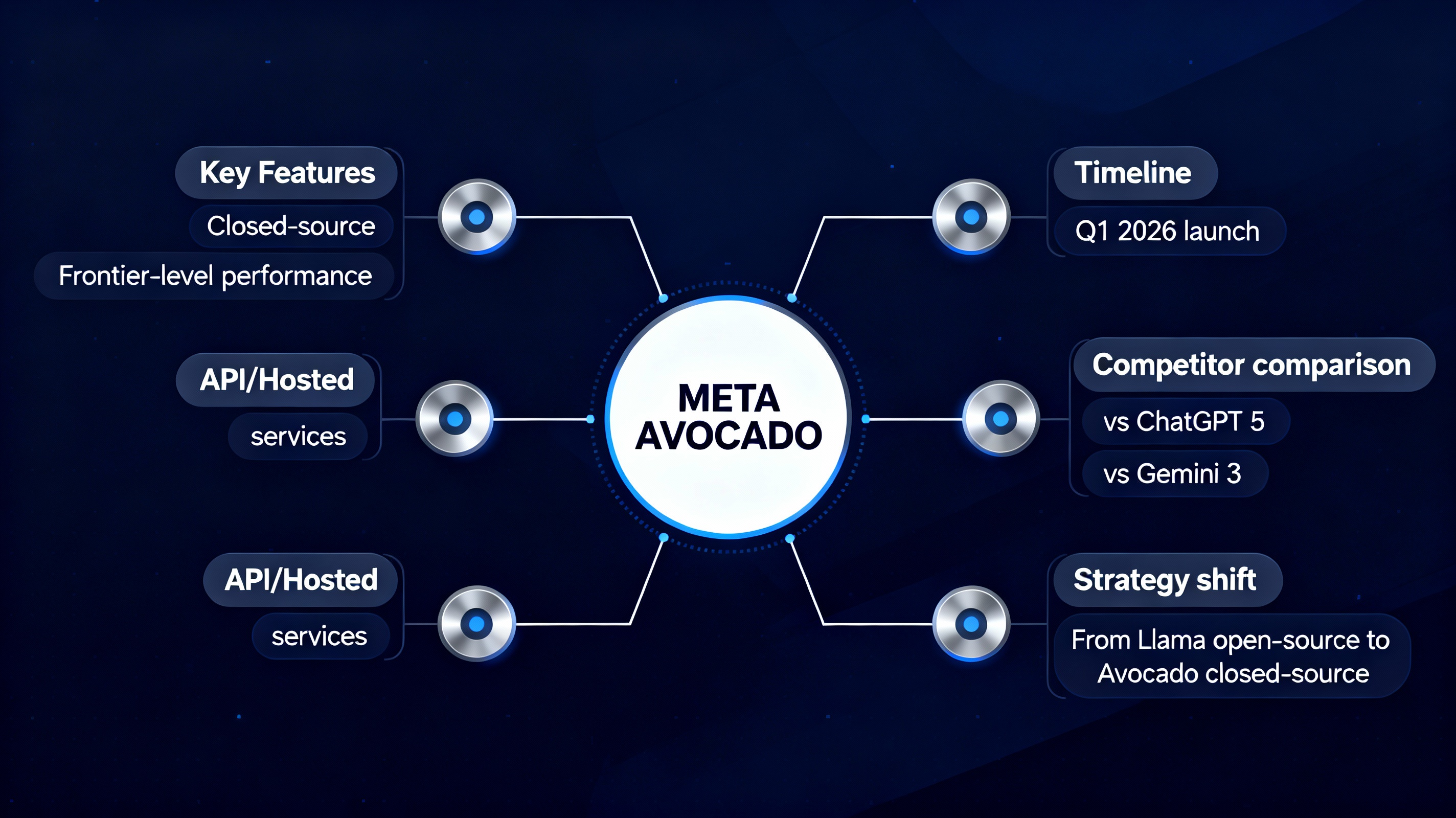
📌 Closed-Source: Only Meta controls it. No one can copy it or see the inside.
📌 Frontier-Level Performance: It’s designed to be as good as—or better than—GPT-5 and Gemini 3 Ultra.
📌 Multimodal: Can handle text, images, and possibly video (like other modern AI).
📌 Better at Thinking: Focused on reasoning, long contexts, and tool use (like making API calls).
📌 API & Hosted Access: You’ll pay to use it through APIs, not download it for free.
When Is Avocado Launching?
Originally, Meta planned to launch Avocado by the end of 2025. But that’s been pushed back. According to reports from CNBC and Bloomberg (as of December 2025), Avocado is now expected to launch in Q1 2026 (January–March 2026). This is because Meta is still testing and training the model to make sure it actually beats the competition.
Mark Zuckerberg is personally involved in this project, which shows how serious Meta is about winning the AI race.
How Does Avocado Compare to ChatGPT, Gemini & Claude?
| Feature | Meta Avocado | ChatGPT 5 | Google Gemini 3 | Claude 4 |
|---|---|---|---|---|
| Launch Date | Q1 2026 | Already Available | Already Available | Already Available |
| Access Model | Closed (Paid API) | Closed (Paid) | Closed (Paid) | Closed (Paid) |
| Performance Target | Frontier-Level | Best-in-Class | Best-in-Class | Excellent |
| Open-Source? | ❌ No | ❌ No | ❌ No | ❌ No |
| Previous Version | Llama 4 (Underperformed) | GPT-4 (Excellent) | Gemini 2 (Good) | Claude 3 (Excellent) |
Why Is Meta Making This Change?
Security & Control: Meta lost control when companies copied Llama. With Avocado, only Meta can improve it.
Money & Profit: Open models don’t make money. Closed models do. Meta wants to charge developers for API access, just like OpenAI and Google.
Performance Competition: Meta’s Llama was never as good as ChatGPT or Gemini. Avocado is being built to match those standards.
Internal Pressure: Meta’s AI teams were frustrated with the open-source approach. They wanted to build something proprietary and powerful.
What Does This Mean for Content Creators Like You?
If you create YouTube videos, blog posts, or social media content (like many Indian creators), Avocado could become a useful tool when it launches:
✅ Better Content Generation: Avocado might write better scripts, summaries, and SEO descriptions than free AI tools.
✅ Automation Workflows: If Meta releases Avocado APIs, Make.com users (like you!) could integrate it into automation workflows.
✅ Paid Tool: It won’t be free. You’ll likely pay per API call or subscription, similar to ChatGPT Plus or Claude Pro.
✅ Competitor to ChatGPT: When Avocado launches, it might become a serious alternative to OpenAI, with different pricing and features.
Will Avocado Be Free or Paid?
Avocado will be paid. Here’s why:
Meta is abandoning open-source to make money. They’ll likely offer:
📌 API Access: Pay-per-call pricing (like ChatGPT API).
📌 Subscription Service: A monthly plan, possibly “Meta AI Pro” or similar (likely ₹500–₹2,000 or $6–$20 USD per month).
📌 Enterprise Plans: Custom pricing for businesses.
Free alternatives (like Meta’s current Llama models or Google’s Gemini) will still exist, but Avocado will be the premium, paid option.
Key Takeaways for You 🎯
✅ Meta is abandoning open-source and building a secret AI model called Avocado.
✅ Launches Q1 2026 (January–March), delayed from late 2025.
✅ Targets GPT-5 & Gemini 3 Ultra in performance, built to compete with OpenAI and Google.
✅ Closed-source & paid (no free downloads, only APIs and subscriptions).
✅ Why the shift? Poor Llama 4 reception, Chinese competition, and the need to monetize AI.
✅ For creators: Could become a useful tool for content generation and Make.com automations when it launches.
The Bottom Line
Meta is betting billions of dollars on Avocado to catch up in the AI race. After losing ground with Llama, they’re making a bold move: abandoning their open-source identity to build a proprietary AI that can actually compete with ChatGPT and Gemini.
When Avocado launches in spring 2026, the AI landscape will shift again. Whether it succeeds depends on whether it’s truly better than ChatGPT 5 and Gemini 3 Ultra—which we won’t know until March or April 2026.
For now, keep an eye on Meta. The Avocado era is coming, and it could change how you create content, automate workflows, and use AI in your business.







