
Executive Summary: OpenAI GPT-6 Sol and Luna Launch
OpenAI has officially launched GPT-6 Sol and GPT-6 Luna, expanding the GPT-6 architecture alongside the flagship GPT-6 Astra. Engineered as everyday workhorses, both models slash token pricing by 50% compared to the previous generation, introduce a 90% prompt caching discount, and cut factual hallucination rates by over a third on the AA-Omniscience benchmark.
👉 Why Did OpenAI Release Two Models Simultaneously?
Flagship frontier models like GPT-6 Astra are extraordinarily capable but too computationally expensive for high-frequency daily agent loops. OpenAI bifurcated everyday workloads into two complementary specializations: Sol for deep multi-file code refactoring and tool use, and Luna for ultra-fast, penny-per-million data extraction and request routing.
👉 What Is the Catch with Reduced Hallucinations?
To slash hallucination rates from 92% down to 60%, OpenAI trained the models with rigorous calibration that penalizes speculative answers. As a result, both models will explicitly decline ambiguous or under-specified prompts rather than attempting a plausible guess.
Video summary: 50% price cut, autonomous coding achievements, and developer routing.
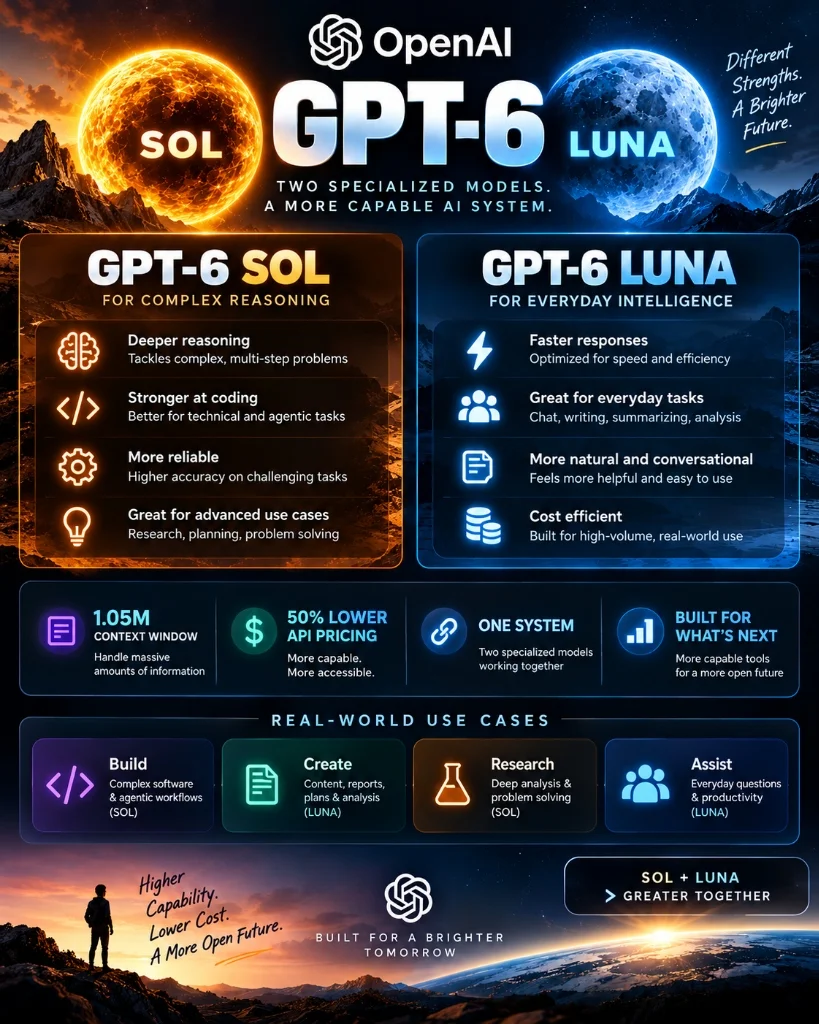
Figure 1: Architectural comparison of GPT-6 Sol and Luna specifications, context windows, and real-world use case allocation.
💡 In Simple Terms: How GPT-6 Sol and Luna Actually Work
To understand why OpenAI released both Sol and Luna on the same day, consider the operational layout of a modern high-volume fulfillment center:
The Corporate Dispatcher vs. Senior Specialist Analogy
If flagship GPT-6 Astra is the senior executive research fellow called in for million-dollar problems, GPT-6 Sol is the dedicated software engineer at the workstation who writes, tests, and refactors code all day. Meanwhile, GPT-6 Luna is the lightning-fast pneumatic dispatch tube that sorts, stamps, and routes thousands of incoming letters per minute without breaking a sweat.
The Flaw of Older Models: Previously, running an agentic coding loop required deploying massive models like GPT-5.6 Sol or Claude Opus at $4 to $20 per million tokens. As automated agents iteratively read the codebase, run terminal commands, and review compiler errors, context tokens accumulate rapidly, leading to astronomical API bills.
Why It Is Different: OpenAI distilled the post-training alignment, terminal interaction, and computer-use techniques pioneered in Astra into two lightweight architectures. Paired with a massive 90% prompt caching discount, background agents can hold large codebases in context continuously for a tenth of traditional costs.
🌟 Where It Shines: 4 Benchmark-Proven Workloads
1. Autonomous Multi-File Coding
GPT-6 Sol outscores Claude Opus 5 (26.9%) on multi-step repository refactoring while slashing compute expenditure by 60%. It navigates complex directories, resolves Git conflicts, and edits multiple files without context drift.
2. High-Throughput Triage & Extraction
GPT-6 Luna processes bulk unstructured documents, customer support logs, and raw HTML scraping at blazing speed (0.71s TTFT), converting raw data into clean JSON schemas for pennies.
3. Long-Context Enterprise Analysis
With 922,000 maximum input tokens, Sol ingests entire corporate codebases, legal libraries, or multi-year financial statements in a single API call, synthesizing cross-document dependencies cleanly.
4. Reliable Production API Integration
Factual error rates decreased by over a third compared to GPT-5.6 Sol. For automated enterprise pipelines requiring grounded responses, Sol reliably admits knowledge limits instead of fabricating answers.
⚡ GPT-6 Sol vs. GPT-5.6 Sol vs. Claude Opus 5.5 vs. Grok 4.7: 2026 Comparison
To evaluate how GPT-6 Sol and Luna fit into the current frontier landscape, we cross-referenced empirical measurements from Artificial Analysis, AutomationBench, and developer field tests against active current-generation flagship rivals:
🥊 GPT-6 Sol vs. GPT-5.6 Sol: Is the Cheaper Tier Actually Better?
The direct comparison against its predecessor reveals that GPT-6 Sol is not merely a cost-reduction exercise. In the Artificial Analysis Coding Agent Index, Sol advanced from 54.0 to 57.0, powered by superior multi-file consistency and improved terminal interaction. For everyday development teams, upgrading to GPT-6 Sol cuts API expenses in half while simultaneously delivering higher coding accuracy.
🥊 GPT-6 Sol vs. Claude Opus 5.5: Everyday Workhorse vs. Deep Reasoning
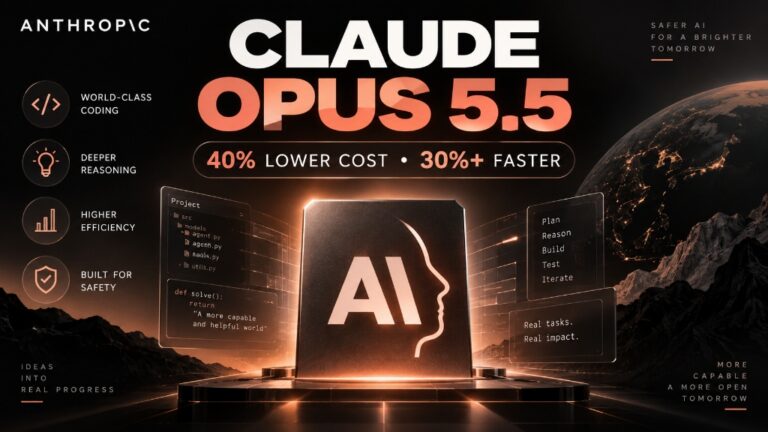
Released on the same day, Anthropic’s Claude Opus 5.5 and OpenAI’s GPT-6 Sol target distinct engineering niches. Opus 5.5 excels at complex single-turn architectural synthesis and deep document reasoning (1,846 Elo on GDPval-AA), but costs $4 / $20. GPT-6 Sol ($2 / $10) provides roughly 85% to 90% of Opus 5.5’s reasoning depth at half the price, allowing engineering teams to run double the execution cycles for the same budget.
🎯 Practical Decision Guide: When to Use Each Model
Scenario A: Autonomous Coding in Cline / Cursor
Deploy GPT-6 Sol: Its 90% prompt caching discount lowers repo-wide scans to $0.20/1M, making persistent background coding loops economically sustainable.
Scenario B: High-Volume ETL & Log Triage
Deploy GPT-6 Luna: At $0.10/1M tokens and 175 tok/s, Luna classifies, formats, and routes thousands of incoming payloads per second at negligible cost.
Scenario C: Deep Contract & Policy Auditing
Deploy Claude Opus 5.5: When mission-critical legal compliance or enterprise policy analysis requires maximum depth, Opus 5.5 remains the benchmark leader.
Scenario D: Multi-Agent Triage Pipelines
Deploy Luna -> Sol Duo: Use Luna as the frontline dispatcher (0.71s latency) to solve trivial tickets directly and escalate complex tasks to Sol.
🔁 From Score to Workflow: The Benchmark Translation Table
Raw benchmark numbers are only meaningful when translated into concrete engineering decisions:
| Benchmark & Score | What It Actually Measures | The Workflow This Licenses | Route Work Here When |
|---|---|---|---|
| AutomationBench 33.2% | End-to-end multi-app software workflows | Autonomous GitHub issue fixing and test execution | Cost per task matters more than marginal frontier accuracy |
| AA-Omniscience 60% Error | Factual recall and hallucination resistance | Automated customer support and regulatory Q&A | An explicit refusal is preferred over an invented false claim |
| 175 tok/s Inference | Raw generation speed and streaming response | Real-time interactive voice agents and autocomplete | Low TTFT latency is critical for user-facing UI responsiveness |
| Coding Index 57.0 | Terminal usage, code generation, and debugging | Repository refactoring and automated PR reviews | Replacing expensive flagship models in CI/CD pipelines |
📉 Where It Falls Short: Limitations & Critical Trade-offs
1. Higher Refusal Rates on Ambiguous Prompts
To reduce hallucinations from 92% down to 60%, OpenAI tuned both Sol and Luna to strictly decline speculative questions. If your prompts lack clear reference context, the models frequently output refusals rather than making educated deductions.
2. Luna Regressed on Complex Coding Synthesis
On the Artificial Analysis Coding Agent Index, GPT-6 Luna recorded a minor regression compared to GPT-5.6 Luna. Because Luna was aggressively optimized for classification throughput (175 tok/s), routing complex code generation to Luna leads to syntactical errors.
3. Reasoning Latency Spikes on High Effort
When configured with extra-high reasoning effort, GPT-6 Sol spends significant time-to-first-token in deliberate thought. Developers building real-time conversational agents should keep reasoning effort on low or medium to maintain snappy response times.
💰 What It Actually Costs You: Pricing Mechanics & Caching Economics
The true financial impact of GPT-6 Sol and Luna comes from the compounding benefit of the 90% prompt caching discount:
Cost Breakdown per 1 Million Tokens
- GPT-6 Sol: $2.00 Base Input · $10.00 Output · $0.20 Cached Input (90% off)
- GPT-6 Luna: $0.10 Base Input · $0.50 Output · $0.01 Cached Input (90% off)
❓ Frequently Asked Questions
Is GPT-6 Astra better than GPT-6 Sol?
Yes, GPT-6 Astra remains OpenAI’s top flagship reasoning model for high-stakes scientific logic and novel mathematics, while GPT-6 Sol is an everyday cost-optimized workhorse that provides 85-90% of Astra’s capability at a fraction of the cost.
Can you use GPT-6 Sol and Luna for free?
GPT-6 Luna is available to free and Go users via the official ChatGPT desktop application on macOS and Windows, while GPT-6 Sol is available via the paid API, ChatGPT Work, and Codex.
How do I use GPT-6 Sol in coding agents like Cline or Cursor?
Simply select the model ID gpt-6-sol in your agent settings using your standard OpenAI API key to automatically benefit from the $2/1M rate and 90% prompt caching discounts.
Published by SoftReviewed Editorial Team · Verified against OpenAI official launch documentation, system cards, and Artificial Analysis benchmark matrices.