⚡ Key Takeaways: The Nvidia–Hugging Face Reports
💰 $12.9 Billion
The reported price — roughly 86× annual revenue, against about $150M a year.
🔁 They Said No Once
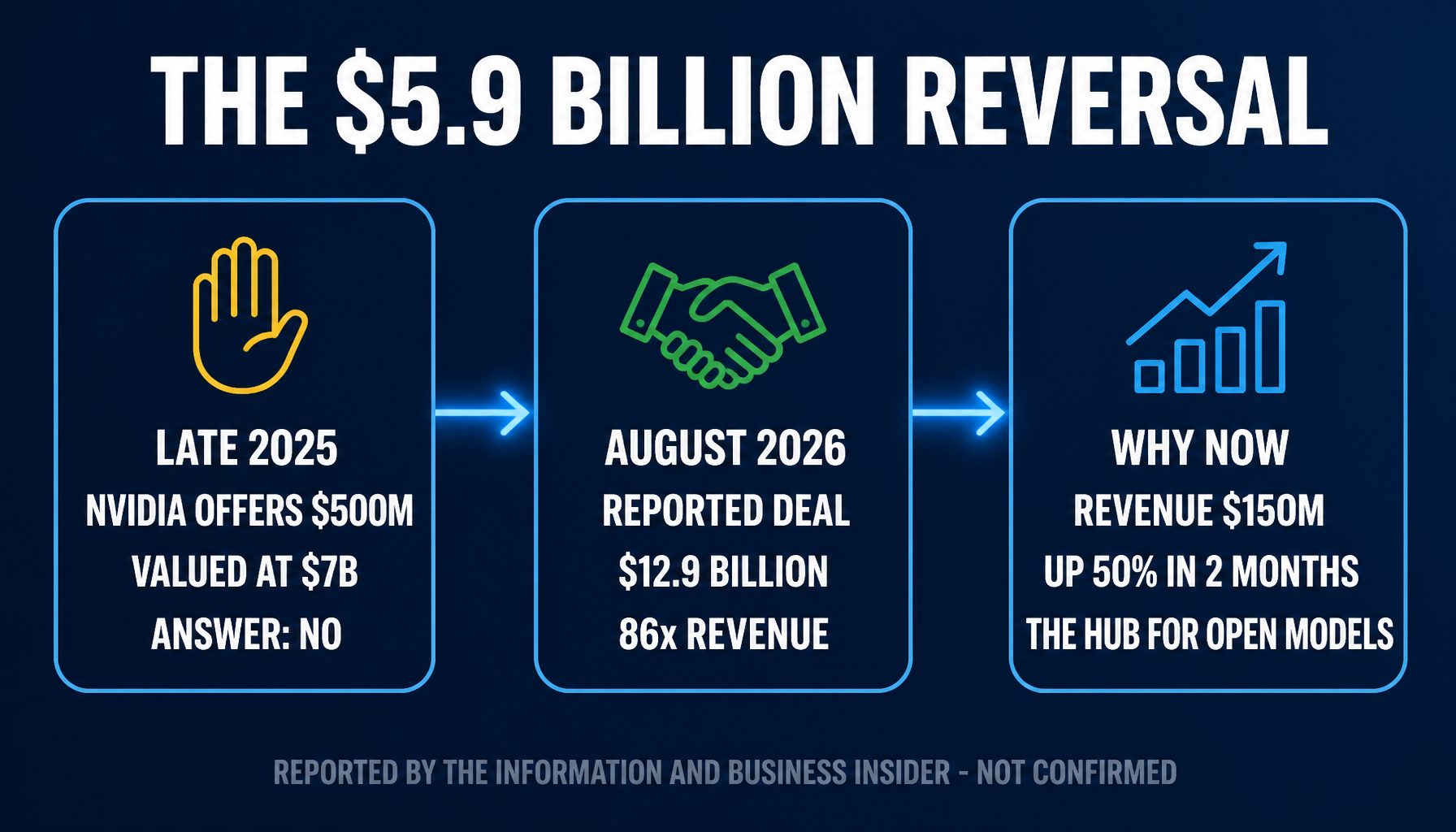
Late 2025: Hugging Face rejected $500M at ~$7B, citing neutrality. A $5.9B gap.
🧩 It’s Not a Website
Hugging Face writes transformers and diffusers — the code that picks the chip.
⚠️ Nothing Is Confirmed
Two outlets disagree on whether it is signed. Both companies are silent.
The $5.9 Billion Reversal
Late 2025 — rejected at ~$7B
August 2026 — reported at $12.9B
What’s In This Article — Tap To Expand
Short answer: reportedly yes — but nothing is confirmed, and the two outlets that broke the story do not agree with each other. On 26–27 August 2026, The Information reported that Nvidia had agreed to acquire Hugging Face for $12.9 billion. Business Insider reported something weaker: serious talks at a valuation above $13 billion, with no signed agreement and a real chance the deal collapses. Neither Nvidia nor Hugging Face has publicly confirmed any of it.
If you have seen three different numbers today and assumed someone was wrong, this is why. They were describing different stages of the same negotiation.
Where the reporting actually stands
The Information: Nvidia has agreed to buy Hugging Face for $12.9B, citing one person with knowledge of the agreement.
Business Insider: The two sides held serious talks at over $13B, but had not signed, and the talks could still fall apart.
Both companies: no comment. Neither has confirmed, and neither has denied.
🎬 Watch the 60-Second Video Breakdown
60-second visual breakdown of the $12.9B valuation reversal, CUDA software moat, and default routing.
What Is Hugging Face, and Why Would Anyone Pay $12.9 Billion for It?
Hugging Face, founded in 2016, is usually described as “the GitHub of AI,” and for once the shorthand is accurate.
In simple terms: if open-source AI were a city, Hugging Face would be the roads. It is not the most valuable building on any street. It is the thing that makes every building reachable. When a lab releases an open model, it lands there. When a developer downloads one, it comes from there. When someone fine-tunes it, they push it back there.
Now the number that makes people blink. Hugging Face was recently generating roughly $150 million a year in revenue. At $12.9 billion, that is a multiple of about 86× revenue. For comparison, mature software companies typically trade in the single digits to low teens.
So no, Nvidia would not be buying Hugging Face for its revenue. Three things explain the price better.
1. The revenue is small but accelerating hard
That $150 million figure was up from roughly $100 million just two months earlier. A 50% jump in a single quarter changes what a multiple means — you are not paying 86× what the business earns, you are paying for where the curve is pointing.
2. Hugging Face doesn’t just host the models — it writes the code
This is the part that gets flattened into “distribution layer,” and it is the most concrete thing on the list. Hugging Face maintains transformers, diffusers, accelerate, tokenizers, datasets and peft — the libraries that a very large share of AI applications import, often without the developer thinking about it.
Those libraries are the layer that decides which backend actually gets called when a model runs. Whoever maintains them sets the default path from Python down to the silicon. That is not a website. That is the code in the middle of everyone else’s stack.
3. It owns the deploy button, and the demand data behind it
Hugging Face also runs inference — Inference Endpoints and Spaces — and today that compute is routed to AWS, Google Cloud and Azure. Nvidia has its own cloud offering. It does not take much imagination to see where a newly-owned deploy button might point.
Underneath that sits the telemetry: every download, every trending model, every shift in what developers are actually building, visible before it is visible to anyone else.
Worth separating: what Hugging Face owns is fact — the libraries, the endpoints, the telemetry are all a matter of record. What Nvidia would do with them is analysis. Neither company has said anything about post-acquisition plans, because neither company has confirmed the acquisition.
The Real Reason: Nvidia’s Moat Is Software, Not Silicon
Here is the argument that explains the price better than any of the above, and it is the one most coverage is skipping.
Nvidia’s durable advantage has never been purely that its chips are fast. It is CUDA — the software layer that a decade and a half of AI tooling has been written against. Competitors have shipped genuinely competitive silicon and still struggled, because the code assumed CUDA.
The thing that erodes a software moat is code that runs anywhere. Hardware-agnostic abstraction layers, portable kernels, backend-swappable libraries — that is the actual threat, and a great deal of it lives on, and is maintained by, Hugging Face.
🏗️ The AI Stack — And Who Owns Each Layer
Nvidia already owns the bottom two. This deal would hand it the one in the middle.
Your AI app
The thing you actually build · owned by you
↓ imports
transformers · diffusers · accelerate → HUGGING FACE
Decides which backend gets called · this is what’s reportedly being bought
↓ calls
CUDA → NVIDIA
The software moat · already theirs
↓ runs on
GPU silicon → NVIDIA
The hardware · already theirs
Read bottom-up: the yellow layer is the only one Nvidia doesn’t control — and it’s the one that could swap the green layers out for someone else’s.
Read that way, Nvidia would not be buying a distribution hub at all. It would be buying the layer most likely to make its own moat irrelevant — which is a much easier thing to justify at 86× revenue than a model-hosting website is.
The Part Most Coverage Is Skipping: Hugging Face Already Said No
This is the detail that makes the story interesting rather than routine.
At the end of 2025 — roughly nine months before these reports — Hugging Face turned down a $500 million investment from Nvidia at a valuation of about $7 billion. The stated reason was neutrality: the company’s position was that the place where everyone stores their models should not be beholden to the company that sells everyone their chips.
The reversal, in numbers
Late 2025: declined a $500M investment at ~$7B — on principle.
August 2026: reportedly agreed to sell outright at $12.9B.
The gap between those two valuations is about $5.9 billion.
The neutrality concern did not disappear in nine months. Hugging Face works with AMD, AWS and Google as well as Nvidia, and that vendor-neutral position is a large part of why it became the default hub in the first place. Nothing about that changed. What changed was the number.
Why Developers Are Worried
The reaction in open-source communities has been noticeably cooler than the reaction in financial press. The concern is not that Nvidia will do something dramatic on day one. It is structural, and it is worth stating plainly rather than dismissing.
- Neutral infrastructure stops being neutral. A hub owned by the dominant chip supplier has an interest in which hardware models are optimised for, benchmarked on, and documented against — even if no one ever writes that policy down.
- Competitors are now hosting on a rival’s platform. AMD, Google and AWS all have models and libraries on Hugging Face. That becomes an awkward arrangement overnight.
- Defaults are quiet power. Nobody needs to delete anything to change an ecosystem. Changing what appears first, what is recommended, and what is easiest is sufficient.
None of this is a prediction that any of it will happen. It is the reason the original neutrality objection was raised — by Hugging Face itself, nine months ago.
What This Means If You Actually Use Hugging Face
Start with what almost certainly won’t happen, because it is where most of the worry goes: the free tier is not the risk. Hosting stays free. Nvidia’s entire interest here is in developers being on the platform — putting a paywall in front of the hub would destroy the exact thing that makes it worth $12.9 billion.
The thing that actually shifts is quieter, and it is the default.
Nobody has to remove anything for an ecosystem to change. It is enough that the optimised kernel lands first, the example notebook assumes one backend, the quantisation config is tuned for one architecture, and the “it just works” path happens to be one vendor’s. “Works out of the box” slowly comes to mean “works on Nvidia” — and if you are on AMD, Intel or Apple silicon, you become the hard path by default rather than by decision.
That is a multi-year drift, not a switch someone flips. Which is why the response to it is cheap and worth doing today regardless of whether this deal is real:
- Know where your weights live. If a model you depend on in production exists only as a Hugging Face repo you do not control, that is a single point of failure regardless of who owns the company.
- Keep local copies of anything load-bearing. Models get renamed, gated behind licence acceptance, or pulled — all of which already happens today, with no acquisition required.
- Know the Hugging Face alternatives exist, without panic-migrating. Self-hosted registries, Kaggle, ModelScope, and direct-from-lab distribution all work. Migrating a working stack because of an unconfirmed report is a cost with no matching benefit.
The realistic risk here is not a sudden shutdown. It is slow drift in defaults over years — which is exactly the kind of change that is easy to adapt to if you are paying attention, and expensive if you are not.
❓ Frequently Asked Questions
The Bottom Line
Is Nvidia buying Hugging Face? The most accurate answer available today is that two credible outlets report a deal at roughly $12.9–13 billion, they disagree on whether it is agreed or merely discussed, and both companies have chosen to say nothing.
The more revealing question is why now. Nine months ago this same company decided that Nvidia’s money came with a string attached to its independence, and said no. The strategic objection has not weakened since — Nvidia’s position in the market has only strengthened. What moved was the price.
Whether $5.9 billion is the right price for the neutrality of open-source AI’s front door is not a question a benchmark can settle. But it is the question actually being asked, and it deserves better than being buried under the headline number.