
Executive Brief: What Changed
- The Release: Google officially introduced Gemini 4 Carbon, a specialized frontier model engineered specifically for cybersecurity research and multi-day autonomous software development.
- Antigravity Rollout: Live on Google AI Ultra and Enterprise tiers across the Antigravity App, CLI, and IDE extensions, supporting parallel agent execution via the new Swarm preview.
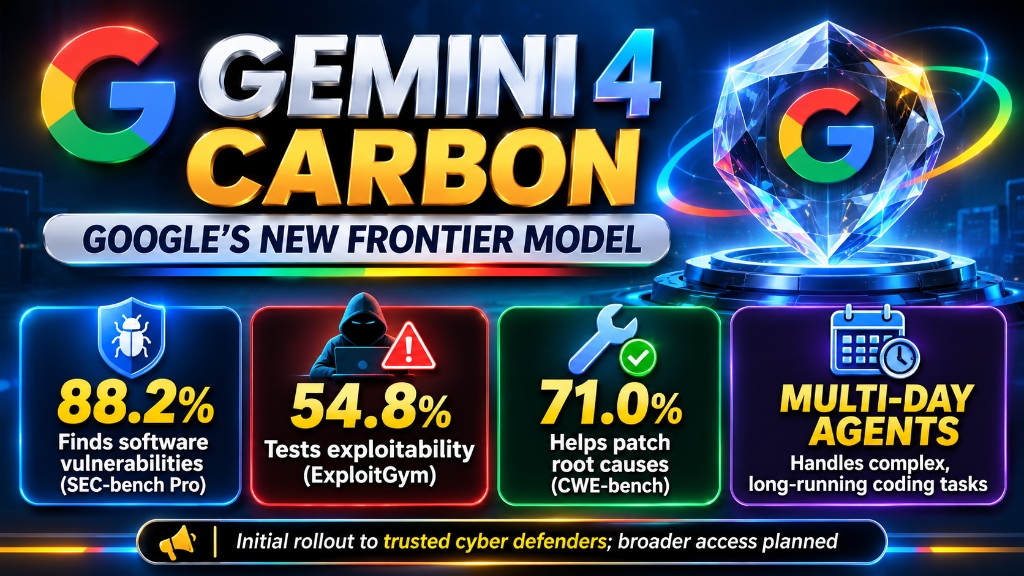
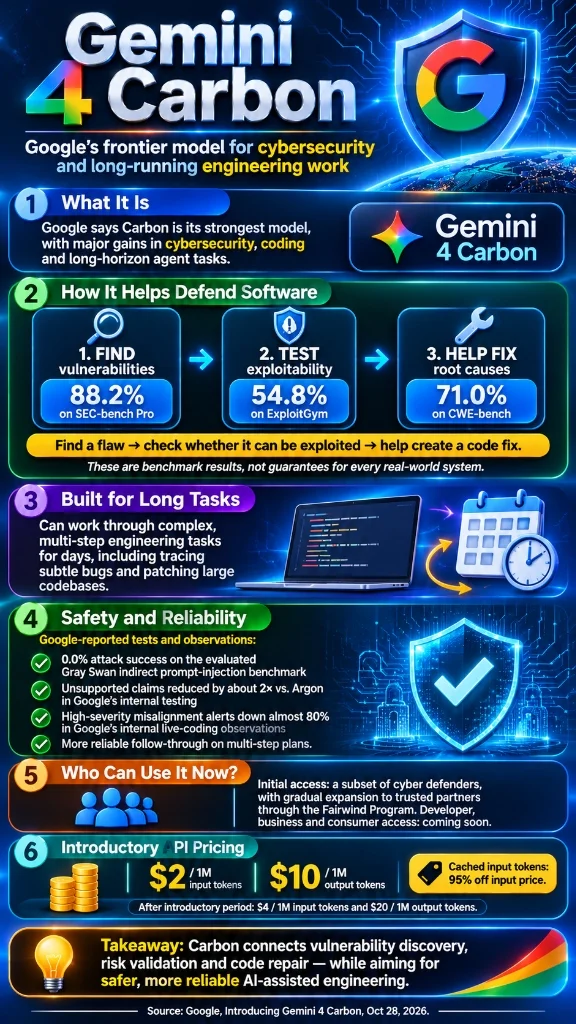
- Security Benchmarks: Achieved an 88.2% flaw detection rate on SEC-bench Pro, 54.8% exploit testing on ExploitGym, and 71.0% root-cause remediation on CWE-bench with safeguards off.
- Real-World Verification: Generated 6.5 million lines of machine-checked Lean proofs over four weeks to formally verify Signal’s compiled protocol implementation.
- Introductory Pricing: Set at $2.00 / 1M input and $10.00 / 1M output tokens, paired with an aggressive 95% cached-input discount ($0.10 / 1M cached tokens).
Google has officially released Gemini 4 Carbon, its most capable autonomous coding and cybersecurity model to date. When I booted up my Google Antigravity environment this morning, Carbon was live in the model selector for Google AI Ultra and Enterprise workspaces.
Unlike standard general-purpose chat models, Gemini 4 Carbon is built from the ground up for long-horizon software engineering. While previous frontier models would often lose track of state, hallucinate nonexistent functions, or hit cognitive exhaustion after a few hours of complex repo editing, Carbon is designed to run continuously for days.
In this breakdown, I will walk you through what Gemini 4 Carbon actually delivers, how it performed in DeepMind’s formal protocol verification runs, its audited security benchmarks, and how the token pricing and tier access work inside Antigravity.
🎬 Watch the 60-second Gemini 4 Carbon breakdown on YouTube Shorts
What Is Gemini 4 Carbon?
Gemini 4 Carbon is Google DeepMind’s specialized frontier model optimized for codebase defense, autonomous vulnerability remediation, and formal code verification.
Input Problem / Codebase ──► Vulnerability Discovery (88.2%) ──► Exploitability Test (54.8%) ──► Automated Patch (71.0%)
In standard programming workflows, developers rely on conversational coding assistants to complete functions or build discrete scripts. However, enterprise software engineering involves multi-file refactoring, tracing architectural bugs across distributed services, and validating security guarantees.
Carbon was designed to handle those heavy, asynchronous engineering tasks without human hand-holding. In internal Google evaluations, engineering agents powered by Carbon completed multi-day tasks that previously required human site reliability teams.
The Signal Protocol Breakthrough
To evaluate whether Carbon could handle production-grade formal verification, Google DeepMind connected Carbon prover agents to AlphaProof Code and tasked them with analyzing Signal’s compiled protocol implementation.
Over a four-week period, the Carbon agents:
1. Analyzed the compiled cryptographic codebase against human-reviewed specifications.
2. Generated approximately 6.5 million lines of machine-checked Lean proofs.
3. Formally verified key security properties without a human mathematician writing intermediate lemmas.
A Lean proof engine verified every step of reasoning deterministically. This proved that Carbon does not simply guess plausible-looking code; it can construct verifiable mathematical arguments that guarantee code correctness.
Cybersecurity Benchmarks: Audited Performance
Google tested Gemini 4 Carbon across industry-standard security evaluation suites with safety guardrails turned off to measure raw vulnerability discovery and exploitation capabilities.
1. SEC-bench Pro (88.2%)
On SEC-bench Pro, which measures a model’s ability to identify subtle software flaws across complex C, C++, and Rust codebases, Carbon scored 88.2%. It identified zero-day vulnerabilities, buffer overflows, and race conditions that prior generations missed entirely.
2. ExploitGym (54.8%)
Finding a vulnerability is only half the battle. On ExploitGym, Carbon achieved 54.8%, proving whether a discovered vulnerability is practically exploitable in a sandbox before alert-fatigued engineers spend time patching non-issues.
3. CWE-bench (71.0%)
On CWE-bench, which grades whether the agent can successfully write and compile a clean patch that resolves the underlying weakness without breaking adjacent tests, Carbon solved 71.0% of challenges.
4. Prompt Injection Defense (0.0% Attack Success)
On the Gray Swan indirect prompt-injection benchmark, Carbon achieved a 0.0% attack success rate. In developer environments where agents read untrusted issues, pull requests, and scraped documentation, this immune response prevents malicious markdown from hijacking the agent loop.
Gemini 4 Carbon vs. Gemini 4 Argon: Comparison Overview
Google’s previous engineering flagship, Gemini 4 Argon, set high marks for raw code completion. Here is how Carbon stacks up against Argon across verified workloads:
| Capability / Metric | Gemini 4 Argon | Gemini 4 Carbon | Operational Difference |
|---|---|---|---|
| Primary Strength | Rapid feature prototyping | Deep security & formal proofs | Carbon specializes in multi-day tasks |
| Flaw Discovery (SEC-bench) | ~64.5% | 88.2% | +23.7% jump in vulnerability detection |
| Patch Resolution (CWE-bench) | 48.0% | 71.0% | Significantly higher first-pass fix accuracy |
| Unsupported Claims | Baseline | 50% Reduction (2× less) | Drastically fewer phantom imports & errors |
| Misalignment Alerts | Baseline | 80% Reduction | Agents stay strictly on task in live runs |
| Formal Lean Proofs | Limited | Full Integration | Machine-verifiable cryptographic proofs |
| Introductory API Price (In/Out) | $1.25 / $5.00 | $2.00 / $10.00 | Premium security tier pricing |
| Cached Input Discount | 80% | 95% | Ultra-cheap long-context cache recycling |
Complete Gemini 4 Carbon Visual Architecture
Here is the complete architectural reference and workflow map for Gemini 4 Carbon:
Antigravity Swarm & IDE Integration
Starting today, Google is rolling out Carbon inside Google Antigravity:
- Model Selection: Available to users on Google AI Ultra ($200+/month) and Enterprise subscriptions.
- Surface Availability: Carbon can be invoked directly inside the Antigravity desktop application, the standalone
agyCLI, and VS Code / JetBrains IDE extensions. - Swarm Preview: In Antigravity App and CLI, users can launch
/swarmmode. This allows multiple Carbon agents to collaborate in parallel:
– Architect Agent: Breaks down large refactoring plans into isolated PR branches.
– Prover Agents: Generate code modifications and test suites.
– Reviewer Agent: Verifies security guarantees and checks against regressions before staging commits.
                  ┌──► Prover Agent A (Code Implementation) ──┐
Swarm Controller ─┼──► Prover Agent B (Unit & Fuzz Testing)   ─┼──► Reviewer Agent (Validation)
                  └──► Prover Agent C (Security Audit)        ┘
Google noted that running multi-agent Swarms with Carbon consumes token quotas much faster than single-turn chats. Users should set strict branch-level token caps before kicking off multi-day automated jobs.
Pricing & Token Economics
Google announced introductory pricing for the Gemini 4 Carbon API, intended to encourage enterprise security audits before standard pricing takes effect:
- Introductory Input Rate: $2.00 per 1 million tokens
- Introductory Output Rate: $10.00 per 1 million tokens
- Cached-Input Discount: 95% off ($0.10 per 1 million cached tokens)
- Standard Rate (Post-Introductory): $4.00 input / $20.00 output per million tokens
The 95% prompt-caching discount is a major advantage for large codebases. When analyzing an entire 500,000-token repository across several dozen agent turns, you only pay full input rates on the initial index; subsequent tool invocations cost a fraction of a cent.
When to Use Gemini 4 Carbon (And When to Skip It)
✅ Best Candidates for Gemini 4 Carbon
- Enterprise Codebase Audits: Scanning large monolithic repos for subtle security holes and dependency exploits.
- Formal Verification: Cryptographic protocols, financial transaction logic, and smart contract validation where unit tests are not enough.
- Multi-Day Refactoring: Heavy migrations (e.g., Python 2 to 3, C++ to Rust, or monolith-to-microservice splits) that run in the background.
- Automated Bug Triage: Testing incoming bug reports with ExploitGym to filter out false alarms.
❌ When to Choose a Different Model
- Quick Everyday Scripts: For quick one-file Python or JavaScript helpers, Gemini 3.8 Flash or Claude 3.5 Sonnet will return answers in seconds at a fraction of the cost.
- Interactive Pair Programming: Carbon’s deep verification reasoning introduces a slightly longer Time-to-First-Token (TTFT), making it slower for rapid conversational brainstorming.
- Budget-Constrained Projects: Running multi-agent swarms with high output tokens on standard rates will quickly exhaust personal budgets.
Frequently Asked Questions
Is Gemini 4 Carbon available on the standard Google AI Pro plan?
No. Currently, Google has restricted Carbon access to Google AI Ultra and Enterprise workspaces in Antigravity, alongside select cyber defense partners via the Fairwind Program. Pro plan users can evaluate Gemini 4 Argon or Gemini 3.8 Pro.
How does Carbon handle hallucinations in long-running jobs?
Google reported that unsupported claims dropped by approximately 2× compared to Argon, and high-severity misalignment alerts decreased by nearly 80% during internal live-coding benchmarks.
Does Gemini 4 Carbon support tools and MCP servers?
Yes. Carbon has full Model Context Protocol (MCP) tool-calling support across Antigravity, allowing it to interact directly with local terminals, Git repositories, Docker containers, and external APIs.