
If you pay $20 a month for Claude Pro, or $100 to $200 for Max and Ultra, you have probably wondered whether a Claude subscription price increase is coming once Anthropic hits the public stock market. With Anthropic set to price its Nasdaq IPO under ticker ANT on November 18, 2026 (at $70 to $78 a share, aiming for roughly a $1 trillion basic valuation and up to $1.4 trillion fully diluted) and begin trading on November 19, 2026, I sat down and read through the company’s SEC Form S-1 filing. What I found makes one thing pretty clear: even if the $20 sticker price stays put for a while, heavy users are already paying more through tighter limits, pay-per-use frontier models, and higher tiers.
Quick Answer · Anthropic IPO & Claude Pricing
Prefer the fast 2-minute summary? Watch my 2-minute video breakdown below covering the S-1 numbers, compute constraints, and Fable 5.2 pricing before we dig into all nine cost drivers.
Quick Summary · Anthropic S-1 Pricing Audit
Verified Nov 18, 2026 · Ticker: ANT
Revenue vs. Compute: $4.59B revenue vs. $7.33B compute in 2025; $16.29B revenue vs. $8.95B compute in H1 2026 ($33.2B over 9 months).
Enterprise Dominance: Customers paying $100k+ generated ~74% of H1 2026 revenue, while usage-based API fees bring in ~80% vs. ~20% for subscriptions.
Long-Term Commitments: Roughly $895B to $900B in multi-decade cloud, chip, and lease obligations (including Google Cloud, AWS, and Azure floors).
Why the Anthropic IPO Filing Signals a Claude Subscription Price Increase
Anthropic's SEC Form S-1 shows a company growing at historic speed while carrying massive compute bills that eat straight into flat-rate subscription plans. In full-year 2025, Anthropic earned $4.59 billion in revenue and spent $7.33 billion on compute. In the first half of 2026, revenue jumped to $16.29 billion (and reached $33.2 billion over the first nine months of 2026), while compute costs alone still took $8.95 billion in just those first six months.
Think of a flat monthly AI plan like an all-you-can-eat buffet. With normal software, adding one more user costs the company almost nothing. With AI, every prompt runs on expensive chips inside a power-hungry data center. The more you eat at that buffet, the more money the restaurant loses on your table.
To be fair with the headline accounting numbers you might have seen online: Anthropic reported an $80.7 billion GAAP net loss for the first half of 2026 (and over $104 billion for the first nine months). Almost all of that huge loss (about $72 billion in H1 and $94.3 billion over nine months) came from non-cash accounting adjustments on convertible notes and investor agreements as Anthropic's valuation surged. Its actual H1 2026 operating loss narrowed to $693 million, and operating cash flow turned positive. Still, those numbers only look healthy because API and enterprise usage pay by the token. Flat-rate consumer subscriptions sit on the opposite side of that math.
9 Cost Drivers Pushing Claude Pricing and AI Subscriptions Higher
Beyond the headline revenue and compute gap, my deeper look into Anthropic's amended S-1 filing, official pricing pages, and 2026 hardware supply data uncovered nine separate forces pushing toward higher AI bills.
1. Agent Tools Like Claude Code Burn Far More Tokens Than Chat
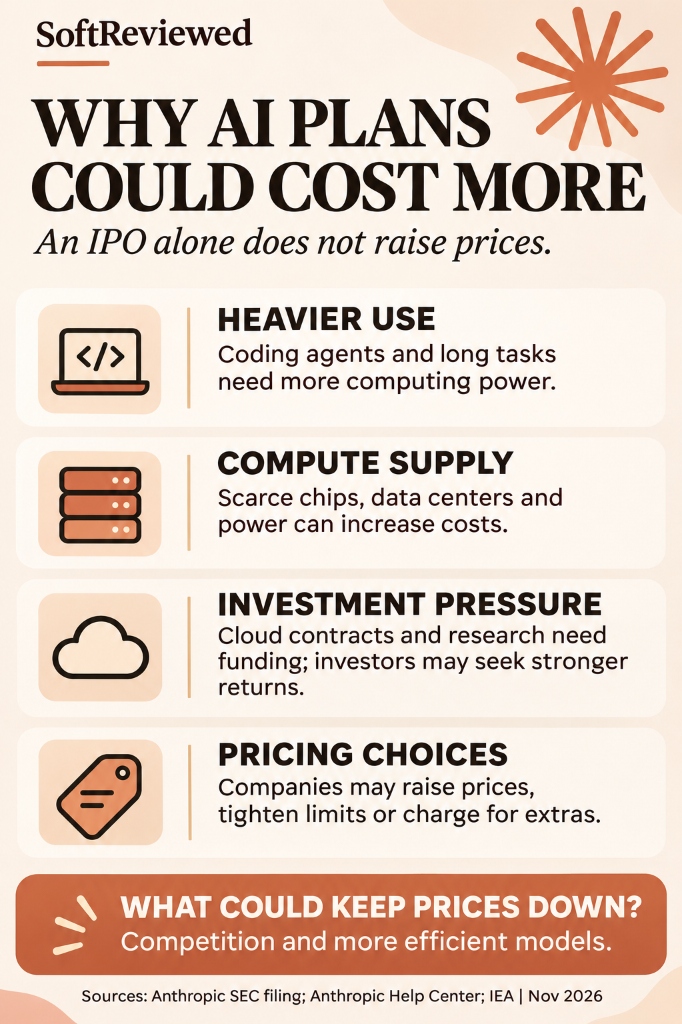
In the risk factors section of its S-1, Anthropic states plainly that its agentic products are "structurally more compute-intensive" and warns investors that it may not be able to price them "at levels sufficient to cover their costs." When you ask a normal chatbot one question, it runs one pass. When you run Claude Code on a real project, it reads files, runs tests, reads error logs, edits code, and loops dozens of times for a single task.
What I keep hearing from developers using Claude Code every day matches this warning. On paid subscriptions, Claude.ai web chat, desktop, mobile, and Claude Code all pull from the exact same rolling 5-hour usage pool and weekly cap. Even worse, when a coding session sits idle long enough for the prompt cache to expire, the next prompt forces Claude to re-read a giant conversation history from scratch, draining a 5-hour Pro window in just a few turns. If you run into this regularly, check my breakdown on how to reduce token usage on Claude Pro before upgrading tiers.
2. Power Grids, Transformers, and Cloud Shortfalls Limit Supply
Even with tens of billions of dollars from an IPO, Anthropic cannot snap its fingers and add unlimited servers. The S-1 states that "availability of sufficient electrical power has emerged as a significant constraint on data center development," including inside the United States. Connecting new power generation and transmission to the grid can take years, and equipment like high-voltage transformers, switchgear, and turbines faces long delivery waits, higher prices, and allocation limits.
This shortage already shows up in real life. A surge in demand caused a Claude outage in March 2026. Anthropic also disclosed in the S-1 that it has asked cloud partners for more compute than those partners were willing to provide, and warned it may not receive the full amount of compute it seeks even with signed contracts. On their late-July 2026 earnings calls, both Microsoft (July 29) and Amazon (July 30) confirmed the exact same squeeze: customer AI demand continues to exceed their available data-center capacity. When supply is tight, cheap seats are the hardest to defend.
3. Nearly $900 Billion in Locked-In Cloud and Chip Commitments
Digging into Anthropic's amended S-1 filings reveals a staggering financial obligation stretching through 2045: roughly $895 billion to $900 billion in total long-term commitments for cloud compute, chips, and data-center leases. The core fixed obligations to the big three cloud providers alone are enormous:
- Google Cloud: Roughly $114.5 billion to $121.3 billion in non-cancelable commitments running through July 2033, complete with shortfall "true-up" clauses that require Anthropic to pay the difference if it uses less than promised.
- Amazon Web Services (AWS): At least $110 billion in compute commitments running through April 2036.
- Microsoft Azure: Between $47.2 billion and $49.2 billion in infrastructure commitments running through June 2033.
On top of those fixed cloud floors, Anthropic signed massive chip and GPU cluster agreements with partners including Broadcom and external GPU providers. Locking into hundreds of billions of dollars in non-cancelable bills creates relentless pressure to keep revenue per user climbing.
4. Cloud Partners Are Also Competitors Taking a Distribution Cut
Google, Amazon, and Microsoft are simultaneously Anthropic's infrastructure suppliers, major investors (Amazon and Google hold a combined 28.4% post-IPO non-voting equity stake), marketplace distributors, and direct AI competitors. In the first half of 2026, roughly 48% of Anthropic's total revenue came through cloud marketplaces like Amazon Bedrock, Google Cloud Vertex AI, and Microsoft Azure.
Anthropic books the full customer bill as revenue, then pays channel distribution fees to those cloud partners as operating expenses. The S-1 openly warns that these rivals can prioritize compute for their own models (like Gemini, Nova, or OpenAI models on Azure) or change terms over time. Paying a toll to your biggest competitors makes it much harder to subsidize a low-margin $20 consumer tier.
5. "Anthropic Direct" Adds Massive Data-Center Build-Out Costs
To break free from relying completely on Google, Amazon, and Microsoft, the S-1 outlines an initiative called Anthropic Direct. Under this push, third-party partners build facilities that Anthropic leases, fits out with chips and cooling, and operates directly to guarantee power and hardware supply.
Owning or fitting out your own compute footprint gives Anthropic more control in the long run, yet it changes the business from lightweight software into heavy industrial infrastructure. Building, cooling, powering, and replacing expensive GPUs every few years requires giant ongoing cash outlays that customers eventually help fund.
6. Post-IPO Wall Street Scrutiny and the 74% Enterprise Mix
While Anthropic was private, venture investors were happy to fund rapid user growth and overlook underpriced consumer plans. Going public on Nasdaq under ticker ANT changes the scoreboard overnight. Public shareholders judge companies every 90 days on operating margins, cash burn, and profit growth.
Look at who actually pays Anthropic's bills. Customers spending more than $100,000 a year generated roughly 74% of Anthropic's H1 2026 revenue. Across the whole company, usage-based API fees make up about 80% of revenue, while flat subscriptions bring in roughly 20%. My read is straightforward: when public investors ask management to protect margins while compute is scarce, a $20 flat-rate consumer plan is the easiest place to squeeze first.
7. HBM Memory "Chipflation" and Semiconductor Tariffs
The hardware inside every AI server is getting pricier too. High-Bandwidth Memory (HBM) is essential for running modern AI models at speed, and it eats far more cleanroom wafer capacity than ordinary RAM. Major memory makers (SK Hynix, Samsung, and Micron) have shifted factory output toward HBM, pushing memory prices up sharply across the entire tech supply chain.
Anthropic's S-1 risk factors also flag international tariffs and semiconductor export controls. Higher tariffs on chips, server racks, and electrical gear raise the baseline cost of every new cluster before a single customer sends a prompt.
8. Copyright Lawsuits, Enterprise Indemnification, and Safety Overhead
Running a frontier AI lab carries legal and safety costs that normal software companies never face. Anthropic's S-1 highlights ongoing copyright litigation and legal uncertainty around training data, plus enterprise copyright indemnification. That means if a large business customer gets sued over Claude's output, Anthropic may have to help foot the legal bill.
Add in Anthropic's Responsible Scaling Policy (RSP) and its Public Benefit Corporation structure, where safety reviews and deliberate holds on releasing models can slow down revenue while still requiring expensive safety research teams. Every dollar spent on legal defense, licensed training data, and safety evaluation becomes part of the overhead built into future pricing.
9. Every Major AI Competitor Is Already Moving to Higher Tiers and Metered Credits
If Anthropic were the only company tightening flat-rate plans, users could just walk away. In late 2026, the entire industry is moving in the same direction at once, with GitHub Copilot, Cursor, and OpenAI all shifting power users toward metered credits and $100 to $500 tiers.
What Is Already Happening to Claude Pro, Max, Ultra, and Fable 5.2
You do not need to wait for a press release to see how a Claude subscription price increase works in practice. On the $20 Claude Pro plan, Anthropic's flagship frontier model, Claude Fable 5.2, is not included inside your regular weekly limits; you pay extra per use through usage credits. On the $100 Claude Max plan and the $200 Claude Ultra plan (which replaced the older Max 20x tier), Fable 5.2 is included up to half of your weekly allowance, after which you switch models or buy extra credits. You can see how its real-world speed and quality stack up in my full Claude Fable 5.2 pricing and benchmarks review.
Looking at Anthropic's published API rates makes the math obvious right away. Fable 5.2 costs four times as much per token as Sonnet 5.5, and eight times as much in Fast Mode.
On top of that, the S-1 states outright that Anthropic has "changed, and may in the future change, usage limits" and points to new models like "outcome or task-based pricing" instead of simple flat monthly fees.
Could Claude Subscription Prices Actually Stay Flat or Drop?
Anthropic's S-1 also explains why a direct jump on the $20 sticker price is not guaranteed right away. The filing explicitly warns investors that fierce competition from OpenAI, Google, and open-weight models could force Anthropic to lower prices on some tiers, and Anthropic has announced zero price increase on the base $20 Pro plan or $100 Max plan as of November 18, 2026.
Anthropic has also made real efficiency gains. Newer releases like Claude Opus 5.5 cut cost per task significantly, increased generation speed by more than 30%, and allowed Anthropic to expand 5-hour usage windows on Pro, Max, and Team plans for standard models, as covered in our Claude Opus 5.5 release breakdown. Rather than jumping Claude Pro from $20 to $50 overnight, I expect the stealth version of a Claude subscription price increase to unfold in three stages: tighter rolling caps on heavy agent workflows, flagship models gated behind pay-per-use credits, and specialized task-based or higher-tier plans for power users.
How I Keep My Claude Bill Under Control Right Now

If you rely on Claude or Claude Code for daily work, four practical workflow habits can keep you from getting pushed onto a $100 or $200 plan before you truly need one.
Step 1: Match the Claude Model to the Job
Use Sonnet 5.5 or Opus 5.5 for everyday writing, emails, quick scripts, and routine debugging. Save Fable 5.2 (and its 4x token burn) strictly for tough architecture problems, complex multi-file bugs, or deep research where the cheaper model stalls.
Step 2: Run /clear Often in Claude Code
Never let a single Claude Code thread drag on for hours across unrelated tasks. Once a task finishes, write down a short 3-line summary, run /clear, and start clean. That stops an expired prompt cache from forcing Claude to re-read tens of thousands of stale tokens and wiping out your 5-hour window.
Step 3: Measure Your Real Usage Before Upgrading to Claude Max or Ultra
Before jumping from $20 Pro to $100 Max or $200 Ultra, track how often you actually hit the 5-hour or weekly wall over two normal work weeks. If you only spill over once or twice a week, topping up a small pay-as-you-go usage credit balance is often much cheaper than paying an extra $80 to $180 every single month.
Step 4: Keep an Open-Weight Model Backup Ready
For repetitive batch tasks, summarizing long documents, or simple code drafts, keeping a fast low-cost API or local open model in your toolkit saves your Claude quota for the hard thinking where Claude still shines.
Frequently Asked Questions About the Claude Subscription Price Increase
Did Anthropic officially announce a Claude subscription price increase for its IPO?
No. As of November 18, 2026, Anthropic has not announced a headline price increase on Claude Pro ($20/month) or Claude Max ($100/month). Instead, costs are rising indirectly because flagship models like Fable 5.2 require pay-as-you-go usage credits on Pro and consume weekly limits much faster on Max and Ultra.
When is the Anthropic IPO date and stock ticker?
According to Anthropic's amended SEC Form S-1, the company is set to finalize IPO pricing on November 18, 2026, with trading on the Nasdaq Global Select Market scheduled to start on November 19, 2026, under the ticker symbol ANT at an expected range of $70 to $78 per share.
Why is Claude Fable 5.2 not included in the $20 Claude Pro limits?
Claude Fable 5.2 costs $8 per million input tokens and $40 per million output tokens on the API, which is double Opus 5.5 and four times Sonnet 5.5. Bundling unlimited Fable 5.2 access inside a $20 flat monthly plan would lose money quickly on heavy coding and agent workloads, so Pro users pay per use with usage credits while Max ($100) and Ultra ($200) include it up to 50% of their weekly cap.
Why does Claude Code hit usage limits so fast on a paid plan?
Claude Code shares the exact same rolling 5-hour and weekly usage pool as Claude.ai web, desktop, and mobile chats. Agentic coding loops read many files, inspect build logs, and re-send large context windows when session caches expire, burning far more compute per prompt than normal chat.
What is task-based pricing in Anthropic's S-1 filing?
In its Form S-1 risk factors, Anthropic notes that it may shift toward "outcome or task-based pricing" as agent tools mature. Instead of charging one flat monthly fee no matter how many hours an agent works, task-based pricing bills based on completed jobs or actual compute consumed, similar to GitHub Copilot's AI Credits model.
How can I avoid paying $100 or $200 a month for Claude?
Use Sonnet 5.5 or Opus 5.5 for routine work, reserve Fable 5.2 for hard problems, run /clear frequently in Claude Code to keep context small, and pay small overage usage credits on busy days instead of upgrading to Max ($100) or Ultra ($200) unless you hit limits almost every day.