
When Google introduced the Gemini 4 family, the naming scheme confused plenty of developers. We went from Flash and Pro to an elemental ladder: Hydrogen, Carbon, and Argon.
On November 18, 2026, Google added another element to the table: Gemini 4 Neon.
I spent the last 24 hours reviewing Google’s technical documentation, DeepMind’s evaluation methodology, and running comparison tests against my existing Claude Opus and Sonnet workflows. Here is a clear, fluff-free breakdown of what Neon actually changes, how its pricing works in practice, and whether it makes sense for your developer toolbelt.
Watch the Video Breakdown: Watch Gemini 4 Neon on YouTube (@Softreviewed)
What Is Gemini 4 Neon?
In Google's official documentation, Gemini 4 Neon is classified as a "fast reasoning model." It is engineered to deliver reasoning quality that approaches Gemini 4 Carbon while keeping response speed and API cost closer to the Hydrogen tier.
Unlike basic completion models, Neon incorporates native thinking levels (ranging from Low to XHigh) and operates inside a 1-million-token unified context window.
The biggest surprise in Google's launch announcement is who they chose to benchmark against. Google did not compare Neon with Anthropic's middleweight Claude Sonnet 5.5. Instead, Google pitted Neon directly against Anthropic's flagship, Claude Opus 5.5, and OpenAI's GPT-6.2 Sol.
Gemini 4 Neon Pricing vs Claude & Earlier Gemini Tiers
Pricing is where Gemini 4 Neon gets interesting. It sits right in the pocket between Claude Sonnet 5.5 and Claude Opus 5.5.
Here is the exact token pricing breakdown per million tokens across the current frontier landscape:
| Model | Input Price (1M) | Output Price (1M) | Cached Input (1M) | Context Window |
|---|---|---|---|---|
| Claude Sonnet 5.5 | $2.00 | $10.00 | $0.20 | 200,000 tokens |
| Gemini 4 Hydrogen | $1.50 | $7.50 | $0.075 | 1,048,576 tokens |
| Gemini 4 Neon | $3.00 | $15.00 | $0.15 | 1,048,576 tokens |
| Gemini 4 Carbon | $2.00 (intro) | $10.00 (intro) | $0.10 | 1,048,576 tokens |
| Claude Opus 5.5 | $4.00 | $20.00 | $0.40 | 200,000 tokens |
The Real Cost Per Task
Looking only at per-token costs can be misleading. According to Google's internal cost-efficiency telemetry:
- At its default high thinking setting, Neon delivers roughly 32% lower cost per completed task compared to Carbon.
- When compared to frontier heavyweights like Claude Opus 5.5, Neon operates at roughly 50% to 75% lower total expenditure on multi-step agent benchmarks.
- Google's prompt caching discounts inputs by 95% down to $0.15 per million tokens, which makes large codebase indexing significantly cheaper than Anthropic's $0.40 cached rate.
One critical note: The Gemini API does not offer a free tier for Gemini 4 Neon. Unlike Hydrogen, every call to Neon carries a usage cost.
Official Benchmark Scorecard: Gemini 4 Neon vs Claude Opus 5.5
Google published a comprehensive evaluation table via DeepMind methodology comparing Neon against Claude Opus 5.5 and GPT-6.2 Sol.
To give you an honest appraisal, I have highlighted where Neon leads and where Claude Opus still holds the advantage:
| Evaluation Benchmark | Gemini 4 Neon | Claude Opus 5.5 | GPT-6.2 Sol | Primary Skill Tested |
|---|---|---|---|---|
| Artificial Analysis Index (xhigh) | 61 | 59 | 57 | Overall Intelligence composite |
| SWE-sweep (Antigravity harness) | 39.0% | 10.1% | 8.3% | Multi-file software engineering |
| Chartography | 73.5% | 66.3% | 75.1% | Dense document & visual data extraction |
| AutomationBench | 56.3% | 42.5% | 41.3% | Autonomous multi-step workflows |
| HLE-Diamond | 71.3% | 67.9% | 64.0% | Humanity's Last Exam reasoning |
| Terminal-Bench 4.1 | 65.2% | 65.8% | 61.5% | CLI & shell problem resolution |
| FrontierCode 2.0 | 46.2% | 47.3% | 43.8% | Complex competitive algorithm design |
Where Gemini 4 Neon Outperforms
- Agentic Coding (SWE-sweep): In the Google Antigravity developer environment, Neon solved 39.0% of end-to-end repository repair tasks, while Claude Opus 5.5 achieved only 10.1%. This gap reflects Google's deep optimization for multi-file workspace tools.
- Document & Visual Reasoning (Chartography): Neon scored 73.5% on dense financial charts and visual spreadsheets, besting Opus 5.5's 66.3%.
- Autonomous Task Execution (AutomationBench): Neon posted 56.3% compared to Opus 5.5's 42.5%, demonstrating stronger reliability on multi-stage branching tasks.
The Honest Caveats: Where Claude Opus 5.5 Wins
Google was transparent in reporting two key benchmarks where Claude Opus 5.5 still leads:
- Terminal-Bench 4.1: Claude Opus edged ahead at 65.8% vs Neon's 65.2%.
- FrontierCode 2.0: Claude Opus captured 47.3% vs Neon's 46.2%.
These differences are narrow (under 1.5%), but they show that Opus remains extraordinarily capable on raw algorithmic logic and Linux terminal manipulation. Always remember that these are Google's own published metrics, so waiting for independent verification on LMSYS Chatbot Arena is sensible before moving mission-critical production pipelines.
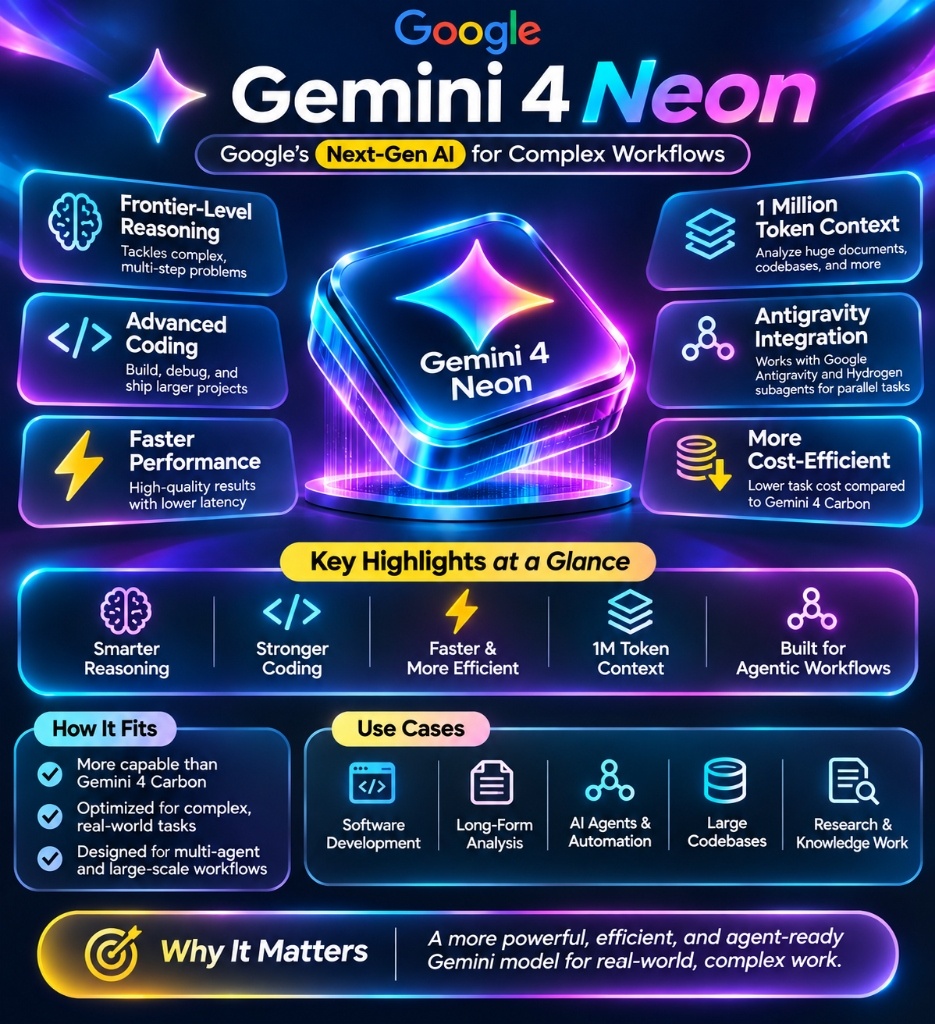
Visual Decision Guide: Gemini 4 Neon specs, tier comparison, and practical multi-agent use cases.
How to Choose: Hydrogen vs Neon vs Carbon vs Argon
With four models in the Gemini 4 family, here is how Google outlines the decision process:
Fast Everyday Queries & Low Latency ──► Gemini 4 Hydrogen ($1.50 / $7.50)
                                                 │
Multi-File Coding, Data & Complex Tasks ────────► Gemini 4 Neon ($3.00 / $15.00)
                                                 │
Heavy Science, Math & Frontier Proofs ──────────► Gemini 4 Carbon ($2.00 intro / $10.00)
                                                 │
Deep Enterprise Orchestration & Cloud Workflows ─► Gemini 4 Argon
- Pick Hydrogen when you need instant responsiveness, high concurrency, simple API calls, and budget-friendly operations.
- Pick Neon when you hand the model a 50-page financial report alongside multiple spreadsheets and ask why revenue slipped, or when you ask an agent to track down and patch a regression across 10 interconnected project files.
- Pick Carbon when solving the most intricate mathematical proofs, quantum simulations, or frontier vulnerability auditing.
Where Can You Access Gemini 4 Neon Today?
Gemini 4 Neon rolled out globally on November 18, 2026, across the following channels:
- Google AI Studio: Available under model dropdown selector
gemini-4-neonfor API key creation and system prompt experimentation. - Google Antigravity: Integrated as an orchestrator model for Pro and Ultra subscribers.
- The Gemini Consumer Web & Mobile App: Available for users on Gemini Pro ($20/mo) and Ultra subscriptions.
- Google Cloud Vertex AI: Available through the Model Garden console under
agent-platform/publishers/google/model-garden/gemini-4-neon.
Frequently Asked Questions
Does Gemini 4 Neon have a free API tier?
No. Unlike Gemini 4 Hydrogen and Gemini 3.8 Flash, Google does not provide free tier query allocations for Neon on the Gemini API. Every call requires a paid billing account.
How does Gemini 4 Neon compare to Claude Sonnet 5.5?
On price, Neon is slightly higher ($3/$15 per million tokens vs Sonnet's $2/$10). However, Google benchmarked Neon against Anthropic's top-tier Claude Opus 5.5 rather than Sonnet, indicating that Neon delivers Opus-tier capabilities at a mid-tier price.
What is the maximum context length for Gemini 4 Neon?
Gemini 4 Neon features a 1,048,576-token input context window with a 65,536-token maximum output generation window.