
Anthropic announced the Anthropic Public Benefit Fund on October 18, 2026. Under this new structure, the AI lab is pledging 5% of its corporate shares to a dedicated public benefit entity, with an automatic escalation clause that adds more equity every time the company’s valuation surges. Within hours, the announcement ignited fierce debate across tech circles, drawing praise as a landmark corporate gift alongside sharp cynicism comparing it to modern corporate indulgences ahead of an IPO. I spent the day tearing down the legal filing, running the equity math, and listening to how engineers and founders are actually reacting to separate verified facts from marketing spin.
Before examining the heated community debate, watch our 50-second video overview below breaking down the core equity mechanics:
What Did Anthropic Actually Announce?
Anthropic was founded as a Delaware Public Benefit Corporation (PBC), meaning its legal charter already requires leadership to balance financial returns with human safety. However, the newly formed anthropic public benefit fund represents an entirely distinct corporate entity designed to hold equity externally.
Every confirmed specification from Anthropic’s official announcement is summarized below:
| Pillar | Official Specification | Operational Meaning |
|---|---|---|
| Initial Equity Stake | 5% of total Anthropic shares | Dedicated corporate stock reserved for public welfare, subject to a formal stockholder vote. |
| Valuation Accelerator | +2% shares per 50% valuation jump | The board holds discretion to expand the fund’s equity as Anthropic’s private or public market value climbs above a baseline. |
| Legal Entity Format | Wholly-Owned LLC | Not a traditional 501(c)(3) charity. Offers structural versatility for direct cash disbursements without strict nonprofit restrictions. |
| Political Restrictions | Zero lobbying or political giving | Strict covenant barring fund equity from campaign donations or government lobbying both domestically and overseas. |
| Total Public Allocation | Roughly 20% of company equity | Combines the new 5% pledge with existing founder commitments (80% pledged) and employee matching programs (~50% staff participation). |
A crucial detail in the announcement is Anthropic’s statement that the fund may explore “direct distributions to specific populations.” That specific phrase sparked immediate speculation across finance and AI research communities that Anthropic is constructing an operational framework for AI-funded Universal Basic Income (UBI).
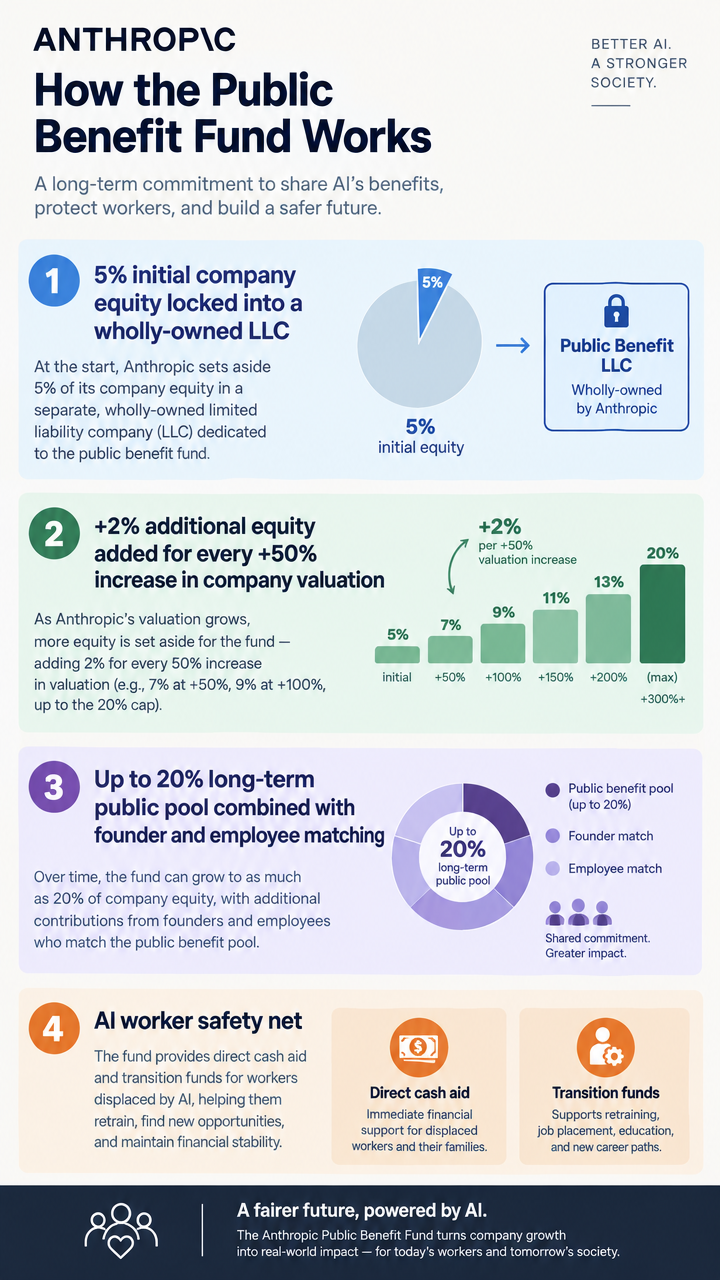
Figure 1: The 4-stage corporate mechanism governing Anthropic’s Public Benefit Fund equity escalator.
Why Did Anthropic Choose an LLC Instead of a 501(c)(3)?
When major technology founders announce billion-dollar pledges, the public instinctively expects a traditional 501(c)(3) nonprofit foundation. However, Anthropic deliberately organized the Public Benefit Fund as a wholly-owned limited liability company (LLC). This design choice carries major practical and legal trade-offs.
In standard 501(c)(3) public charities, federal tax laws strictly regulate grant distributions, require comprehensive annual public disclosures (IRS Form 990), and prohibit profit-generating business operations. An LLC gives Anthropic total flexibility: it can fund applied biomedical research, finance startup incubators, make grants to NGOs, or hand cash directly to displaced workers without navigating charity tax barriers.
⚖️ Structural Teardown: LLC vs. 501(c)(3) vs. OpenAI Hybrid
Anthropic Public Benefit Fund
Structure: Wholly-Owned LLC
Control: 100% owned by Anthropic
Flexibility: High (Cash payouts, NGO grants, research)
Transparency: Discretionary; no mandatory public IRS Form 990
Traditional 501(c)(3) Charity
Structure: Registered Tax-Exempt Nonprofit
Control: Independent Board of Trustees
Flexibility: Strict charitable limitations
Transparency: Mandatory public financial filings
OpenAI Original Structure
Structure: 501(c)(3) controlling For-Profit Arm
Control: Nonprofit board with capped-profit subsidiary
Flexibility: Severely constrained; led to restructuring
Transparency: Heavy regulatory scrutiny during corporate pivot
The obvious counterpoint raised by legal analysts is accountability. Because the LLC is wholly owned by Anthropic, there is no legal requirement to seat independent public trustees or file open balance sheets. Outside stakeholders must rely on Anthropic’s internal governance decisions regarding what genuinely constitutes the public good.
The Labor Market Shield: Is This AI-Funded Universal Basic Income?
Anthropic explicitly pointed to workforce disruption as the primary motivation for creating the fund. The company has already allocated $200 million toward labor-market research, but CEO Dario Amodei and the leadership team acknowledged that the accelerating pace of artificial intelligence requires significantly bolder interventions.
If an automated coding model or general enterprise agent displaces hundreds of thousands of white-collar analysts, traditional retraining grants move too slowly. By equipping the LLC with the legal right to execute direct distributions, Anthropic creates a direct financial pipeline where corporate market cap appreciation can be redistributed to affected labor sectors. For individual professionals navigating this transition, acquiring practical automation skills is no longer optional—which is why I often point builders to the systeme io course certification to master automated workflows and owned digital assets.
When you run the numbers on what this 5% commitment actually means, the dollar figures become staggering. Based on current market valuations and private funding benchmarks, here is how the math breaks down:
- At a $965 Billion Valuation: A 5% allocation equals approximately $48.2 billion in initial assets.
- At a $1.5 Trillion Valuation: A 5% allocation equals $75 billion, with the total 20% public commitment representing $300 billion.
- At a $2 Trillion Valuation: The 5% stake reaches $100 billion. If valuation milestones trigger another 4% in discretionary additions, the fund pool surpasses $180 billion.
These numbers dwarf traditional philanthropic organizations, rivaling sovereign wealth funds. However, until Anthropic publishes the baseline valuation index, calculating the exact trigger points for secondary equity injections remains impossible.
What I’m Hearing From the Tech Community: Three Competing Views
When I dug into how engineers, founders, and researchers are reacting to this, the community was split down the middle. Here is how people on the ground are actually looking at it:
1. The Cynical View: “Corporate Indulgences” Before an IPO
One comparison I kept hearing over and over from developers was to medieval church indulgences—the idea that Anthropic is buying moral absolution with paper stock while building models that automate away human positions. With reports circulating about Anthropic preparing for a potential IPO, critics I spoke with see this as pre-IPO defensive armor: a strategic way to soften regulatory friction and public backlash before going public.
Other skeptics pointed out that parking non-voting shares inside a wholly-owned LLC keeps absolute control in Anthropic’s hands, allowing them to project philanthropy without giving the public any governance voice.
2. The Open-Weights Counterargument
Another perspective that resonated with me came from open-source developers. If Anthropic genuinely wants to create public benefit, many engineers argue the most impactful step wouldn’t be setting up an investment fund—it would be releasing open-weight model checkpoints so builders and researchers can run models locally without paying metered API tolls.
3. The Optimistic View: A Precedent We Haven’t Seen Before
On the flip side, several founders and observers I follow pointed out that this is still far better than the standard tech playbook. Most tech giants concentrate wealth by granting multi-billion-dollar stock packages to founders and early investors. Here, Anthropic is legally routing equity surges into a dedicated pool intended to cushion displaced workers. Even if it serves as good PR, tying a multi-billion-dollar equity safety valve directly to the company’s growth sets a precedent no other frontier AI lab has offered.
Frequently Asked Questions

Is the Anthropic Public Benefit Fund an official nonprofit?
No. Anthropic established the fund as a wholly-owned limited liability company (LLC) rather than a 501(c)(3) charity. This gives the company the legal flexibility to issue direct cash payouts or make commercial investments without standard nonprofit bureaucratic restrictions.
How does the 2% equity escalator work?
Anthropic committed 5% of its shares to launch the fund. Whenever the company’s valuation climbs 50% above an established baseline, the board of directors holds the option to allocate an additional 2% of equity into the fund.
Who will oversee the fund and decide where money goes?
Anthropic has stated that detailed governance plans, independent oversight mechanisms, and specific valuation milestones will be released in an upcoming public benefit report over the coming months.
Can this equity be used for political lobbying?
No. Anthropic’s charter includes an explicit negative covenant barring all equity held by the LLC from being spent on political campaigns or legislative lobbying, both in the United States and internationally.